External Root Resorption: Is Intentional Replantation a Viable Treatment Option: A Case Report
Department of Conservative Dentistry and Endodontics, Seema Dental College And Hospital, Rishikesh
ABSTRACT
External cervical resorption (ECR) is a destructive and often aggressive dental condition that begins on the external surface of the root, typically apical to the epithelial attachment. Its exact etiology remains unclear, but potential factors include trauma, orthodontic treatment, periodontal disease, internal bleaching, and certain systemic conditions. ECR presents a significant challenge for clinicians due to its unpredictable nature, rapid progression, and potential for extensive tooth structure loss. The purpose of this case report is to analyze the result intentional reimplantation in case of external cervical root resorption.
Keywords: External cervical resorption, intentional replantation
INTRODUCTION
External cervical resorption (ECR) originates on the external surface of the root, typically just below the epithelial attachment. It often progresses aggressively, leading to considerable tooth structure loss.
This case report aims to present a multidisciplinary approach to managing ECR in a patient. The key challenge lies in selecting the most appropriate treatment, balancing evidence-based guidelines with clinical expertise.1
The prognosis of ECR treatment relies not only on the quality of endodontic intervention, when necessary, but also on the chosen technique.
In this case, the resorption's location and the patient's limited mouth opening made management difficult. Consequently, an extra-oral approach with intentional replantation was chosen as the treatment method.2
CASE REPORT
A 38 year old female patient came to the department of Conservative Dentistry and Endodontics with complaint of pain on chewing and mobility of tooth in lower right back tooth region. On clinical examination there was class 1 caries and grade 1 mobility wrt 45. On vitality testing with cold test gave no response indicating pulpal necrosis wrt 45. Radiographic examination showed external cervical resorption towards the mesial aspect of the root and large J shaped periapical radiolucency wrt 45 . Diagnosis made was pulpal necrosis and external cervical resorption with symptomatic apical periodontitis wrt 45. Treatment plan was non surgical root canal treatment followed by intentional reimplantation wrt 45.

Pre-Operative Radiograph

Obturation And Post Endodontic Radiograph
First the root canal treatment was performed intraorally. After copious irrigation with NaOCl and EDTA, the obturation was done with gutta-percha and bio-ceramic sealer (EndoSequence BC Sealer, Brassler, USA). The tooth was then filled with resin composite.

Extraction
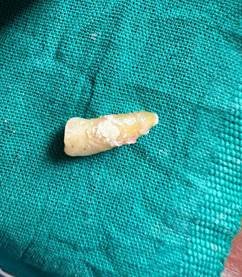
Cleaning of the resorption area and placement of GIC

Post Operative Image After Reimplantation and Splinting
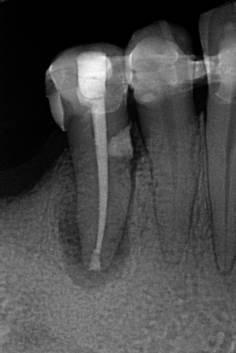
Post-Operative Radiograph
The extraction was performed as atraumatically as possible. Extraoral treatment involved cleaning the resorption area using a fine diamond bur and root end resection was performed and filling the defect with GIC. The tooth was handled only with sterile gauze and gloves, and it was continuously kept moist with sterile saline. Replantation was completed within 15 minutes of extraction. The tooth was then splinted to the adjacent teeth and removed from occlusion.
DISCUSSION
Management of ECR is highly complex and dependent on several factors, such as the extent and location of the resorptive lesion, accessibility, and the presence or absence of symptoms. Since it often leads to significant structural damage before detection, early diagnosis is crucial for improving the prognosis.4 Treatment options aim to remove the resorptive tissue, repair the defect, and restore normal function. However, access to the resorptive area can be difficult, especially in cases where the lesion is located deep within the root or in patients with anatomical challenges such as limited mouth opening.3
Conventional treatments for ECR include endodontic therapy, surgical exposure, and restoration of the affected area. However, when these approaches are unfeasible, as in cases where deep lesions are inaccessible intraorally, more advanced techniques like intentional replantation may be considered.
The success of intentional replantation hinges on several key factors:
- Atraumatic Extraction: It is critical to minimize damage to the periodontal ligament and surrounding structures during extraction. Maintaining the integrity of the periodontal ligament helps reduce the risk of root resorption and improves the chances of successful replantation.
- Extraoral Management: During extraoral treatment, the resorptive lesion must be carefully debrided, often with a fine diamond bur, and the defect filled with a suitable material like a self-etch, self-adhesive composite. The handling of the tooth is crucial—sterile gauze, gloves, and constant moistening with saline are necessary to preserve tissue vitality.5
- Time Considerations: Minimizing the extraoral time is essential. Studies suggest that keeping the tooth out of the socket for less than 15 minutes is ideal, as prolonged exposure increases the risk of resorption and ankylosis post-replantation.
- Post-Replantation Care: After replantation, the tooth is typically splinted to adjacent teeth to provide stability during the healing process, and it is removed from occlusion to prevent excessive loading. Splinting ensures that the periodontal ligament has an optimal environment for healing, reducing the risk of further complications like root resorption.
Prognosis and Long-term Considerations
The long-term success of intentional replantation depends on several factors, including the stage of the resorptive lesion, the quality of endodontic and restorative procedures, and patient-specific variables like immune response and oral hygiene. Potential complications include root resorption, ankylosis, and eventual tooth loss. However, when executed with precision, intentional replantation can preserve the tooth for several years, delaying the need for more invasive procedures such as implants.6
Intentional replantation is often considered a last-resort treatment option for managing ECR, but it can offer excellent outcomes in cases where more conventional treatment options are insufficient or impractical. Advances in materials, imaging, and microsurgical techniques have improved the predictability and success rates of this technique, making it a viable option for managing complex endodontic cases.
CONCLUSION
ECR are always a challenge for the clinician. In some cases, the standard procedures are difficult to implement. Intentional replantation after treating the tooth extra orally could be an option, in case where is feasible, to improve the prognosis of a tooth that otherwise would be hopeless.
REFERENCES
- PATEL, S. et al. External cervical resorption: a three-dimensional classification Int Endod J, p. 206-14, July 2017
- PLOTINO, G. et al. European Society of Endodontology position statement: Surgical extrusion, intentional replantation and tooth autotransplantation Int Endod J, p. 655-659, Jan 2021
- PATEL, S. et al. European Society of Endodontology Position Statement: External Cervical Resorption Int Endod J, p. 1323-1326, Sept 2018
- BECKER, B. D. Intentional Replantation Techniques: A Critical Review J Endod, Jan 2018
- PLOTINO, G. et al. Clinical procedures and outcome of surgical extrusion, intentional replantation and tooth autotransplantation – a narrative review Int Endod J, p. 1636-1652, Sep 2020
- CHANIOTIS, A.; KOUIMTZIS, T H Intentional replantation and Biodentine root reconstruction. A case report with 10-year follow-up Int Endod J, p. 988-1000, Jan 2021
Disclaimer from Guident
The views and opinions expressed in articles published in Guident are solely those of the authors and do not necessarily reflect the views of the editors, the editorial board or the publisher, Ivory India. Guident does not endorse any product, technique or treatment described. Clinical content is intended for qualified dental and medical professionals and is not a substitute for individual clinical judgement. Guident, its editors and the publisher accept no liability for any consequence arising from the use of information published in the journal.
How to cite this article
Dr. Rohit Babu, Dr. Anil Dhingra. External Root Resorption: Is Intentional Replantation a Viable Treatment Option: A Case Report. Guident. 2024 Oct;17(11). Available from: https://guident.in/articles/endodontics/external-root-resorption-is-intentional-replantation-a-viable-treatment-option-a-case-report.html