
Mastering the Blunderbuss Canal Management: A Case Report
Department of Conservative Dentistry and Endodontics, Seema Dental College And Hospital, Rishikesh
ABSTRACT
Apexification is a crucial endodontic procedure utilized in the treatment of immature permanent teeth with necrotic pulp and open apices. This procedure aims to promote the closure of the open apex by inducing the formation of a hard tissue barrier near the root apex. By removing infected or inflamed pulp tissue, disinfecting the root canal system, and employing biocompatible materials, such as calcium hydroxide,MTA,Biodentin apexification facilitates the development of dentin-like tissue, strengthening the tooth's root structure and enhancing its resistance to fracture or reinfection. Successful apexification requires careful monitoring and may involve multiple treatment sessions to achieve optimal outcomes. Early diagnosis and timely intervention are imperative for preserving the affected tooth and promoting long-term oral health.3
INTRODUCTION
Traumatic injuries to the teeth are common among most of the facial injuries.Traumatic injury can occur in any age group but thirty percent of traumatic injuries to the dentition occurs during childhood.1 Most of these injuries occur before the completion of root formation. Premature loss of vital pulp results in a fragile tooth with a compromised crown-root ratio, thin dentin walls and an apex which is not completely formed. Open apex often requires utmost care by a dentist as roots are more susceptible to fracture and the obturating material can impinge on the periodontal tissues.2
The essence of apexification lies in its ability to restore the integrity and functionality of compromised teeth by instigating a reparative process within the root canal system. Through meticulous debridement and disinfection of the infected pulp tissue, the detrimental agents causing pulpal necrosis are eradicated, laying the groundwork for subsequent therapeutic interventions.4
Central to the apexification process is the induction of a hard tissue barrier near the apex, akin to the physiological closure observed in mature teeth. This barrier not only fortifies the structural integrity of the tooth's root but also creates a formidable defense against potential fractures and reinfection.
INDICATIONS
performed in teeth with open apices and thin dentinal walls in which standard instrumentation techniques cannot create an apical stop to facilitate effective root canal filling.7
CONTRAINDICATIONS
- Purulent drainage.
- History of prolonged pain.
- Very short roots.
- Marginal periodontal breakdown.
- Vital pulp
Different materials which can be used for apexification are as follows:
Calcium hydroxide ,Mineral trioxide aggregate, Biodentine, Tricalcium phosphate, Dentin chips, Calcium phosphate, ceramics and hydroxyapatite Bone morphogenetic proteins, Bioceramics.
CASE REPORT
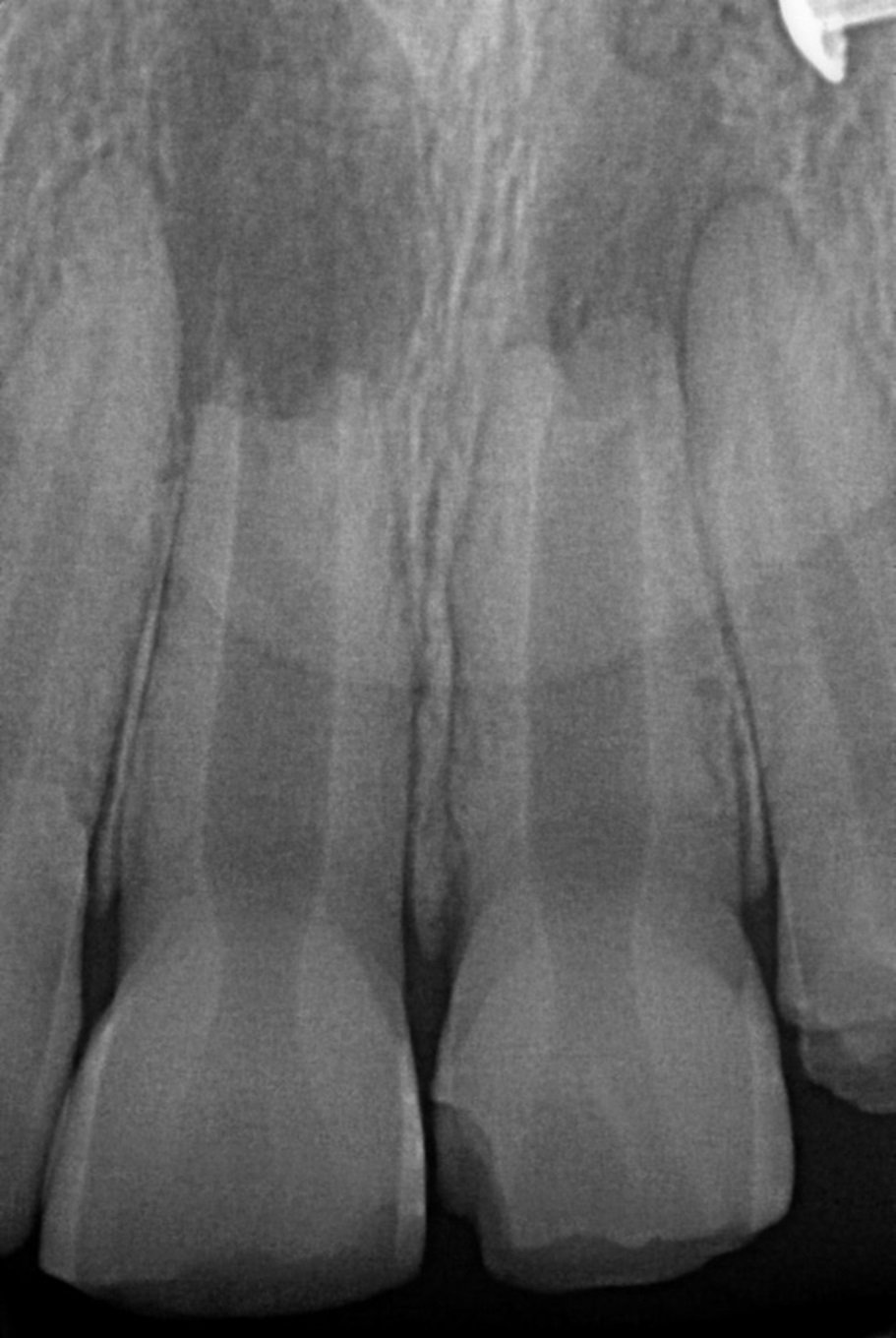
A 29 year old Female patient reported to Department Of Conservative dentistry And Endodontics with chief Complaint of broken and discolored tooth in upper front tooth region Patient met with an accident while riding bicycle in childhood. On clinical examination Ellis Class II Fracture i.r.t 11 21 Cold Test = No response EPT= No response. Radiographically Blunderbuss canal noted i.r.t 11,21 and the diagnosis made was Pulpal necrosis with asymptomatic apical periodontis i.r.t 11 21

PREOPERATIVE PICTURE
RADIOGRAPH

POST OPERATIVE RADIOGRAPH

6 MONTH FOLLOW UP
DISCUSSION
Apexification with MTA several clinical studiesreport that MTA provides a viable alternative to achieve root closure in immature teeth or root fracture, even in cases with an open apex.
The time required for the formation of the barrier is significantly less in teeth treated with MTA compared to teeth treated with Ca(OH)2. There is currently a study conducted by Mente et al. in which it presents the largest sample number treated with apexification (252 samples) and with a 10-year follow-up period, which concludes that the success rates of teeth with open apices reported in this cohort study suggest that the placement of apical plugs with MTA is an appropriate treatment option for teeth with an open apex.3
The presence of preoperative apical periodontitis was identified as the most important prognostic factor, success rates remain constantly high, even after follow-up periods of more than 4 years.
Chan et al. studied whether MTA favors apexification and periapical scarring even when a considerable amount of this material has been inadvertently extruded. Although it is recognized that the extrusion of MTA through an open apex is not a common mishap during the apexification procedure, the extruded material does not adversely affect the healing of the periapical tissues, as verified in the present study with clinical observations and X-rays with a follow-up of cases of 36–54 months.5
Nosrat et al. analyzed whether after the extrusion of MTA in periradicular tissues, bone healing, and reabsorption of MTA may occur or may remain unactivated, and affect the healing process. Physical irritation of the oral mucosa after the extrusion of MTA is another possibility when the endodontic material is sandwiched between the bone and the mucosa, so that the result of the treatment after the extrusion of MTA in the periradicular tissues can not be limited and therefore it is unpredictable.
There is an evolution in the endodontic materials to perform apexification through an apical barrier, and among them, we have the repair cement biodentine which is presenting favorable clinical and radiographic results, which can be an effective alternative when performing an apicoformation.6
CONCLUSION
In conclusion, discussions on apexification underscore its significance in endodontic practice while emphasizing the need for continued research and refinement to optimize its efficacy and minimize complications. Collaboration among clinicians, researchers, and educators remains pivotal in advancing apexification techniques and improving patient outcomes in endodontic therapy.1
REFERENCES
- Lauridsen E, Hermann NV, Gerds TA, Kreiborg S, Andreasen JO. Pattern of traumatic dental injuries in the permanent dentition among children, adolescents, and adults. Dent Traumatol. 2021;28:358–63.
- Shabahang S. Treatment options: Apexogenesis and apexification. Pediatr Dent. 2020;35:125–8.
- Nicoloso GF, Pötter IG, Rocha RO, Montagner F, Casagrande L. A comparative evaluation of endodontic treatments for immature necrotic permanent teeth based on clinical and radiographic outcomes: A systematic review and meta-analysis. Int J Paediatr Dent. 2017;27:217–27.
- Iqbal, M., & Kim, S. (2018). Complete healing of periapical lesion after nonsurgical endodontic therapy alone: A case report. Journal of Endodontics, 32(8), 740-742.
- Witherspoon, D. E., Small, J. C., Harris, G. Z., & Vanillo, F. J. (2019). Mineral trioxide aggregate pulpotomies: A case series outcomes assessment. Journal of the American Dental Association, 137(5), 610-618.
- Felippe, W. T., Felippe, M. C., & Rocha, M. J. (2006). The effect of mineral trioxide aggregate on the apexification and periapical healing of teeth with incomplete root formation. International Endodontic Journal, 39(1), 2-9.
- Trope, M. (2014). Treatment of the immature tooth with a non-vital pulp and apical periodontitis. Dental Clinics of North America, 50(2), 379-396.
Disclaimer from Guident
The views and opinions expressed in articles published in Guident are solely those of the authors and do not necessarily reflect the views of the editors, the editorial board or the publisher, Ivory India. Guident does not endorse any product, technique or treatment described. Clinical content is intended for qualified dental and medical professionals and is not a substitute for individual clinical judgement. Guident, its editors and the publisher accept no liability for any consequence arising from the use of information published in the journal.
How to cite this article
Dr. Ayushi Rawat, Dr. Anil Dhingra. Mastering the Blunderbuss Canal Management: A Case Report. Guident. 2024 Aug;17(9). Available from: https://guident.in/articles/endodontics/mastering-the-blunderbuss-canal-management-a-case-report.html


