Managing Canal Curvatures with New Generation NITI File System: Genendo
Department of Conservative Dentistry and Endodontics, Seema Dental College And Hospital, Rishikesh
Endodontic therapy involves treating vital and necrotic dental pulps so that patients can retain their natural teeth in function and esthetics. Although successful therapy depends on many factors, one of the most important steps in any root canal treatment is canal preparation. This is essential because preparation determines the efficacy of all subsequent procedures and includes mechanical debridement, creation of space for medicament delivery, and optimized canal geometries for adequate obturation.1 It is generally believed that engine-driven or manually used nickel titanium (NiTi) instruments produce better-prepared root canals than their stainless steel counterparts. Clinically, however, such instruments, and in particular the rotary types, do have a higher risk of separation (Barbakow & Lutz 1997).1
Despite the advantages related to the superelasticity, fracture of NiTi files (Serene et al. 1995) due to torsional overloading or flexural fatigue remains a concern in clinical practice (Iqbal et al. 2006). Possible strategies to increase efficiency and safety of NiTi rotary files include an improvement in the manufacturing process, or the use of new alloys that provide superior mechanical properties (Gambarini et al. 2011, Shen et al. 2013).2
Keeping in mind the gap and need for aggressive rotary files Coletene Whaledent and Micro Mega France, have come up with a very promising file system GenENDO which is not only aggressive but also safe. The starter pack comes in a pack of 4 files: CF (Coronal Flare) File, GPF (Glide Path File), PF (Preparation File), UF1 (Universal Finishing File 1) which are recommended by the manufactures to be used at 400rpm with torque setting upto 2.5 Ncm, whereas preferable torque setting for CF & GPF is 1.8 Ncm. it is believed that T-Wire heat treatment used in the production of 2Shape files might have contributed to the increase in file’s elasticity. Higher austenite finish (Af) temperature of T-Wire alloy might enable 2Shape files to have softer structure at test temperature (35°C). This might be the reason for higher fracture resistance of 2Shape files when compared to TF and ESX files exposed to different heat treatments.3
The treatment of Coronal Flare (CF) uses T wire Technology, which is a new heat treatment system which, according to the manufacturer, optimizes cyclic fatigue resistance by 40%.3 It is believed that T-Wire heat treatment increases the file’s elasticity. Higher austenite finish (Af) temperature of T-Wire alloy might enable files to have softer structure at test temperature (35°C). This might be the reason for higher fracture resistance.4 A wide variety of NiTi wires were produced by thermomechanical treatment of NiTi alloy like M-wires, Max, R-phase, controlled memory (CM) wires and recently C-wire. The Glide Path File is without any heat treatment while Preparation File and Finishing File have C-wire treatment. Instruments made from controlled memory wire were 300%-800% more resistant to cyclic fatigue than regular NiTi wires. Moreover, instruments manufactured from a heat-treated NiTi wires exhibit an increased austenite transformation temperature and significant change in the phase transformation.5
Each GenENDO file was used in 10 canals following the manufacture’s direction, at 400 rpm and 2.5Ncm, with slightly apical pressure and pecking motion. The operative sequence was size 09/25 (CF) 17mm, 03/14 (GPF), 04/20 (PF) and 04/25 (UF1) in lengths 21 mm & 25 mm. Irrigation was performed at every change of instrument. Files were cleaned by ultrasonification for 15 min and then autoclaved at 132 °C/ 4 min with 20 mins dry time.
Following cases were done with GenEndo Rotary file system for root canal treatment.
Case 1:
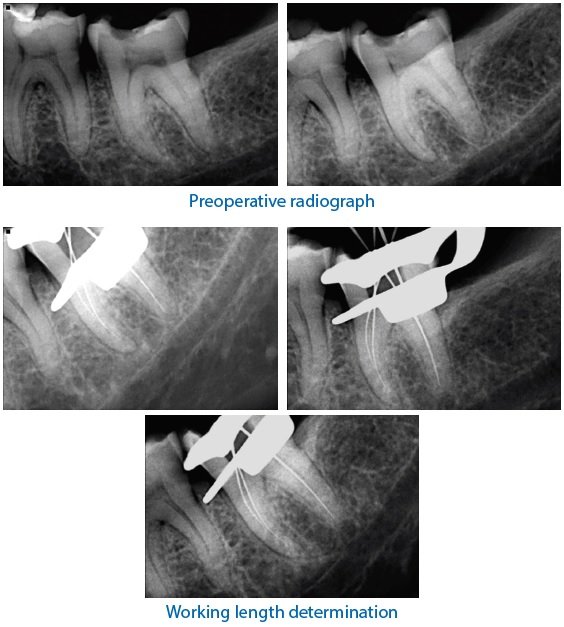
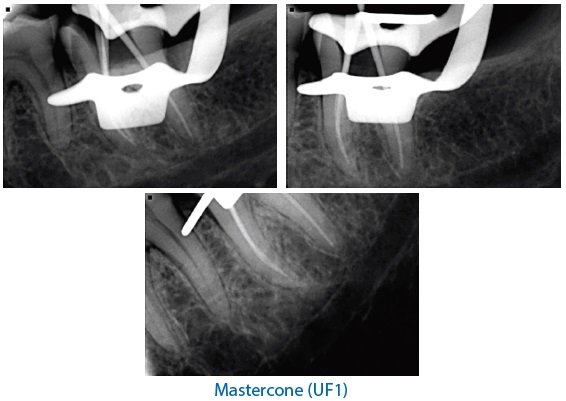
A 37 year old female patient came with chief complaint of pain in lower left back region of mouth since few days. Patient had a history of sudden sharp pain which lasted for long due to cold or sweet food stuff. On clinical examination there was deep occlusal caries w.r.t 37. radiographic examination showed radiolucency involving enamel, dentin and pulp horns were also affected. According to the findings the tooth was diagnosed with chronic irreversible pulpitis w.r.t.37. Treatment plan was to proceed with non surgical endodontic treatment w.r.t 37.

Case 2:
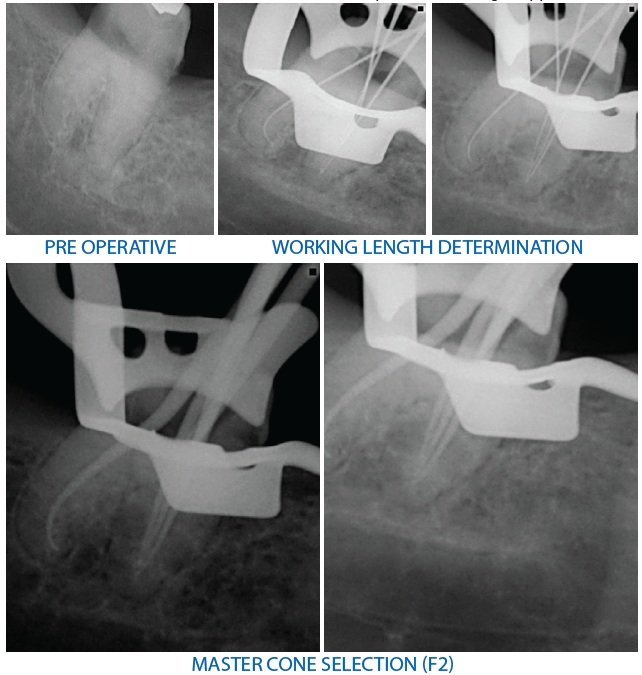
A 25 year old female patient came with chief complaint of pain in lower left back region of mouth since 1 week. Patient had a history of of sharp shooting pain. On clinical examination deep occlusal caries was present w.r.t to 36. Radiographic examination showed radiolucency involving enamel, dentin and pulp. Diagnosis was chronic irreversible pulpitis w.r.t. 36. Treatment plan was to proceed with non surgical endodontic root canal treatment.


Case 3:
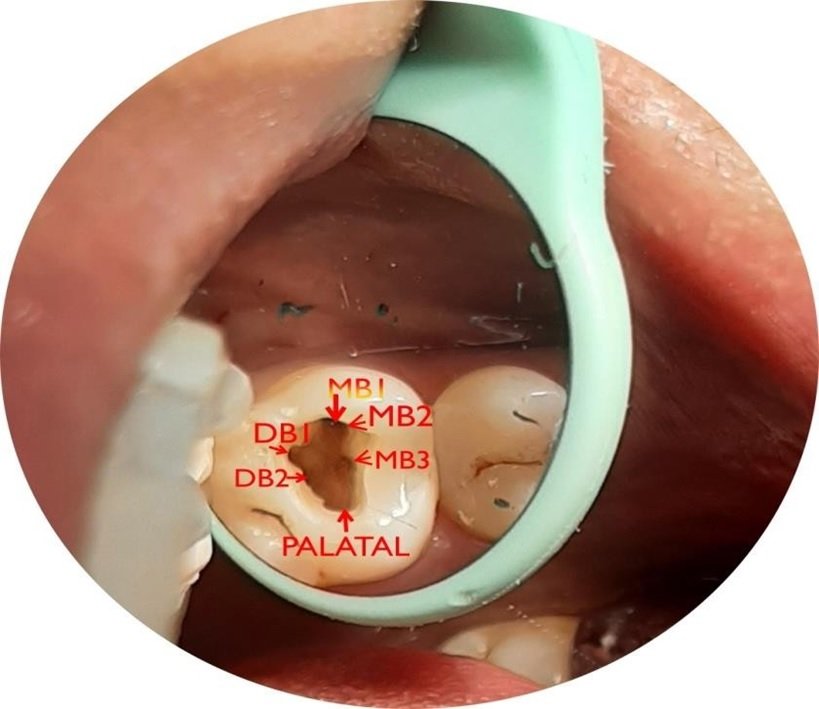
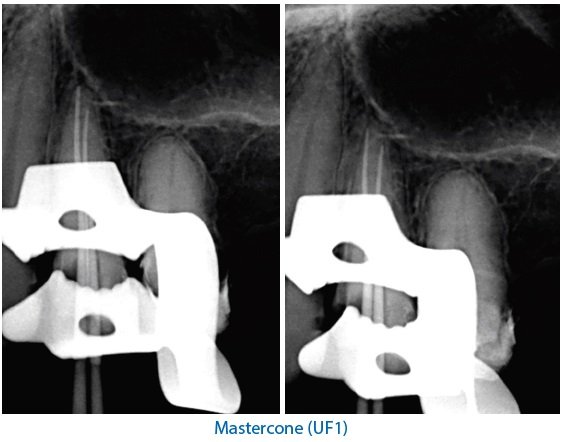
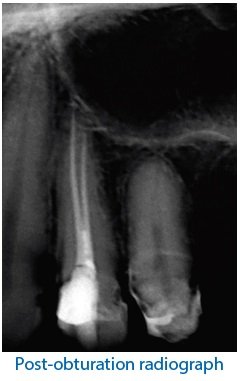
A 35 year old female patient came with chief complaint of pain and food lodgement in upper left back region of mouth. Pain was aggravated on food lodgement. On clinical examination patient had deep proximal carie w.r.t. 24. On radiographic examination, radiolucency was observed involving enamel, dentin and pulp w.r.t. 24. Tooth was diagnosed with chronic irreversible pulpitis. Treatment advised was non surgical endodontic treatment.


Case 4:
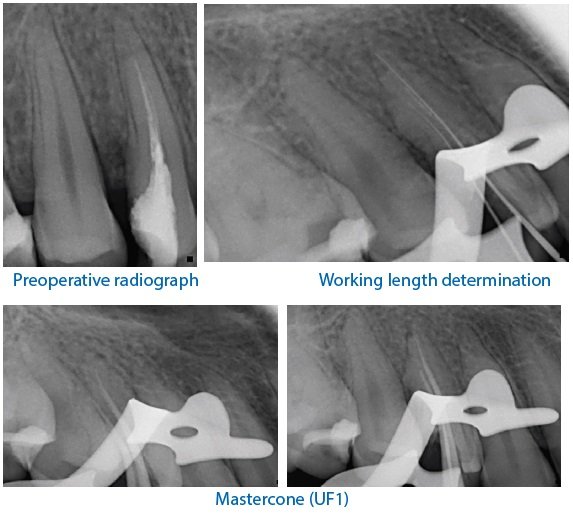
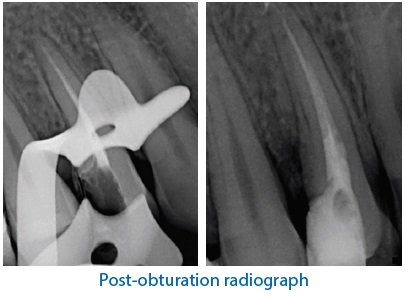
A 28 year old male patient came with chief complaint of broken restoration in upper right back region of mouth since 1 year .The patient had no history of pain and swelling. On clinical examination dislodged restoration was noted w.r.t. 14. On radiographic examination incomplete obturation was noted w.r.t to 14. Treatment plan was to retreatment of the root canal treated tooth w.r.t.14.
CONCLUSION
GenEndo file system is a promising file system launched by Coltene (Whaldent) manufactured by Micromega (France). It is efficacious not only in its aggresive style of shaping but is safe as well. Keeping in mind about the targetted segment of customers all the files are stiffer as compared to Hyflex EDM and CM. The nomenclature, heat treatment and file design has made it a perfect combination of performance and price.
The files are also designed to offer high cutting efficiency for the preparation of all canals, from straight to complex. Comparatively GenEndo file system has given better efficacy for negotiating ledges and curvatures due to aggressive cutting action. The files system even after being used in more than 10 canals has so far not shown any signs of deformation probably indicating the lesser incidence of breakage. The combination of different cross section designs and metallurgy of each file staring from coronal flaring file to finishing files is of greater advantage for the file system. Also, these files can be pre-bent similar to stainless steel files before introduction in the curved canals.
Endodontics has seen big changes in terms of both technology and technique. The use of new generation instruments can definitely be an asset to the practicing dental professionals in managing difficult cases with much ease and lesser mishaps.
REFERENCES
- Peters OA. Current challenges and concepts in the preparation of root canal systems: A review. J Endod 2004;30:559-67
- Pirani, C., Iacono, F., Generali, L., Sassatelli, P., Nucci, C., Lusvarghi, L Prati, C. (2015). HyFlex EDM: superficial features, metallurgical analysis and fatigue resistance of innovative electro discharge machined NiTi rotary instruments. International Endodontic Journal, 49(5), 483–493.
- Capar ID, Ertas H, Arslan H. Comparison of cyclic fatigue resistance of nickel-titanium coronal flaring instruments. J Endod. 2014 Aug;40(8):1182-5.
- Uslu, GülÅŸah et al. “Cyclic fatigue resistance of 2Shape, Twisted File and EndoSequence Xpress nickel-titanium rotary files at intracanal temperature.” Journal of dental research, dental clinics, dental prospects vol. 12,4 (2018): 283-287.
- Khalil, Wafaa. (2019). Effect Of Heat Treatment On Cyclic Fatigue, Flexibility And Phase Transformation Of Two Controlled Memory Niti Rotary Instruments. Egyptian Dental Journal. 65. 1463-1468.
Disclaimer from Guident
The views and opinions expressed in articles published in Guident are solely those of the authors and do not necessarily reflect the views of the editors, the editorial board or the publisher, Ivory India. Guident does not endorse any product, technique or treatment described. Clinical content is intended for qualified dental and medical professionals and is not a substitute for individual clinical judgement. Guident, its editors and the publisher accept no liability for any consequence arising from the use of information published in the journal.
How to cite this article
Dr. Unnati Nautiyal, Dr. Pallabi Sarkar, Dr. Annil Dhingra. Managing Canal Curvatures with New Generation NITI File System: Genendo. Guident. 2021 May;14(6). Available from: https://guident.in/articles/endodontics/managing-canal-curvatures-with-new-generation-niti-file-system-genendo.html