Fourth Dimension of Endodontics- A.I.
Department of Conservative Dentistry and Endodontics, Seema Dental College And Hospital, Rishikesh
Artificial intelligence, the newer dimension in the tech-savvy world is composed of neural network architecture similar to human brains and mimics human intelligence.
Artificial intelligence has found its way into our daily lives. It has become so general that we don’t realize we use it all the time. For instance have you ever wondered how google is able to give you such accurate search results or how your Facebook and Instagram feed always gives you content and advertisements based on your interest.
Artificial intelligence is the science of getting machines to mimic the behavior of humans. Machine learning is a subset of AI that focuses on getting machines to make decisions by feeding them data. On the other hand deep learning is a subset of machine learning that uses concept of neural networks to solve complex problems, so to sum it up AI, Machine learning and deep learning are interconnected fields.
A well known mathematician John McCarthy had coined the term artificial intelligence in 1955 and is also the father of artificial intelligence. Richard Bellman, an applied mathematician in 1978 defined artificial intelligence as the automation of activities associated with human thinking abilities, which includes learning, decision making and problem solving.
AI intends to reproduce the cognitive process of humans and can achieve the same outcome as medical professionals within a much shorter time. There are two types of AI which is available for healthcare delivery called physical and virtual. Physical AI are delivered by automated robotics. On the other hand, Virtual artificial intelligence, the software-type algorithm has powerful capabilities in data analysis which is expected to improve accuracy and efficacy of dental diagnosis, differentiate between lesions and normal structures, provide visualized anatomical guidance for treatment, prioritize risk factors , simulate and evaluate prospective results and project the occurrence and prognosis of disease.
Barcelona declaration for proper developmental and usage of artificial intelligence in Europe (2017) segregated virtual AI in knowledge driven and data driven AI. Knowledge based AI attempts to model human knowledge using self- reported concepts that human use to solve problems, whereas data driven AI, machine learning trains the mathematical models with data driven from human activities. Due to huge amount of dental data available, data driven AI is appreciated more in dentistry.
Artificial intelligence have been applied in various field of dentistry, namely oral and maxillofacial surgeries, prosthodontics, endodontics, periodontics, temporomandibular joint disorders, orthodontics for diagnosis, treatment and predicting its prognosis. Here the article specifically discusses about its efficiency in the field of Endodontics.
In cariology, AI helps in identification of proximal lesions and hidden carious lesion using IOPAR, bitewing radiographs and near infrared transillumination images which gave about 69% accuracy. AI identified individuals prone to tooth surface loss & root caries based on various factors such as personal nutrition, lifestyle, and other clinical factors with 90% accuracy.
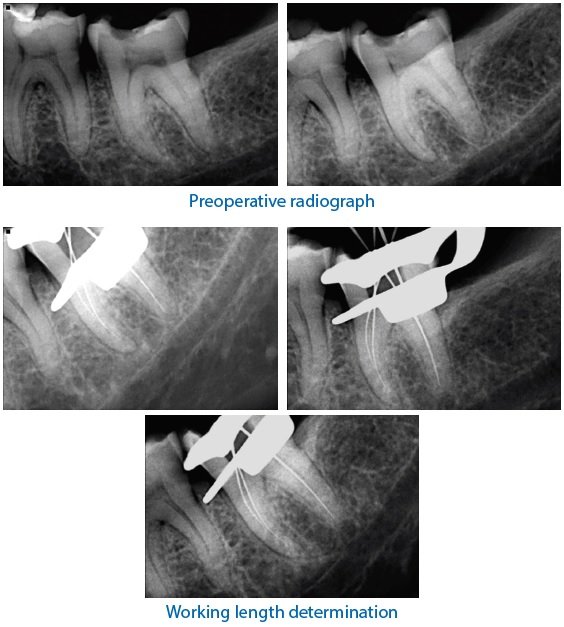
Working length is a distance from a coronal reference point to the point at which canal preparation and filling could terminate. Correct working length determination is an essential step in achieving successful root canal treatment outcome. Instrumentation beyond the apical foramen, flare-ups, periapical foreign body reaction, poor microbial control are result of poor WL determination and control are result of poor working length determination and control. A study reported on AI based model being applied for determining the working length on single rooted teeth on the dry skull and cadaver models, artificial neural network demonstrated excellent result with 93-96% accuracy which was better than the experiences endodontist who demonstrated 76% accuracy. These results are suggestive AI is efficient in locating minor apical foramen and determine working length accurately. These models can be of great help for less experienced dentists and non specialists as these AI models can be used in clinical application when non availability of specialists.
AI is widely used in diagnosis of periapical pathologies. A study reported on application of AI based Convolutional neural network model for radiographic detection of lesions and the results were satisfactory with high sensitivity 65 %. Ekert et al concluded that a moderately deep CNN trained on a limited amount of image data showed satisfying discriminatory ability to detect apical lesions on panoramic radiographs. Another model detecting lesions on CBCT images had reliability of 92%. This suggests that dentists diagnostic efforts for detecting apical lesions on panoramic radiographs may be reduced by applying AI.
AI also aids in detection and diagnosis of vertical root fracture which might get unnoticed after an endodontic treatment as its symptoms are not severe. In a study Fukuda et al, they evaluated CNN system for detecting VRF on panoramic radiograph, and found 267 out 330 fractures were detected. According to study by Johari et al. CBCT and Periapical radiographs were evaluated for vertical root fracture and it gave an accuracy of 96%.
One of the most essential factors for success of an endodontic treatment is proper knowledge of anatomical configuration of root canals. According to a study by Hiraiwa et al. root morphology assessment was done using CBCT and panaromic images with 86.9% accuracy for the determination of whether distal roots were single or had extra roots. This is suggestive of accurately finding canals while endodontic treatment. The study also showed better accuracy of DL system than the trained radiologists.
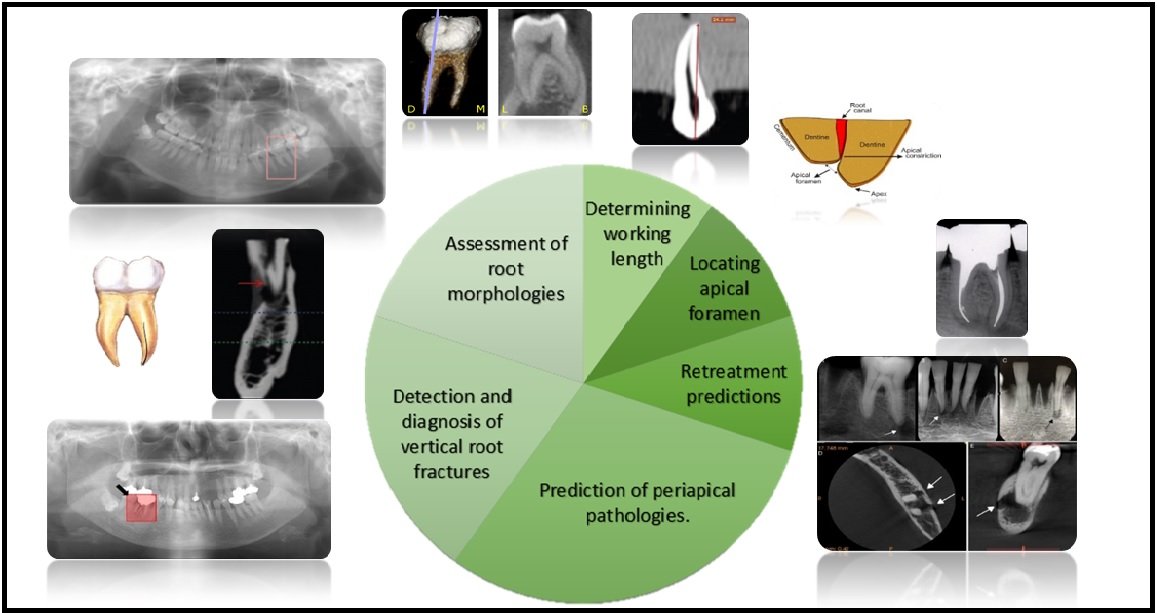
According to Campo et al study, a Bayesian network system was used to predict the need for retreatment which used anatomy, tooth position, periapical pathology, and many other variables into consideration. The results were effective and this system can reduce the number of unsuccessful retreatments as it predicts the rate of success or failure
Endodontic cases failure can be avoided by carefully assessing the difficulty level before initiation of treatment or by referral to specialist. AI also can be used to predict the difficulty of endodontic cases according to 83 features of American Association Of Endodontists Endodontic Case Difficulty Assessment Form with a sensitivity of 94.96% was achieved using machine learning algorithm. This is an helpful tool in developing countries, where endodontic treatment and referral guideline are often neglected.
Though it is advantageous, it has few limitations such as data acquisition, interpretability, computing power and ethical considerations.
In conclusion AI is only a win-win situation for us if we integrate it into our lives rather than depend on them. Higher level understanding that relies on expertise of dentist is required especially in ambiguous condition, to conduct physical examination, integrate medical histories, evaluate aesthetic outcome and facilitate discussion. Fleshless machine led dentistry does not embody the wreath of clinical care. Issues such as clinical intuition, ineffable perception and empathy which are keys to the delivery of personalized health care and professionalism cannot be delivered by machines.
REFERENCES
- Sanjeev B.Khanagar, Ali Al-ehaideb, Prabhadevi C.Maganur, Satish Vishwanathaiah Shankargoud Patil, Hosam A.Baeshen, Sachin C.Sarode, Shilpa Bhandi. Developments, application, and performance of artificial intelligence in dentistry – A systematic review, journal of dental science. 2020
- Boreak N. eefectiveness of artificial intelligence applications designed for endodontic diagnosis, decision making, and prediction of prognosis: a systematic review, J. Contemp Dent Pract, 2020, 21(8):926-934.
- Grischke J et al. Dentronics: towards robotics and artificial intelligence in dentistry. Dent Mater (2020)
- T. Shan et.al. Application of artificial intelligence in dentistry. Journal of dental research, international & American association for dental research 2020.
- Fukuda et al. Evaluation of an artificial intelligence system for detecting vertical root fractures on panaromic radiograph, Japanese society for oral and maxillofacial radiology and springer nature Singapore, 2019
- Mallishery et al, The precision of case difficulty and referral decisions: an innovative automated approach. Springer-verlag GmbH Germany, 2019
- Ekert et al. Deep learning for the radiographic detection of apical lesions. Journal of endodontics, 2019.
- Hiraiwa et al. a deep learning artificial intelligence system for assessment of root morphology of the mandibular first molar on panaromic radiograph, dentomaxillofacial radiology, 2019.
- Saghiri et al. the reliability of artificial neural network in locating minor apical foramen: a cadaver study. Journal of endodontics, 2012, volume 38, number 8.
Disclaimer from Guident
The views and opinions expressed in articles published in Guident are solely those of the authors and do not necessarily reflect the views of the editors, the editorial board or the publisher, Ivory India. Guident does not endorse any product, technique or treatment described. Clinical content is intended for qualified dental and medical professionals and is not a substitute for individual clinical judgement. Guident, its editors and the publisher accept no liability for any consequence arising from the use of information published in the journal.
How to cite this article
Dr. Pallabi Sarkar, Dr. Annil Dhingra. Fourth Dimension of Endodontics- A.I. Guident. 2021 Mar;14(4). Available from: https://guident.in/articles/endodontics/fourth-dimension-of-endodontics-a-i.html