Edelweiss Direct Post and Core System - a Novel State of the ART Concept for Rehabilitation of Severely Damaged Root Canal Treated Teeth
Department of Endodontics, K.D. Dental College & Hospital, Mathura
ABSTRACT
Treatment decision with dowel depends on the amount of remaining tooth structure and functional demands that will be placed on the tooth. Teeth with minimal remaining tooth structure provide decreased retention for the restoration and are at increased risk for fracture. As the remaining tooth structure decreases and functional forces increases, greater restorative control is needed.
Although a wide variety of post & core restoration technologies and materials have been introduced into the dental market, there is no consensus on the most appropriate treatment choice for post & core systems. Prefabricated posts have good bio- mechanical and physical properties. However, they cannot be customized for optimal adaptation to the prepared post space. On the other hand, using composite resins for core material may have a higher failure rate because of the weak bonding between the prefabricated post and composite core. To overcome all of these issues when restoring a badly broken crown from a endodontically treated tooth, edelweiss dentistry presents a unique, single-piece, high-strength customizable composite POST & CORE. Edelweiss dentistry believes in making dentist’s chairside treatment simple, easy and predictable.
Keywords: Edelweiss dentistry, customizable composite post & core.
INTRODUCTION
Restoration of the endodontically treated tooth is very important as it has impact on the long-term prognosis of tooth. The root canal treated tooth is mostly associated with the loss of coronal and radicular tooth structure from preexisting restorations, restorative failures, trauma, dental caries, and endodontic access preparation. When a huge amount of the clinical crown has been lost due to damage, it is often impossible to achieve the sufficient anchorage of a restoration in the remaining dentin. This hard tissue toothstructure leads to decreased occlusal load carrying capacity of the root canal treated tooth. Therefore, posts are essentially indicated for the root canal treated teeth to prevent fracture of the remaining tooth structure and to prevent tooth loss.1,3 The anterior teeth are not placed perpendicular to the occlusal plane and predominantly subjected to the labially inclined shear forces during function and therefore considered more prone for failure.6,7
Numerous techniques and materials have been proposed for the restoration of endodontically treated teeth.3 Metallic prefabricated and cast posts have been utilized for decades. More recently, in response to the request for tooth-coloured posts, several non-metallic dowels have been marketed. Among them, epoxy resin posts reinforced with carbon fibres, epoxy or methacrylate resin posts reinforced with quartz or glass fibres, zirconia posts, and polyethylene fibre-reinforced posts can be distinguished.4,5
A recent innovation is the Edelweiss POST & CORE system which is a laser sintered monoblock that avoids the wedging effect. The posts have a conical shape for perfect post space adaptation. The translucency of the post allows uninterrupted light transmission for complete polymerization. The adhesive bonding also avoids the wedging effect. The preparation of the core feels like preparing the natural tooth and makes handling easier. The opaque buildup in A1 also offers different anatomical forms. The buildup from the edelweiss POST & CORE has a rough surface for better retention of the clinical crowns. It is possible to carry out the treatment in just one session, which is both time and cost effective for patient and dentist alike.2
ADVANTAGES
- Prefabricated POST & CORE
- Translucent Post for periapical light polymerisation
- Innovative monoblock of post and core with A1 buildup for natural integration
- Monoblock avoids wedge effect
- Biocompatible
- Flexural strenght 20GPa like Dentin (15 - 20 GPa)
- Unmatched radiographic visibility
- Cuts like dentin
- Superior adhesion to the root canal
- One session, reduced treatment time
- Time and cost effective


This article is an attempt to elucidate the modern concept of direct composite edelweiss post and core system for achieving bio-esthetics and function in one appointment.
CASE REPORT
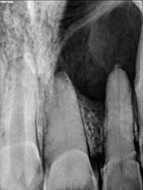
A 20 year old female patient reported to our department with the chief complaint of broken tooth in right upper front region of mouth since one year. Patient gave history of trauma one year back. She had undergone root canal treatment six months back irt#11 and #12 in a local dental clinic. Clinical findings showed Ellis Class IV fracture irt#11(Figure 1).Radiographic finding showed presence of periapical radiolucency in relation to #11 with radiopaque material seen in the root canal irt#11 and #12 (Figure 2). Medical history was non contributary. Based on patients demand an Edelweiss direct post and core followed by PFM crown was indicated.

Figure 1: Preoperative photograph
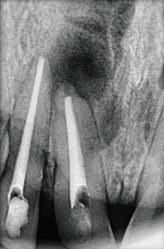
Figure 2: Preoperative radiograph
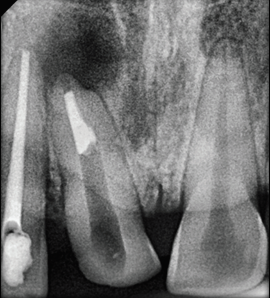
Figure 3: Post space preparation was done using precision post drill to prepare post space available in the kit (Henry Schein Dental US Edelweiss Post & Core - Intro kit)
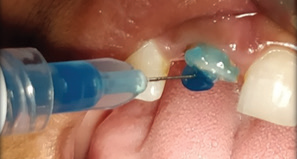
Figure 4: Post space was etched with 37% phosphoric acid for 15 seconds and then rinsed.
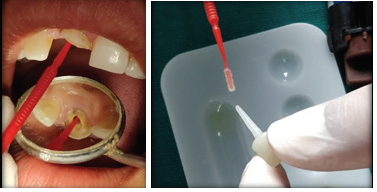
Figure 5: Bonding agent was applied in the canal for 10 seconds and air dried. Bonding agent (Edelweiss Veneer Bond) was applied on the post for 30 seconds.
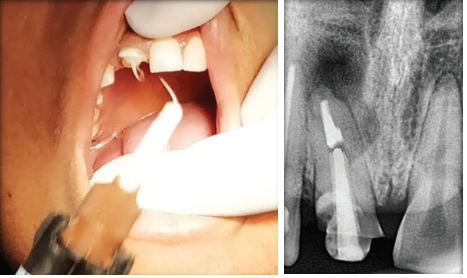
Figure 6 & 7: Dual core cement (DMG Luxacore Z) was placed inside the canal along with edelweiss post core and cured for 60 seconds and radiograph was taken.
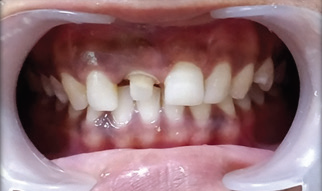
Figure 8: Crown cutting was done for PFM crown

Figure 9: Putty impression irt#11
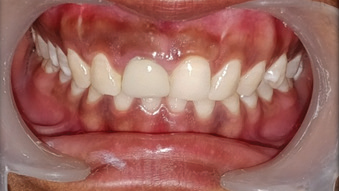
Figure 10: Cementation of PFM crown irt#11 was done with luting glass ionomer cement.
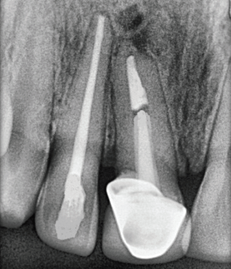
Figure 11: A one year follow up radiograph irt#11 and #12 showed successful healing of the periapical radiolucency and the patient was satisfied with the esthetics.
DISCUSSION
The philosophy of edelweiss dentistry is simple: making dental treatments easy and affordable for patients and dentists alike while following ethical aspects of modern treatments, which is achieved by respecting the principles of biocompatibility and bio-aesthetics. This all together allows minimally invasive treatments. Restoration and optimisation are carried out while considering and preserving the healthy tooth structure. The function and aesthetics are reconstructed with a highly filled nano-hybrid composite very similar to the tooth substance—a concept that clearly speaks in -favour of non-restorative or additive techniques. This makes the DIRECT SYSTEM from edelweiss the state-of-the-art for modern and minimally invasive aesthetic dentistry.
The material of the edelweiss POST & CORE is barium glass, strontium and zincoxide (antibacterial) embedded in resin. The crystals are sintered to a monoblock which leads to perfect mechanics in the material. The flexural strength is similar to that of natural tooth. Congruent precision dental drilling creates a perfectly prepared post space. Different sizes of drills enable therapy for all dental anatomies. There are three different types of the edelweiss POST & CORE: anteriors, premolars and molars.
The edelweiss POST & CORE system is a simple and a quick solution for all your post-endodontic needs. The one-piece composite POST & CORE can be customized as per the needs of the tooth with a true monoblock effect. It is an ideal choice for rebuilding and strengthening broken down teeth. Cementation using dual cure composite material or adhesive resin cements.2
CONCLUSION
The Edelweiss Post & Core system is a simple and a quick solution for all your post-endodontic needs. It is a novel one piece composite post & core which can be customized as per the needs of the tooth with a true monoblock effect. It is an ideal choice for rebuilding and strengthening broken down teeth.
REFERENCES
- Peroz I, Blankenstein F, Lange KP, Naumann M. Restoring endodontically treated teeth with posts and cores-A review. Quintessence Int. 2005;36:737–46
- Stephan Lampl, Claudio Novelli. Edelweiss dentistry products gmbh, Austria office@edelweiss-dentistry.com
- Comparative evaluation of the metal post and fiber post in the restoration of the endodontically treated teeth. Journal of dental research and review 2015.
- Schwartz RS, Robbins JW. Post placement and restoration of endodontically treated teeth: a literature review. J Endod 2004;30:289–301.
- C Goracci, M Ferrari. Current perspectives on post systems: a literature review Australian Dental Journal 2011; 56: 77–83
- Theodosopoulou JN, Chochlidakis KM. A systematic review of dowel (post) and core materials. J Prosthodont 2009;18:464–472.
- Zishan Dangra and Mahesh Gandhewar, All about Dowels - A Review Part I. Considerations before Cementation. Journal of Clinical and Diagnostic Research. 2017 Aug, Vol-11(8): ZG06-ZG11
Disclaimer from Guident
The views and opinions expressed in articles published in Guident are solely those of the authors and do not necessarily reflect the views of the editors, the editorial board or the publisher, Ivory India. Guident does not endorse any product, technique or treatment described. Clinical content is intended for qualified dental and medical professionals and is not a substitute for individual clinical judgement. Guident, its editors and the publisher accept no liability for any consequence arising from the use of information published in the journal.
How to cite this article
Dr. Anika Saraswat, Dr. Rohit Paul, Dr. Ajay Nagpal. Edelweiss Direct Post and Core System - a Novel State of the ART Concept for Rehabilitation of Severely Damaged Root Canal Treated Teeth. Guident. 2019 Jun;12(7). Available from: https://guident.in/articles/endodontics/edelweiss-direct-post-and-core-system-a-novel-state-of-the-art-concept-for-rehabilitation-of-severely-damaged.html