Teaming Up with Your Dental Laboratory!
Department of Prosthodontics, Srinivas Institute of Dental Science. Mangalore, India
The field of dentistry is evolving rapidly and there have been tremendous advancements in technology and material in the recent years, at the same time there is an increase in the patient’s knowledge and treatment needs. The fabrication of a high quality, durable dental prosthesis to fulfill the high expectations of patients, requires great clinical skills from the dentist and also precision in fabrication of prosthesis by the dental laboratory technician. The successful and precise treatment outcome can be only achieved when both the clinician and the dental technician works as a team, with good interactive relationship between them.
A fixed partial denture of good quality should be well designed and constructed. It should restore the function and promote the health of the masticatory unit and provide a long service life. These criteria are influenced by the quality of clinical procedures, the standards of the laboratory work, and the oral conditions prevailing in the patient.1
Good clinical records must be accompanied by a clear and effective communication of prosthetic requirements and design features when sent to the dental technicians, as this has long been recognized as a main factor that contributes to the production of high quality fixed prostheses. Studies have shown that proper work authorization form is considered as one of the best modes of communication between them.2,3 Many other studies conducted to evaluate the quality of the communication form or the details that were given in these forms have concluded that they lack enough information and thus affect the quality of the final prosthesis.4-6
The extensive review of literature did not reveal any such studies conducted in the Indian scenario, except for a study conducted in Maharashtra (JANKAR A.P et.al 2016) which assessed the clinical protocols, materials used by private dental practitioners, and the main cause for shortcomings and failures observed in fixed restorations. It was found in this study that 41% of the problems observed were food lodgements and 49% shortcomings observed by practitioners were because of laboratory errors.6 Thus, there is little evidence on the quality of clinical work and their effect on the final outcome. This article will discuss the importance of teaming up with a dental laboratory by improving the quality of clinical records provided and the level of communication, and thus improving the quality of fixed restorations provided to our patients.
WHAT DOES THE LAB EXPECTS FROM YOU?
A standard dental laboratory which is up to date with the current trends in fabrication of fixed prosthesis, has invested in the latest technologies and advance training, is a good indicator of their intentions on improving the quality of the finished product. Unfortunately, these newer technologies are quite useless unless they are provided with adequately prepared clinical records, therefore the dental technician is handicapped if the clinicians fail to provide him the following
- Adequate space for the restorative material (Adequate Preparation)
- Good impressions / casts
- Appropriate shade selection
- Good clinical Photographs for support
- Proper communication with good enough time
ADEQUATE PREPARATION
To achieve a restoration that is esthetically and functional optimum, It is mandatory that the basic principles of tooth preparation are followed, ensuring adequate space based on the clinicians choice of restorative material, and a definitive finish line on which the restoration can be finished to enhance the emergence profile. These basic principles will also ensure the structural durability and adequate fit of the restorations. FIG 1,2. Gingival retraction before making an impression enables the clinician to record the finish lines so that they can be adequately marked on the dental models. FIG 3 A well fabricated temporary restoration will not only give the patient an idea about how the final restoration look, but it will also provide the technician with a guide as to what is expected from his work FIG 4. When these are recorded well and provided to the laboratory they are in a position to fabricate fixed restorations that closely mimics natural teeth both functionally and esthetically. FIG 5,6
GOOD IMPRESSION / MODELS
To obtain the desired quality of fixed prosthesis, along with adequate tooth preparation, the choice of impression material, selection of appropriate impression trays, pouring of accurate models and adequate inter-occlusal records play a pivotal role.Elastomeric impression material due to their high dimensional stability are the most preferred impression material and proper selection of impression trays is one of the key factors that affect the stability. The master casts are used for the wax up or the designing of the prosthesis and must be poured with a material that produces good details and has a greater abrasion resistance or surface hardness. Type IV die stone are the best choice of dental stone for pouring these models. These models need to be mounted on an articulator simulating the clinical maxillo- mandibular relationship of the patient, with the use of adequate inter occlusal record. A Poly vinyl siloxane based bite registration material are the ideal material for these purpose as they are of low viscosity, very rigid when set, dimensional stable and set fast. 7-11 The dental laboratory creating these prosthesis require certain basic details that are distinctly evident in the dental model, which includes a very well defined gingival finish line, void free or a bubble free anatomic structures and good record of occluding surfaces to enable the technician to articulate the models. Although the clinicians are skilled and make accurate impressions with irreversible hydrocollide (alginate) and elastomeric impression material, it is not a rare occurrence to have errors in the impression. It is also important to note that most often the dental offices use the assistance of an unqualified clinic attendant to make models from these impressions. Inaccurate water powder ratio and improper pouring techniques can lead to models of poor quality FIG 7, which can further compromise the quality of the final fixed prosthesis. It is thus important for the dentist to evaluate and accept the quality of impressions and dental models before sending it to the laboratory with an adequately filled technician prescription. Although there is some general consensus about what constitutes a good quality impression, laboratories sometimes conclude that the dental impressions or the dental cast they receive are suboptimal.6 There are few studies that evaluated the dental impressions and dental models that was sent to a laboratory for fabrication of fixed prosthesis and they concluded that quality standards for impressions for crown and bridge work in general dental practice are a cause for concern. It observed at least one clinical error such as drags or indefinite finishing lines in impressions and inadequate reduction, undercuts, or obvious taper on stone casts. These inaccuracies largely contribute to poor quality of final prosthesis.
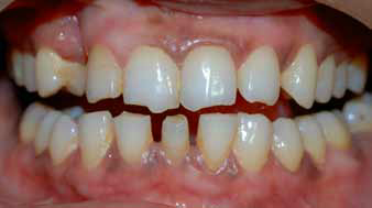
FIG 1: Pre-op frontal
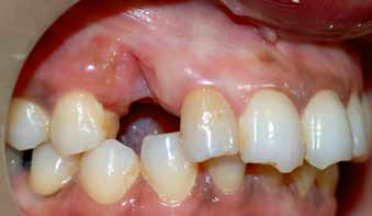
FIG 2: Pre-op lateral

FIG 3: Tooth prep with retraction

FIG 4: Provisional restoration

FIG 5: Post op and post comp front view

FIG 6: Post op and post comp lat veiw

FIG 7: Poorly made dental cast

FIG 8: Use of photographs made using smartphone to convey the shade.
APPROPRIATE SHADE SELECTION
The shade that is perceived or selected can be influenced by the light source, the condition of the tooth that absorbs, transmits, reflects or scatters the light from the source and the level of fatigue of the human visual system. Therefore, it is important that shade selection should be done before you prepare the teeth, Use the correct shade guide, do it in natural light or under prescribed lighting with a surrounding that has more neutral colours. It is important to note this shade in the technicians prescription and the need for special characterization must be explained by the use of a sketch of the tooth.
GOOD CLINICAL PHOTOGRAPHS FOR SUPPORT
Photography is a good aid in communicating the clinical situation to the technician. It has the ability to convey the extra bit of information to the technician, which otherwise you would have left it to the imagination of technician. It may not be mandatory to have a professional DSLR camera set up for making good photographs, the current day smartphone camera’s are quite capable and do a fantastic picture in any light condition. But, if you need to make photographs for your professional presentations or publications then it is imperative to have these photographs made using a good camera and standard magnification. The minimum photographs that will help the technician to enhance the quality of restoration should include the following:
a. Smile line – will help the technician to ascertain the level of precision that will be required at the gingival third and how that may affect the overall esthetic outcome of the prosthesis
b. Pre Prep – gives information on the shape and contours of the teeth that are prepared and also most importantly the surface characteristics of the prepared teeth that will be otherwise permanently lost to preparation.
c. Shade selection – its ideal to make this photograph in good lighting as this give vital information on the level of translucency of the teeth.
d. Prepared tooth – Helps to correlate the models to the clinical situation
e. Provisional – A photograph of a well made provisional gives the technician a very clear picture of what the patient and clinician expecting from the prosthesis.
PROPER COMMUNICATION WITH GOOD ENOUGH TIME
Good Communication with the technician goes a long way to enhance the final outcome, thus it must be done right with a definitive prescription, which should include the delivery date along with all other instructions to the technician. An email, phone call can be an adjunct to this form of communication. Writing on the cast, scribbling on piece of paper and conveying through the pickup boy are best avoided. Always provide good enough time to the technician in order to receive quality work. Ways to maintain your relationship with your dental technician
1. Don’t expect miracles and get upset when your technician cannot deliver.
2. Don’t treat your technician as a subordinate, rather treat him as an important member of your team
3. Don’t expect your technician to rush every case and don’t forget to thank them!
REFERENCES
- Winstanley RB, Carrotte PV, Johnson A. The quality of impressions for crowns and bridges received at commercial dental laboratories. Br Dent J. 1997;183(6):209-213.
- Farah JW, Dootz E, Mora G, Gregory W. Insights of dental technicians: a survey of business and laboratory relations with dentists. J. Dentistry. 1991;11(3):9-11,20.
- Metz MJ, Abdel-Azim T, Miller CJ, et al. Implementation of a laboratory quality assurance program: the Louisville experience. J Dent Educ. 2014;78(2):195-205.
- Abdul Rohman Salem Alnegrish. Assessment of Impressions made for Fixed Partial Denture prosthesis in Jordan. Pakistan Oral and Dental Journal 2009;29:167-170.
- Zu saifudin AA,Kamaruddin F, Ab ghani SM. The quality of working impressions for the fabrication of fixed prosthodontic prostheses (crown and bridgework). Eur J Gen Dent 2014;3:100-4.
- Amruta P. Jankar et al Impression materials and techniques used and followed for the fixed partial denture treatment by private dental practitioners in Maharashtra state: A questionnaire study International J. of Healthcare and Biomedical Research, Volume: 04, Issue: 03, April 2016, 83-92
- Padbury Jr A, Eber R, Wang H-L. Interactions between the gingiva and the margin of restorations. J. Clin Perio 3; 30:379–385.
- Aimjirakul P, Masuda T, Takahashi H, Miura H. Gingival sulcus simulation model for evaluating the penetration characteristics of elastomeric impression materials.,Int. J. Prosthodont 2003;16:385–389.
- Lawson NC, Burgess JO. Clinicians reaping benefits of new concepts in impression. Compend Contin Educ Dent. 2015;36(2):152-153.
- Donovan TE, Chee WW. A review of contemporary impression materials and techniques. Dent Clin North Am. 2004;48(2):vi-vii, 445-470.
- McCracken MS, Louis DR, Litaker MS, et al. Impression techniques used for single-unit crowns: findings from The National Dental Practice- Based Research Network. J Prosthodont 2017;1:1-11
Disclaimer from Guident
The views and opinions expressed in articles published in Guident are solely those of the authors and do not necessarily reflect the views of the editors, the editorial board or the publisher, Ivory India. Guident does not endorse any product, technique or treatment described. Clinical content is intended for qualified dental and medical professionals and is not a substitute for individual clinical judgement. Guident, its editors and the publisher accept no liability for any consequence arising from the use of information published in the journal.
How to cite this article
Dr. Nitesh Shetty, Dr. Arifa Hassan, Dr. Hasan Sarfaraz. Teaming Up with Your Dental Laboratory!. Guident. 2018 Apr;11(5). Available from: https://guident.in/articles/prosthodontics/teaming-up-with-your-dental-laboratory.html