Semi Precision Attachment in Removable Partial Denture
Department of Prosthodontics K.L.E.S Institute of Dental Sciences, No.20 Yeshwanthpur Suburb, Bangalore, India
ABSTRACT
Successful rehabilitation of the dentition requires plenty of contemporary and conventional treatment planning and attachment retained partial dentures are one such kind of treatment modality. They have opened a new horizon of possibilities in prosthodontic rehabilitation. Varieties in size, shape and configuration allows them to be utilized in many clinical scenarios. Limited space for extracoronal attachments is a serious gap in the design and the fabrication of a precision attachment Removable Partial Denture (RPD). A custom semi-precision attachment with a partial denture offers strength and improved aesthetics in cases with minimal space. This article presents a method of fabrication of semi-precision attachment to eliminate metal display and enhance esthetics. A comprehensive evaluation, multi-disciplinary approach and a sequential treatment plan, worked out in harmony with the patient’s aesthetic demand and perceptions are important for a long-term successful outcome. A case report in which a simplified approach to semi-precision attachments have been adopted, is discussed here.
INTRODUCTION
Dentistry has evolved from being curative to creative in recent times. Our ever-increasing knowledge of the oral environment, together with development in technology has taken us to give a restoration, which is esthetically pleasing and comfortable. This makes it all the more important to reconcile what is actually feasible with the patient's own expectations.1
Prosthodontic rehabilitation of distal extension partially edentulous cases remains challenging ; where fixed prosthesis cannot be fabricated and implant retained restoration are an option but is sometimes not possible due to local or systemic factors or economic reasons. A unilateral prosthesis lacks the effect of cross arch stabilization, making it less stable. The support for distal extension RPD is derived from edentulous ridge and terminal abutment teeth, which would act as fulcrum exerting forces on abutment teeth jeopardizing the periodontium of these teeth.2
An alternative reconstructive option meeting the needs of the patient as well as the clinician is a combination prosthesis with fixed and removable partial denture connected with attachments.When literature is reviewed retrospectively, survival of attachment retained partial denture shows 83.3% for 5 years, 67.3% up to 15 years and of 50% when extrapolated to 20 years. Hence, they are believed to be the best prosthesis available to dentistry especially in conditions where fixed restorations are contraindicated.3
This article describes the clinical case report of bilateral distal extension situation restored with attachment retained removable partial denture.
An attachment is defined as “A mechanical device for the fixation, retention and stabilization of prosthesis. There are two types of attachments:
- Precision Attachments
- Semi-Precision Attachment
Staubli 4 has classified attachments as:
Class 1a : Solid, rigid, nonresilient
Class 1b : Solid, rigid, lockable with U-pin
Class 2 : Vertical resilient
Class 3 : Hinge resilient
Class 4 : Vertical and hinge resilient
Class 5 : Rotational and vertical resilient
Class 6 : Universal, omniplanar.
A precision attachment is fabricated from milled alloys and tolerances are within .01mm. They are generally intra- coronal and non-resilient. Their advantages include consistent quality, controlled wear and easier repair. They have standard parts which are interchangeable.5 A Semi-Precision attachment is fabricated by the direct casting of plastic, wax, or refractory patterns. They are considered “semi-precision” since in their fabrication they are subject to inconsistent water/powder ratios, burn out temperatures and other variables. The resulting components therefore, vary to a small degree. They are less costly, easy to fabricate and may be cast in alloy. They are generally extra coronal and resilient.
They are strongly recommended in the following clinical scenarios 6
- In the aesthetic zone
- When redistribution of forces required
- To minimize trauma to soft tissue
- Controlling rotational and loading forces
- For retention and stability
SELECTION OF ATTACHMENTS
There are a few criteria that help to decide the appropriate attachment based on the individual need of the case7
1. Location 2.Function 3. Retention 4. Space 5. Cost
- Based on location, the semi precision attachments are divided into:-
- Intracoronal Attachments: Placed within the contours of the crown form. The advantage is that the occlusal forces exerted upon the abutment tooth are applied close to the long axis of the tooth. It, usually requires a box preparation to allow the attachment to fit within the crown contour. If it is not possible to create a box preparation that will totally incorporate the female element, then an extracoronal attachment should be considered. Since all intracoronal attachments are non- resilient, double abutting is recommended.
- Extracoronal Attachments :They are positioned entirely outside the crown contour. Advantages are that the normal tooth contour can be maintained, minimal tooth reduction is necessary and the possibility of devitalizing the tooth is reduced. Also, the path of insertion is easier for patients with dexterity problems. Most extracoronal attachments have some type of resiliency (stress redirectors). Even with resilient attachments, double abutting is recommended whenever possible. Patients are instructed on the use of dental floss and hygiene accessories as it is more difficult to maintain hygiene.
- Radicular / Intraradicular Stud Type Attachments : These are connected to a root preparation. The female or male is soldered or cast to a root cap coping . The female element of intraradicular stud type attachments fit within the root form contour. The SwissLogic, Zest and the ZAAG are examples of this type of attachment. Some stud type attachments, such as the Uni- Anchor and the Direct O-Ring, are directly cemented into the prepared root without requiring a cast coping. Stud type titanium implant attachments are also available to screw directly into implants or tissue extensions.
- Bar Type: Bar type attachments span an edentulous area and connect abutment teeth, roots or implant. The removable bridge, partial denture, or over denture fits over the bar and is connected to it with one or more retention sleeves, riders/clips, or retentive plungers.
- Based on function, it is important to differentiate between a solid and resilient type restoration.
- Abutment/tooth supported restorations are solid and sub classified into, non- lockable and lockable types.
- Abutment/tooth and tissue supported restorations are resilient and categorized into 5 classifications ranging from vertical to universal resiliency. The higher the number of classification, the less torque transferred to the abutment, root or implant.
- Based on modes of retention, they are Frictional, Mechanical, Frictional & Mechanical, Magnetic and Suction types.
- Frictional retention is resistance to the relative motion of two or more surfaces in intimate contact with each other.
- Mechanical retention is resistance to the relative motion of two or more surfaces due to a physical undercut.
- Magnetic retention is the resistance to movement caused by a magnetic body. Magnets do not provide lateral stability and are contraindicated for flat ridges. It is used in limited applications, heat curing will weaken magnets and they are liable to corrode.
- Frictional and Mechanical retention combines both features of frictional and mechanical retention as discussed. The Score-PD attachment is a good example.
- Suction is a force created by a vacuum that causes a solid object to adhere to a surface. An example would be a well- fitting denture.
- Space considerations also are important while deciding the attachment to be used.
- The space available vertically, bucco-lingually and mesio-distally play a key role in attachment selection.
- The vertical space is measured from the tissue to the marginal ridge or from the margin of the abutment to the marginal ridge of the opposing dentition.
- Buccal-lingual or labial-lingual space is very critical, especially with removable partial dentures.
- Mesial-Distal measurements are critical for intracoronal attachments, since a box preparation is required. To avail maximum use, largest attachment possible for the space available should be used.
All these factors should be considered for the correct attachment selection.
Understanding the difference in nature and behavior of the tissues supporting RPD is critical for long term success of the prosthesis. These differences multiplied by the function create major stresses on the prosthesis. The stress-control on abutment is an essential factor for the success of distal extension cast partial denture which is achieved through dual impression technique, broad coverage and stable denture base, rigid design, physiologic shimming, splinting of abutments, proper selection of attachment and clasp design.
This study describes the clinical case report of bilateral distal extension situation restored with semi precision attachment.
CASE REPORT
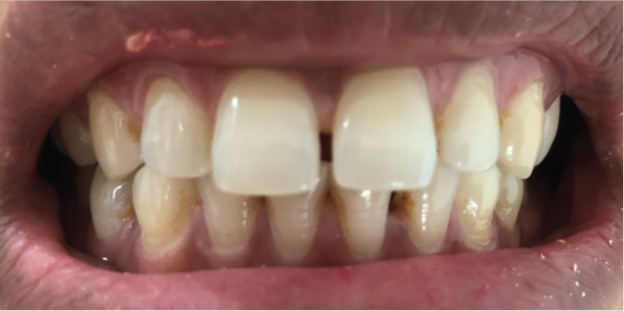
A 42-year-old male reported to the Department of Prosthodontics, KLE Society’s Institute of Dental Sciences with the chief complaint of multiple missing teeth in the maxillary and mandibular arch with inability to chew food properly. Intra oral examination revealed the following findings teeth missing were 14,15,16,24,25,26,36,37,46,47 with crowns present on 13,23,17 and 27.The remaining teeth had good intercuspation and were periodontally sound . The patient was not willing to accept an interim removable partial denture and requested for an alternative prosthesis. After radiographic examination and diagnostic model study, interocclusal distance was found to be adequate. Treatment was carefully planned by taking into consideration patient’s esthetic need and economical condition.
TECHNIQUE
- Diagnostic impressions were made with irreversible hydrocolloid (Zhermack Tropicalgin) and poured with Type III dental stone (Goldstone by Asian Chemicals).
- A diagnostic mounting was done for evaluation of the existing space for the extracoronal resilient attachment.
- Tooth preparation was done on 34,35,44,45 to receive PFM crowns ( Fig- 1 ) Retraction cords were placed followed by 2 stage putty wash poly vinyl siloxane impressions for both maxillary and mandibular arch (Aquasil)
- The casts were poured in die stone (Kalrock, Kalabhai Karson, Mumbai).
- A cast partial denture with rest seat incorporated in the crowns of 13,23,17,27 was planned ( Fig – 2 )
- The attachment system was selected on the basis of available space. (OT CAP, Rhein 83 Inc, USA).
- This followed the surveying of master cast to obtain maximum parallelism with path of insertion and removal and to avoid interferences.
- The crowns were then waxed to full contour, milled for the mandibular arch and cast partial metal framework milled for the maxillary arch to check for marginal integrity and passive fit (Fig 3a & 3b ).
- The fixed component including veneered metal- ceramic crowns & the patrices were tried in the patient mouth and a pick-up impression was made (Aquasil) ( Fig 4 ).
- Maxillomandibular relation was recorded, teeth arrangement done followed by trial.
- This was followed by the investing and acrylisation of the removable partial denture and the cast partial denture. (Fig – 5 )

Fig 3a &3b - Metal framework trial

Fig 4 - Pick up impression

Fig 5 - Final Prosthesis with aesthetic clasps & semi precision RPD
CONCLUSION
Attachment retained RPD is a viable treatment option in case of distal extension partial dentures providing better resistance to the movement of the prosthesis toward the tissue and away from the tissue and also acts as “stress breaker” by minimizing the stress on the distal abutment. Emphasis must be placed on proper patient selection, patient motivation, basic prosthodontics principles, detailed home care instructions and treatment recall. Dental caries and periodontal breakdown are the factors that may jeopardize the success. If these two factors are well controlled by proper home care hygiene methods, the prosthesis may past long for many years.
REFERENCES
- Makkar S, Chhabra A, Khare A. Attachment Retained Removable Partial Denture: A Case Report. IJCDS 2011;2(2);39-43
- Master M, Shetty O, Charushila SS. Full mouth rehabilitation of a patient using cast partial dentures with precision attachments. Heal Talk 2013;5(5):26-28.
- Schuyler CH. An analysis of use and relative value of the precision attachment and the clasp in partial denture planning. J Prosthet Dent 1953;3:711-714.
- Jain AR,Philip JM,Argia P. Attachment- Retained Unilateral Distal Extension (Kennedy’s Class II Modification I) Cast Partial Denture. Int J Prosthodont Restor Dent 2012;2(3):101-107.
- Burns DR, Ward JE.A review of attachments for removable partial denture design: Part 1. Classification and selection.Int J Prosthodont 1990;3:98-102.
- Gozneli R, Yildiz C, Vanlioglu B, Evren BA, Kulak-Ozkan Y.Retention behaviors of different attachment systems: Precious versus nonprecious, precision versus semi-precision,Dent Mater J. 2013;32(5):801-7
- Prasad D K, Swaminathan A, Prasad D A. A Simplified Approach to Semi-Precision Attachment. NUJHS .2016; 6(3):51-5.
Disclaimer from Guident
The views and opinions expressed in articles published in Guident are solely those of the authors and do not necessarily reflect the views of the editors, the editorial board or the publisher, Ivory India. Guident does not endorse any product, technique or treatment described. Clinical content is intended for qualified dental and medical professionals and is not a substitute for individual clinical judgement. Guident, its editors and the publisher accept no liability for any consequence arising from the use of information published in the journal.
How to cite this article
Dr. Surabhi Chhabra, Dr. Rohit Mohan Shetty, Dr. Yamini Nandini. Semi Precision Attachment in Removable Partial Denture. Guident. 2018 Dec;12(1). Available from: https://guident.in/articles/prosthodontics/semi-precision-attachment-in-removable-partial-denture.html