Easy Fix with Laminates
Department of Prosthodontics MIDSR Dental College, Latur, India
ABSTRACT
It is predicted that the esthetic dental services will continue to grow. Laminate veneer restorations have a unique position in today's dental practice. These are conservative restorations, a factor which is especially important for young permanent dentitions. Porcelain veneers can be considered to be very much in cosmetic dentistry because they offer innumerable advantages over any previous form of veneering systems. This Case report discusses a patient having spaces between teeth in the anterior region. The patient was treated with porcelain laminate veneers in both the arch for the same.
INTRODUCTION
Teeth the most dominant component of smile connotes a lot in today’s growing society. Derangement in the confident smile may affect the individual in almost every zone of his life. From a purely cosmetic standpoint, the value of the appearance of one’s teeth has taken on a great importance in today’s society.1 The presence of diastemas between maxillary teeth compromised the balance and harmony of smile. Diastemas can be closed by orthodontic treatment and more easily accepted by elderly is direct and indirect veneers.
INDICATION
- Improve extreme discolorations such as tetracycline staining, flourosis, devitalized teeth, and teeth darkened from age.
- Repair chipped or fractured teeth.
- Closing of diastemas between teeth.
- Ability to lengthen anterior teeth.
- Minor mal alignment corrections of the teeth.
CONTRAINDICATION
- If little or no enamel is present, full crown should be considered.
- Certain tooth-to-tooth habits like bruxing or clenching, or other para-functional habits such as pencil chewing or ice crushing.
- Teeth that exhibit severe crowding.
- Certain types of occlusal problems such as Class III & end-to-end bites.
DISADVANTAGES
- The process is irreversible.
- More costly than composite veneers.
- Not suitable for patients with clenching or grinding habits.
- Not repairable if they chip or crack.
- Tooth may become sensitive to hot and cold foods and beverages.
- They can dislodge and fall off.
- Technique sensitive.
CASE REPORT
A 34-year-old female patient with diastema and aesthetic concerns about her anterior teeth (Fig 1). After comprehensive evaluation and collection of data regarding the patient's complaint, various treatment approaches were considered, including orthodontic treatment option, which was immediately refused owing to its long duration and much more expenses. The patient was more interested in alternative approaches that would be less time-consuming but still aesthetic and conservative. After analyzing the patient’s smile line it was decided to place porcelain laminate veneers from canine to canine in both arches.
Procedure
Diagnostic impressions were made in irreversible hydrocolloid (Septodent, USA). The models were studied and a diagnostic wax up (Fig 2)was carried out. In order for the patient and the operator to know the final outcome of the treatment and preparation for laminates. The wax-up was shown to the patient and the patient accepted and consented to the prescribed option. On the study cast with the wax-up, a matrix was constructed with the aid of o condensation silicone (Speedex, Rio de Janeiro, RJ, Brazil), for mock-up purpose. The mock-up was performed with bisacrylic resin (Cooltemp, 3M-ESPE, Coltene) inserted inside the matrix and placed on the labial surface of the teeth to be restored(fig 3). The restorative mock-up enabled that the patient predicted the final aspect of her smile(fig 4 ).
Before carrying out the tooth preparation for laminates, shade selection was carried out using Vitapan Classical shade guide (VitaZahnfabrik, Germany). The 6 maxillary and mandibular anterior teeth were then prepared to receive porcelain laminate veneers. Depth orientation grooves were placed on the facial surface of the tooth(fig 5) with 0.3mm and 0.5mm three wheel diamond depth cutter on the gingival half and incisal half respectively. The tooth structure remaining between the depth orientation grooves were removed with a round end tapered diamond. 0.25 mm chamfer was maintained in the cervical region finish lines were kept at the level of gingival margin. The length of the maxillary central incisors was adjusted corresponding to the aesthetic plane. Mesial reduction was kept at a minimum in the maxillary right lateral incisor and more of reduction on the distal side was done in order to compensate for the diastema. The incisal chamfer was extended palatally as little increase in height was desirable. The centric stops were carefully avoided during preparing the palatal finish line. The proximal preparation was extended beyond the contact area to avoid visibility of the tooth restoration junction.
After finishing the preparations the gingival retraction and final impressions were made in vinyl polysiloxane impression material (ExpressTM XT, 3M ESPE) by double step double mix technique(fig 6). Temporary restoration was done with light cured composite resin. It was bonded to the teeth only at 2 to 3 spots with composite resin.
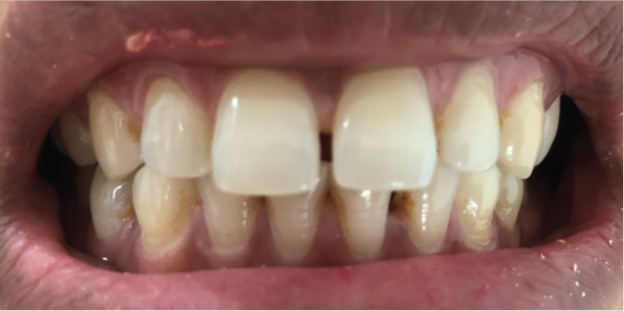
Fig 1: Pre Operative frontal view

Fig 2 : Mock Wax Up on Diagnostic Cast

Fig 3: Transfer of Mock up without preparation

Fig 4 : Mock up transferred in mouth.

Fig 5 : Depth orientation groove

Fig 6 : Impressions
VENEER CEMENTATION
The temporary veneers were removed; the teeth were cleaned using pumice and was dried. The porcelain veneer made up of IPS-emax (fig 7) were then tried in for shade, fit, marginal adaptation, shape, size, symmetry and contacts. First they were tried-in individually using vaselline as a holding medium. After individual evaluation, collective try-in was done and patient’s approval was obtained.
The veneers were removed from the tooth, rinsed thoroughly, and dried. The inner side of porcelain veneer was etched with 9.6% hydrofluoric acid (Poreclain Etch Gel, Pulpodent Corporation) for 20 seconds, washed under running water and dried. A layer of silane coupling agent (Silano,Angelus) was applied on the inner surface of veneer and gently air dried after one minute. The silane coupling agent forms a chemical bond between the porcelain and resin, besides it also reduces the marginal leakage and discolouration.2 The silanized surface was then coated with a thin layer of bonding agent thinned with air from the air syringe. The resin layer was polymerized with light. The prepared teeth were etched with 37% phosphoric acid for 30 seconds, rinsed thoroughly and dried. A layer of bonding agent (Adper single bond 3M ESPE USA) was applied on to the tooth surface. A self adhesive resin cement (3M RelyXTM U200) was used for bonding the veneer to the tooth. A layer of cement was applied on the inner surface of veneers. The veneers were then positioned on the teeth correctly with slight pressure, the excess cement was removed with a brush. After the initial set the remaining excess cement was removed with a NO: 12 Bard-Parker blade. The polymerization was continued for 60 seconds by directing the light initially from lingual side, so that the resin cement shrinks towards tooth providing more retention. Then each segment of veneer was light cured for 40 seconds. Occlusion was checked to ensure that no contact existed on tooth-porcelain interfaces. The patient was satisfied with her new smile(fig 8)

Fig 7 : IPS Emax

Fig 8 : Final Restoration
DISCUSSION
Treatment planning for spaces correction include orthodontic closure, restorative therapy, surgical correction or multidisciplinary approach depending upon the cause. The restorative closure of diastema or gaps can be achieved by using any of the techniques mentioned; direct composite veneers, indirect composite veneers, porcelain laminate veneers, all ceramic crowns, metal ceramic crowns and composite crowns. Porcelain laminate veneersoffers more comprehensive applications when they are used cautiously and the outcome accomplished have been pleasing for the patient.2 The highly glazed surface of the porcelain laminates prevents plaque accumulation, and provided a life like appearance.3-6 However, porcelain laminates have their own limitations too.
CONCLUSION
Bonded porcelain veneers can provide successful aesthetic and functional long-term service for patients with diastema. Bonded porcelain veneers have a number of significant advantages over metal-ceramic or all-ceramic crowns. One of the most important advantages is that they are extremely conservative in terms of tooth structure reduction.1
REFERENCE
- Giordano R. McLaren EA. Ceramics overview: classification by microstructure and processing methods. Compend Cumin Educ: Dent. 20I0:31(9):682-684.
- Chaturvedi S, Chaturvedi M, Rajguru JP, Somayaji N. Porcelain Laminate Veneers - Revitalizing Smile: A Case Report. J Clin Den Res Edu 2013;2(2):69-72.
- Rammelsberg P, Spiegl K, Eickemeyer G, Schimitter M. Clinical performance of metal free polymer crowns after 3 years in service. Journal of Dentistry 2005;33:517-523.
- Sheets CG, Taniguchi T. Advantages and limitations in the use of porcelain veneer restorations. The Journal of Prosthetic Dentistry 1990;64(4):406-411.
- Bhoyar AG. Aesthetic Closure of Diastema by Porcelain Laminate Veneers: A Case Report. People’s Journal of Scientific Research 2011;4(1):47-50.
- Magne P, Douglas WH. Cumulative effects of successive restorative procedures on anterior crown flexure: intact versus veneered incisors. Quintessence Int 2000;31(1):5-18-8.
Disclaimer from Guident
The views and opinions expressed in articles published in Guident are solely those of the authors and do not necessarily reflect the views of the editors, the editorial board or the publisher, Ivory India. Guident does not endorse any product, technique or treatment described. Clinical content is intended for qualified dental and medical professionals and is not a substitute for individual clinical judgement. Guident, its editors and the publisher accept no liability for any consequence arising from the use of information published in the journal.
How to cite this article
Dr. Rashmi R. Shah. Easy Fix with Laminates. Guident. 2018 Dec;12(1). Available from: https://guident.in/articles/prosthodontics/easy-fix-with-laminates.html