Long-Span Fixed Partial Denture Reinforced with a Titanium Bar: Biomechanical Considerations and Clinical Implications
Department of Dentistry, Era Medical College, Lucknow, UP, India
Abstract
Long-span fixed partial dentures (FPDs) are associated with increased biomechanical complications due to framework flexure and unfavorable stress distribution. Reinforcement using a titanium bar has been proposed to improve structural rigidity and clinical longevity. This article reviews the biomechanical rationale, material properties, design principles, fabrication techniques, and clinical outcomes of titanium bar–reinforced long-span FPDs. Available evidence indicates that titanium bar reinforcement enhances load distribution, reduces connector stress, and improves prosthesis survival when proper design protocols are followed.
Keywords: long-span fixed partial denture; titanium bar; biomechanics; prosthodontics
Introduction
Long-span fixed partial dentures (FPDs), defined as prostheses replacing three or more consecutive missing teeth, pose significant biomechanical challenges. Increased span length results in greater deflection, higher connector stress, and an elevated risk of prosthetic failure. Titanium bar reinforcement has emerged as a predictable approach to enhance the mechanical performance of such restorations.
Biomechanical Considerations
According to beam theory, deflection increases exponentially with span length. Long-span FPDs are therefore more susceptible to flexure, ceramic fracture, and cement failure. Reinforcing the framework with a titanium bar reduces bending moments and distributes occlusal forces more favorably to the abutment teeth.
Material Properties of Titanium
Titanium exhibits excellent biocompatibility, corrosion resistance, and a favorable strength-to-weight ratio. Its modulus of elasticity allows controlled stress absorption while maintaining sufficient rigidity when used as a reinforcing bar.
Design and Fabrication
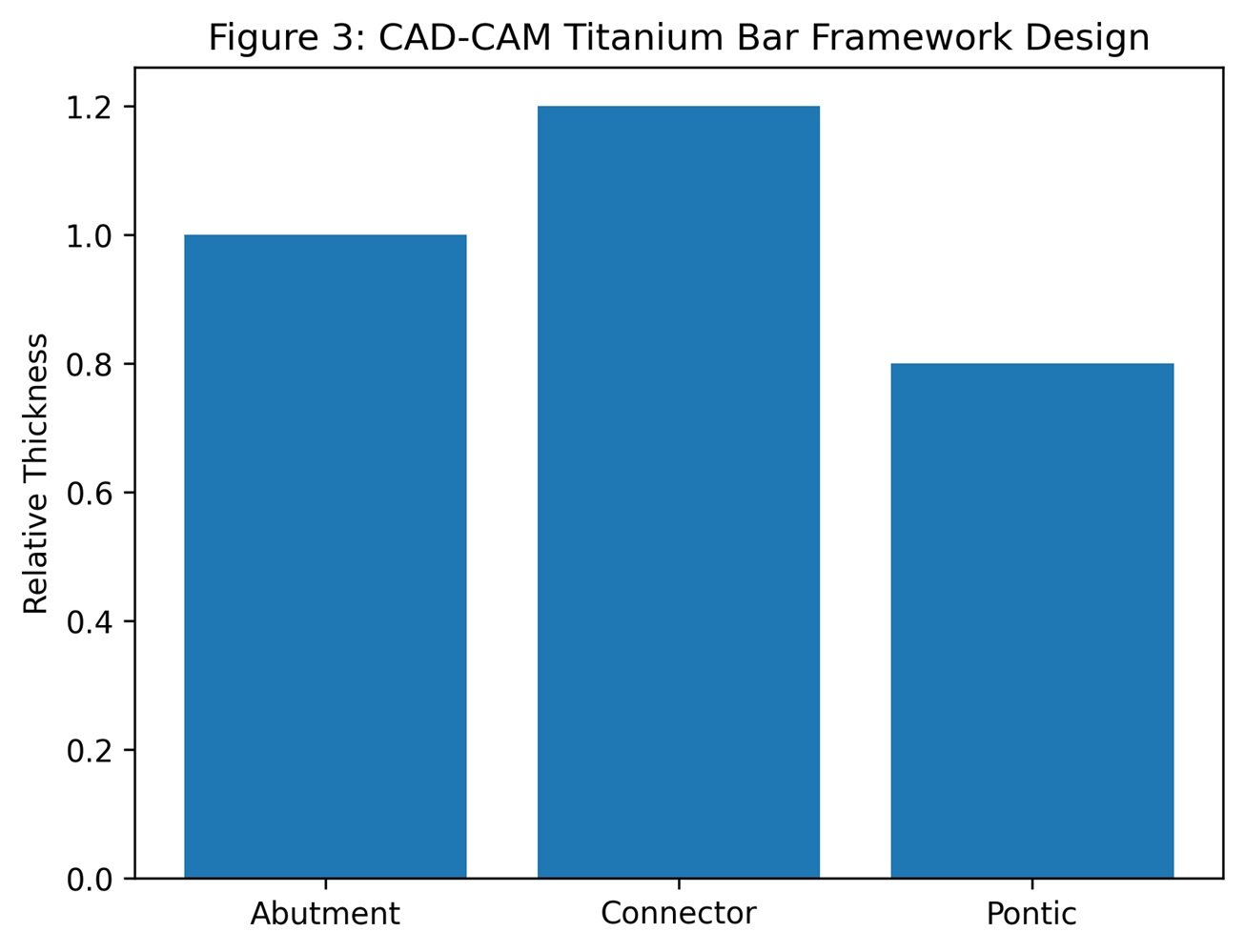
Successful titanium bar–reinforced FPDs depend on adequate connector dimensions, rounded internal line angles, and precise fabrication. CAD-CAM milling is currently the preferred technique due to superior accuracy and passive fit.
Clinical Indications
Titanium bar–reinforced long-span FPDs are indicated in patients with multiple missing teeth, high occlusal loads, or when implant therapy is contraindicated.
Conclusion
Within the limitations of available evidence, titanium bar reinforcement represents a biomechanically sound option for long-span FPDs. Proper case selection and adherence to established design principles are essential for long-term success.
References
- Shillingburg HT, Hobo S, Whitsett LD. Fundamentals of Fixed Prosthodontics. 4th ed. Quintessence; 2012.
- Goodacre CJ, Bernal G, Rungcharassaeng K, Kan JY. Clinical complications in fixed prosthodontics. J Prosthet Dent. 2003;90:31-41.
- Anusavice KJ, Shen C, Rawls HR. Phillips’ Science of Dental Materials. 12th ed. Elsevier; 201
- Wataha JC. Biocompatibility of dental casting alloys. J Prosthet Dent. 2000;83:223-23
Disclaimer from Guident
The views and opinions expressed in articles published in Guident are solely those of the authors and do not necessarily reflect the views of the editors, the editorial board or the publisher, Ivory India. Guident does not endorse any product, technique or treatment described. Clinical content is intended for qualified dental and medical professionals and is not a substitute for individual clinical judgement. Guident, its editors and the publisher accept no liability for any consequence arising from the use of information published in the journal.
How to cite this article
Dr. Aamina Nisar. Long-Span Fixed Partial Denture Reinforced with a Titanium Bar: Biomechanical Considerations and Clinical Implications. Guident. 2026 Feb;19(3). Available from: https://guident.in/articles/prosthodontics/long-span-fixed-partial-denture-reinforced-with-a-titanium-bar-biomechanical-considerations-and-clinical.html