Vaccines Against Periodontal Diseases: A Myth or Reality
School of Dental Sciences, Sharda University, Greater Noida.
ABSTRACT
Vaccination is a process that induces specific immune resistance to a bacterial or viral infection. Vaccine research in periodontal diseases is still in its infancy. The complexities in the etiopathogenesis of the periodontal diseases have been the prime obstacle in the hunt for vaccine. Among some 300 species of bacteria involved in subgingival plaque, 5-7 species have been implicated in the etiology of periodontitis which might play an important role as primary pathogens.
Key Words: Periodontitis, Periodontal Vaccines, Immunization.
The search for periodontal vaccine revolves around the antigenic factors of the periodontal pathogens. The objective of periodontal vaccine is to identify the antigens involved in the destructive process of periodontitis against which antibodies would be evoked to exert protection. Till date no preventive modality exists for periodontal disease and treatment rendered is palliative. Thus availability of periodontal vaccine would not only prevent and modulate periodontal disease but also enhance the quality of life for whom periodontal treatment cannot be easily obtained.
INTRODUCTION
Periodontitis is defined as inflammation of the gingiva extending into the adjacent attachment apparatus. The disease is characterized by loss of clinical attachment due to destruction of the periodontal ligament and loss of the adjacent supporting bone.1 Although, periodontal diseases are primarily initiated and perpetuated by mixed biofilm (also including micro-organisms), other factors such as host-associated factors, genetic predisposition, immune dysfunction, and environmental factors can aggravate the disease. Thus, a mixed strategy, targeting both specific pathogenic species and the host immune response would have to be adopted for the sophisticated management of periodontitis subjects.
The age-old and time-tested proverb ‘‘prevention is better than cure’’ sums up the essence of vaccination.2 The term ''vaccine'' is derived from Edward Jenner's use of the term ''cow pox'' (Latin ''variolæ vaccinæ'', adapted from the Latin ''vaccÄ«n-us'', from ''vacca'' cow), which, when delivered to humans, provided the protection against smallpox. It is any preparation intended to produce immunity to a disease by stimulating the production of antibodies which includes suspensions of killed or attenuated microorganisms, products or derivatives of microorganisms. They improve immunity to a particular disease which typically contains an agent that resembles a disease-causing microorganism, and is often made from killed forms of the microbe. The agent triggers the body's immune system to recognize the agent as foreign, destroy it, and "remember" it, so that the immune system can more easily recognize and destroy any of these microorganisms that it later encounters.3 Vaccines can be prophylactic, or therapeutic. Vaccines have prevented several infectious diseases for many years, and are still being investigated. They are generally prophylactic, i.e., they enhance the effects of future infection, one of which is considered here the ‘PERIODONTAL VACCINE’.
Vaccine research in periodontal diseases is still in its infancy. The complexities in the etiopathogenesis of the periodontal diseases have been the prime obstacle in the hunt for vaccine. Among some 300 species of bacteria involved in subgingival plaque, 5-7 species have been implicated in the etiology of periodontitis which might play an important role as primary pathogens. Now, vaccine research has shifted toward identification of valid antigenic targets/molecules of P.gingivalis and A.actinomycetemcomitans involved and thus induction of suitable immune response. This article will focus on the various vaccine approaches towards periodontal diseases that have been investigated in the recent times with its indications, current strategies, problems and future considerations.
NEED FOR VACCINES4,5
The current concept of etiopathogenesis of periodontal disease includes a multifactorial model in which the essential components for the disease causation includes host associated factors, genetic predisposition, immune system dysfunction and environmental factors, such as the presence of virulent periodontal pathogens (bacteria or viruses) in the form of dental biofilm. Hence, any intervention to arrest or prevent the progression of periodontal disease would include combination approaches, including that of host immune modulation and pathogen-specific approaches.
The need for vaccine development due to the following reasons:
-
For bacteria which are capable of evading host immune responses and invading the tissue:
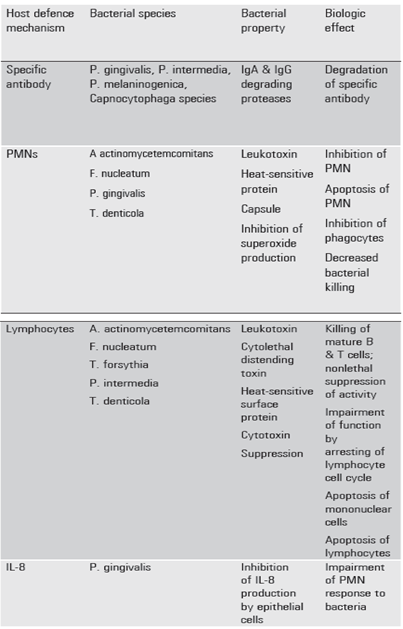
gingivalis produces proteases that degrade serum antibacterial components (antibodies, complement protein) and immune cell derived peptides (eg. Cytokines). A.actinomycetemcomitans produce a protein (leukotoxin) that especially toxic to host immune cells (e.g. neutrophils and monocytes) and also produces factors that can inhibit immune responses.
Bacterial properties involved in ivasion of host defense machanism.
-
To decrease the incidence of periodontal disease
Periodontal diseases are not isolated lesions but have systemic episode. It arises in higher systemic levels of inflammatory markers viz c-reactive protein and fibrinogen. These systemic changes lead to various conditions like myocardial infarction, cerebrovascular stroke, pneumonia etc. Some studies have shown that subjects with high anti-HSP (HSP 60, Dna K, and Gro El) antibody concentrations tended to have significantly healthier periodontal tissues. Thus, it might be feasible to develop a vaccine against periodontitis based on P. gingivalis, specific HSP or HSP epitopes.
-
Financial burden
Periodontal treatment puts a financial burden on the individuals suffering from it. Availability of vaccine for preventing or modulating periodontal disease would be of great benefit in both developing and developed countries.
IMMUNIZATION AGAINST PERIODONTITIS
A substantial number of bacteria (exceeding 300 species) appear to be involved in subgingival plaque. Among these five to seven species have been implicated in the etiology of periodontitis, but few species, P. gingivalis or T. forsythus or A.actinomycetemcomitans, might play an important role as primary pathogen.6,7
ACTIVE IMMUNIZATION FOR PERIODONTAL DISEASE
VACCINE CANDIDATE ANTIGEN
The antigenic profile of P. gingivalis, T. forsythus and A.actinomycetemcomitans has been studied and the following information has been gathered:
- The protein which evokes the best (most protective) immune response.
- The most potent antigen to do so.
- The shared antigens or epitopes which would provide co-immunization to several periodontopathic bacteria.
- The protein antigen proved to be safe/non-toxic in human trials.
- Alternative modes of introducing the antigen in to the host.

Table 2: Components of periodontal bacteria tested for antigenicity and potential as vaccine candidates
Active immunization against P. Gingivalis components
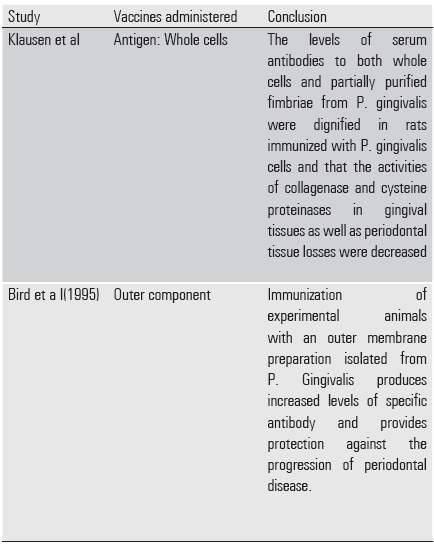
- gingivalis is a potential vaccine candidate because this pathogen carries several high potent antigens, a lipopolysaccharide (LPS) capsule, lipids, and outer membrane proteins (OMP) which are used as subunits for development of active immunization.5

PASSIVE IMMUNISATION FOR PERIODONTAL DISEASE
Chronic disease is not generally an indication for passive immunization by the repeated administration of a xenogeneic immunoglobulin. However, passive immunization against periodontal diseases has been attempted because of the success of active and passive immunization against P.gingivalis and S. mutans, respectively. The host does not respond to the immunization and protection lasts only as long as the injected antibody persists thats why the passive immunization is short lived.
PASSIVE IMMUNIZATION8
:
-
Murine monoclonal antibodies
In this, the antibodies are obtained by inoculating the antigens into mice. These antigens are injected into the host that brings about passive immunization. Booth (1996) developed a murine monoclonal antibody to P. Gingivalis that prevented recolonization of deep pockets by this pathogen in periodontitispatients.
Passive immunization of humans utilizing P. gingivalis monoclonal antibodies temporarily prevents colonization of P. gingivalis. Kaizuka et al (2003) showed that a human monoclonal antibody (Hu MAb – HMGD1) that is capable of recognizing the 43 and 49 KDa proteins from P.gingivalis and inhibiting the haemagglutinating ability of P.gingivalis may prove useful in passive immunization against periodontitis, with safety and efficacy studies pending.
-
Plantibodies
-
A very recent approach for vaccination strategies is molecular biological techniques to express bacterial or viral antigens in plants, which could be used as orally delivered vaccines. A recent approach using planti bodies has been suggested for vaccination strategies. It utilizes molecular biological techniques to express bacterial or viral antigens in plants, which could be used as orally administered vaccine candidates.
Lehner et al (1995) in a study created secretory antibodies with heavy and light chains, J Chain and secretory components.[15] Ma et al (1998) have characterized a secretory IgG antibody produced in transgenic plants (such as plantibodies) that was more stable and exhibited a higher functional affinity that the native antibody as well as affording protection against Streptococcus mutans colonization.
Advantages of periodontal immunotherapy8
- Current management options inadequate for many.
- Current disease prevention options inadequate for most.
- Nonexistence of equivalent technology for periodontal disease control or prevention
LIMITATIONS OF PERIODONTAL VACCINES
The development of vaccines is a complex process that requires substantial resources over a long period of time. Currently, approximately 40% of vaccine projects are directed towards bacterial pathogens. Additionally, development of vaccines takes approximately 9-10 years, which is comparable to other biopharmaceutical agents. Human periodontal disease is multifactorial caused by manifold pathogens. The multiplicity of pathogenic organisms indicates that vaccine design against periodontitis is very complex.
Bacterial whole cells or crude extracts preparation for vaccination is not desirable because the antigenic determinants of bacteria potentially possess a high risk of cross‑reactivity with human counterparts. Finally, animal models for vaccine trials may pose inconsistencies with human models in major histocompatibility complex‑restriction of antigens presented by antigen presenting, thus obscuring the immunodominant epitope(s).
FUTURE CONSIDERATIONS
There is a need for a better understanding of the infections in periodontitis. The majority of studies that can be linked to vaccine trials have been focused on P. gingivalis. Although it appears clear that this pathogen is involved in periodontitis, other pathogens may be more critical in the early development of the biofilm resulting in periodontitis. The foremost area of concern is the development of a vaccine that is an admixture, targeting multiple bacterial antigens. Vaccines targeting the specific periodontal pathogen involved or the antecedent plaque organisms may be the best approach possible.
Further studies are needed to develop scientific models for studies of naturally occurring periodontitis. The effect of trauma induced by ligature placement alone will, in itself, cause an inflammatory response with bone loss. Thus, the induced mechanical trauma from ligatures will mask any positive impact of infection prevention in a vaccine project. Additional studies are, however, necessary to find a suitable model for vaccine trials. Recent advent of nanotechnology opens an entire array of nanospheres and liposomes for controlled release of protein or nucleic acid for the delivery of vaccine in adequate amounts.
Delivery routes, such as oral drops, nasal spray, dermal patch and subcutaneous or intramuscular injections are to be studied. Local delivery of vaccine is also another option. Plantibodies that can be used orally could also evolve as one of the major modes of administration due to its ease of development and efficacy.
CONCLUSION
Major efforts have been dedicated to the development of vaccines against serious diseases, highly prevalent diseases, and diseases without effective treatments. With regard to periodontitis, there are well-established treatment modalities for chronic periodontitis, the most common type of periodontitis. Whether there is merit in developing a periodontal vaccine for the prevention of periodontitis in general, and for special risk populations, must be considered before major efforts can be pursued in periodontal vaccine development. Recent findings of associations between periodontitis and other systemic diseases may provide a rationale for the development of a vaccine against periodontitis, especially a vaccine that could have additional benefits and reduce risks for other diseases.
REFERENCES
- Rosa AM Jong and Wil A van der Reijden Feasibility and therapeutic strategies of vaccines against Porphyromonas gingivalis.Expert Rev. Vaccines 9(2), 193–208 (2010).
- Kunal Dhingra, K.L. Vandana. Prophylactic Vaccination Against Periodontal Disease: A Systematic Review of Preclinical Studies. Journal of Periodontol 2010: Nov; Vol 81;1529 1546.
- Delves P, Martin S, Burton D, Roitt I. Textbook of Roitt’s Essential Immunology. 11th Ed. Blackwell synergy; 2006.
- Dr. Anil Kumar, Dr. Sharnamma B, Dr. Poonam Dutt, Dr. Gunjan Gupta. Periodontal Vaccine—A Boon In Periodontics. IOSR Journal of Dental and Medical Sciences 2014(apr),Volume 12, Issue 5 Ver. I., 54-59.
- Sara G. Grossi, Joseph J. Zambon, Alex W. Ho, Robert J. Genco. Assessment of risk for periodontal disease. 2. Risk indicator for alveolar bone loss. J Periodontol 1995; 66; 23-29.
- Sara G. Grossi, Joseph J. Zambon, Alex W. Ho, Robert J. Genco. Assessment of risk for periodontal disease. 1. Risk indicators for attachment loss. J Periodontol 1994; 65: 260-267.
More references are available on request.
Disclaimer from Guident
The views and opinions expressed in articles published in Guident are solely those of the authors and do not necessarily reflect the views of the editors, the editorial board or the publisher, Ivory India. Guident does not endorse any product, technique or treatment described. Clinical content is intended for qualified dental and medical professionals and is not a substitute for individual clinical judgement. Guident, its editors and the publisher accept no liability for any consequence arising from the use of information published in the journal.
How to cite this article
Dr. Radhika Gupta, Dr. Anshuman Dwivedi, Dr. Uttam Kumar Department of Periodontology. Vaccines Against Periodontal Diseases: A Myth or Reality. Guident. 2015 Jun;8(7). Available from: https://guident.in/articles/periodontics/vaccines-against-periodontal-diseases-a-myth-or-reality.html