Co-Enzyme Q10:-Another Armour for Novel Periodontal Therapy
Department of Periodontology K. D. Dental College & Hospital, Mathura
ABSTRACT
- AIM: The aim of the study is to perform a comparative evaluation of two different gum paints that is 1% Chlorhexidine Gluconate gel and Co-enzyme Q10 gel on its effects on periodontal pockets.
- MATERIAL AND METHODS:A total of 30 patient with pocket depth of around 4-8mm were selected in the out patient department of periodontology kd dental college ,15 patients for each group were selected for the study and were divided into two groups A and B.Subjects under group A were prescribed chlorhexidine gluconate 1% gel for topical application and Subject under Group B were prescribed Co-enzyme Q10 gel for topical application after scaling and root planing twice a day for 45 days. Clinical parameters such as gingival index (GI), probing pocket depth (PPD) were assessed at baseline, 21 days and 45 days .
- RESULTS: The results of this study shows that there is statically significant result in both the group in pocket reduction.On intergroup comparision the result are non-significant.
- CONCLUSION: This study showed that Co-enzyme Q10 has given equivalent result as compare to that of the benchmark chlorhexidine as it has no known side-effects and hence is safe for use over a long period of time.
- KEYWORDS: Co-enzyme Q10, 1%Chlorhexidine gluconate.
INTRODUCTION
In periodontal inflammatory disease the role of dental plaque is well established.Elimination of plaque and preventing its formation is the cornerstone of periodontal therapy.Bacterial plaque is the principle causative factor in gingival and periodontal diseases, the most important methodology toward the prevention of periodontal diseases would be regular effective removal of plaque by maintaining proper oral hygiene.Ideal methodology to control and remove the plaque can be obtained by mechanical and chemical means.Since mechanical plaque control require proper skill and time due to which most of the people experience difficulty in maintaining adequate levels of plaque control, particularly at interproximal sites, chemichal agents become necessary.The chemical agent used for plaque control can act at various stages.1
Periodontitis is an inflammatory response caused by groups of specific microorganisms in which the structural support to the tooth is destroyed.2This disease results in resorption of the alveolar bone, destruction of the periodontal ligament supporting the tooth and formation of a periodontal pocket with attachment loss. The pocket provides an ideal environment for the proliferation of a variety of pathogenic bacteria.3,4. A promising periodontal treatment is dependent on anti-inflammatory procedure, which includes both mechanical and chemotherapeutic approach4. Chemotherapeutic approach includes local application or sustained release of local drug delivery agents and systemic approaches.
Antioxidant material such Coenzyme Q10 is a fat-soluble quinone found in all cells in the body5. Primary biochemical action of CoQ10 is a powerful antioxidant that prevents the generation of harmful free radicals that attack the body’s defenses and also prevent modifications of proteins, lipids, and DNA6. Coenzyme Q10 play critical role in the generation of (ATP adenosine tri-phosphate) the essential component of energy in the body .7,8
Also it has a bonus effect with significant reduction of motile rods and spirochetes .Particularly affects the cells of that are most metabolically active: heart, immune system, gingival and gastric mucosa .Research has found it beneficial for cancer, gastric ulcer, aging, physical performance, periodontal disease, muscular disease, neurodegenerative disorders and cardiovascular disease9. For all these functions it’s used for intra- pockets application as gel form called (CNBC gel) solitary and also additive with scaling and root planing for the treatment of chronic periodontitis thus, opening new treatment options.
Chlorhexidine (CHX) is a bisbiguanide antiseptic that is a symmetrical molecule consisting of four chlorophenyl rings and two biguanide groups connected by a central hexamethylene bridge. The compound is a strong base and is di- cationic at pH levels >3.5, with the two positive charges on either side of the hexamethylene bridge10. Several bisguanide antiseptics possess anti-plaque activity, including chlorhexidine, alexidine andoctenidine. Chlorhexidine gluconate, however, is the most studied bisguanide and is the one on which there is most information on toxicology. It acts by altering integrity of cell membrane of bacteria. Its superior anti-plaque activity is the result of its substantivity and pin-cushion effect11
The ability of drugs to adsorb onto and bind to soft and hard tissues is known as substantivityand this property was first described for chlorhexidine in the 1970s.Substantivity is influenced by the concentration of the medication, its pH and temperature, and the length of time of contact of the solution with the oral structures. This property of chlorhexidine was associated with its ability to maintain effective concentrations for prolonged periods of time12and this prolongation of its action made it especially suitable for the inhibition of plaque formation13
MATERIALS AND METHODS
The total patients number was 30, 15 patient in each group were selected. After scaling and root planing.Subject of Group A were prescribed topical application of chlorhexidine gel twice a day and Subject of Group B were prescribed topical application of Co-enzyme Q10 gel (CNBC gel)twice a day for 45 days.
Inclusion criteria:
Both male and female subjects were included of age :20- 40 years,Subjects with atleast 20 teeth,Pocket depth of 4 to 8mm,Subjects who were willing to be a part of treatment (clinical Trial) ,Subjects with no history of any dental treatment ,No antibiotic or anti-inflammatory drug therapy for the past 3 months .
Exclusion criteria
Subjects with any of history systemic diseases or conditions , fibrotic gingival enlargement were excluded from the study ,Pregnant Females and Lactating mothers ,Patients with deleterious habbits like smoking and drinking were excluded, Patients received periodontal treatment and used antibiotics or anti inflammatory medications in the last 3 months.
Clinical parameters
- Gingival index (Loe and Silness)
- Probing Pocket Depth
- All the above mentioned indices were recorded at baseline, after 21 days and45 days.
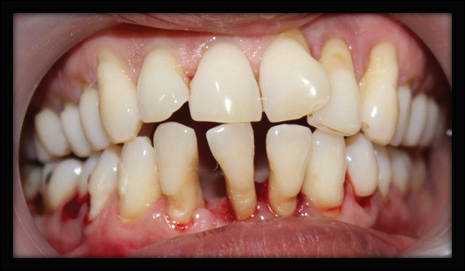
FIGURE 1. Group A (Chlorhexidine Gluconate 1% gel)

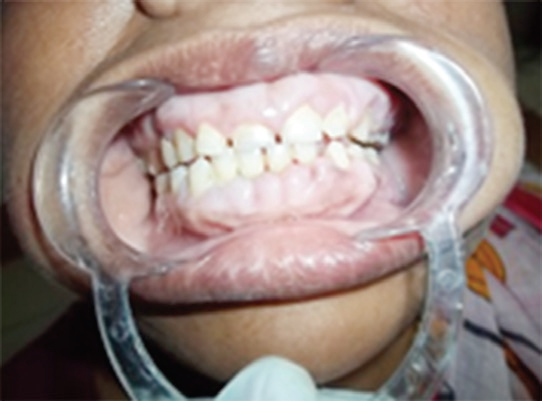
FIGURE 2. Group B (Coenzyme Q10)

RESULTS
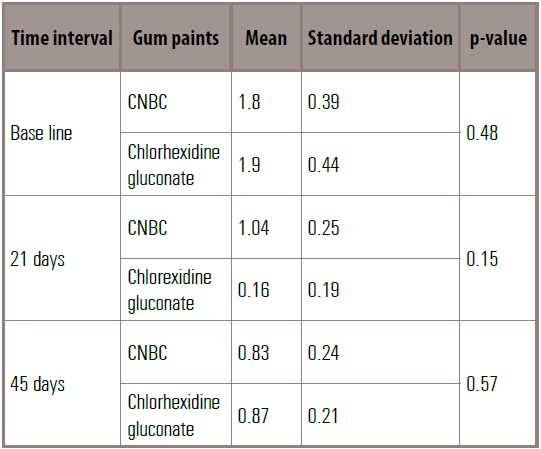
SPSS version 18 was used. The t-test was used to compare the data of test and control sites at baseline,21days and at 45 days. For all the tests a p-value of 0.05 or less was considered for statistical significance. There was a significant reduction in pocket depth in both the group from baseline to the 45 days. All the clinical parameters ie. gingival index, pocket probing depth shows statical significance but on inter group comparision the results were non-significant.
Table no. 1. PROBING DEPTH INDEX
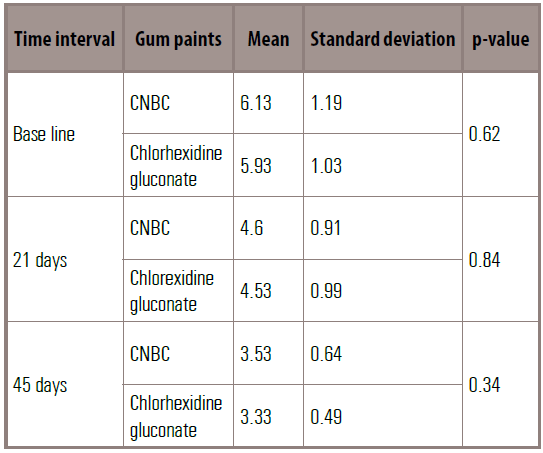
Table No. 2. Gingival INDEX
DISCUSSION
The concept of antioxidant therapy in the treatment of numerous diseases including inflammatory periodontal disease exists in the literature. Because of its function, CoQ10 has received much research attention in a medical literature in the last several years. However, there is a dearth of new information regarding CoQ10 in the treatment of periodontal conditions (7).. The mechanism of Coenzyme Q10 had not been known until Littaru and Kamamura reported its deficiency in patients with periodontal disease.14
CONCLUSION
Co-enzyme Q10 had shown great results in periodontal pockets treatment challenging the chemical agents with its natural properties. This study showed that Co-enzyme Q10 has given equivalent result as compare to that of the benchmark chlorhexidine. It has no known side-effects and hence is safe for use over a long period of time. The clinical parameters significantly improved in the phase of periodontal treatment, indicating that CoQ10 opens new treatment options.
REFRENCES
- Loe h,Theilade E,Jensen SB.Experimental ginigivitis in man.J Periodontal 1965;36(3):177-87.
- Canakci CF, Canacki V, Tatar A, et al. Increased levels of 8-hydroxyguanosine and malondialdehyde and its rela- tionship with antioxidant enzymes in saliva of periodon- titis patients. Eur J Dent 2009; 3:100-6.
- Dhotre PS, Suryakar AN, Bhogade RB. Oxidative Stress in Periodontitis. Eur J Gen Med 2012; 9(2): 81-84.
- Greenwell H, Bissada NF. Emerging concepts in periodontal therapy. Drugs 2002; 62(18): 2581-7.
- Molyneux SL, Florkowski CM, George PM, Pilbrow AP, Frampton CM, Lever MR. Coenzyme Q10 An Independent Predictor of Mortality in Chronic Heart Failure. J the American College of Cardiology JACC 2008; 52(18):1435–41
- Saini R. A clinical and microbiological study to evaluate the effect of dietary supplement of coenzyme Q10 in nonsurgical treatment outcome of chronic periodontitis patients after phase 1 periodontal therapy. European J General Dentistry 2014; 3(3):194-8.
- Chatterjee A, Kandwal A, Singh N and Singh A. Evaluation of Co-Q10 anti- gingivitis effect on plaque induced gingivitis: A randomized controlled clinical trial. J Indian Soc Periodontol 2012; 16(4): 539–42.
- Soni S, Agrawal Pk, Sharma N&Chander S. Coenzyme Q10 and Periodontal Health: A Review, Inter J Oral Maxillofac Pathol 2012; 3(2): 21-6.
- Chaturvedi R. Idiopathic gingival fibromatosis associated with generalized aggressive periodontitis: A case report. J Can Dent Assoc 2009; 75: 291-95.
- L. Flo¨tra,P. Gjermo, G. Rolla, J. Waerhaug, Side effects of chlorhexidine mouthwashes, Scand J Dent Res , 79, 1971, 119-125.
- M. Addy, Chlorhexidine compared with other locally delivered antimicrobials. J ClinPeriodontol, 13,1986, 957–964
- P. Bonesvoll , P. Lökken , G. Rölla, Influence of concentration, time, temperature and pH on the retention of chlorhexidine in the human oral cavity after mouth rinses. Arch Oral Biol, 19, 1974, 1025-1029.
- Winrow M. Metabolic studies with radiolabelled chlorhexidine in animals and man. J Periodont Res, 12, (suppl.), 1973, 45-48
- Littarru GP, Nakamura R, Ho L, Folkers K, Kuzell WC. Deficiency of coenzyme Q10 in gingival tissue from patients with periodontal disease. Proc Natl Acad Sci USA 1971; 68: 2332-5.
Disclaimer from Guident
The views and opinions expressed in articles published in Guident are solely those of the authors and do not necessarily reflect the views of the editors, the editorial board or the publisher, Ivory India. Guident does not endorse any product, technique or treatment described. Clinical content is intended for qualified dental and medical professionals and is not a substitute for individual clinical judgement. Guident, its editors and the publisher accept no liability for any consequence arising from the use of information published in the journal.
How to cite this article
Dr. Aditi Bhalla, Dr. Jithendra K.D, Dr. Shailendra Singh. Co-Enzyme Q10:-Another Armour for Novel Periodontal Therapy. Guident. 2019 Apr;12(5). Available from: https://guident.in/articles/periodontics/co-enzyme-q10-another-armour-for-novel-periodontal-therapy.html