Retrieval of Fractured Abutment Screw : An Insight
Department of Prossthodontics, K.D Dental College & Hospital, Mathura, India
Implant therapy is a reliable and predictable treatment for partially and completely edentulous patients and is gaining tremendous popularity and interest amongst patients and dentists.1
Although the overall success rate of implant dentistry is very high, more than 90 per cent of the treatment modality is not free of complications and failures.2
COMPLICATIONS ASSOCIATED WITH IMPLANT TREATMENT
Complications have been defined as secondary conditions that develop during implant surgery or placement of the prosthesis and can be mechanical, biologic, esthetic or phonetic.3
MECHANICAL COMPLICATIONS
Mechanical complications include4
- crown fractures,
- framework fractures,
3.) problems of retention,
4.) screw loosening and
5.) screw fracture
BIOLOGICAL COMPLICATIONS
Biological factors include unsuccessful osseointegration or the presence of peri-implantitis
Failures of implant-supported restorations result from technical problems and can be divided into two groups:3
1) related to the implant components
2) relating to the prosthesis
Fracture of implant components may occur due to fatigue from:
1. biomechanical overload,
2. improper placement techniques,
3.non passive fit of the suprastructures,
4.manufacturing errors
It has been reported that abutment screw or prosthesis screw loosening as the most frequent mechanical complication.The primary reason for screw fracture is undetected screw loosening, which can be due to bruxism, an ill-fitting superstructure, or overloading.3
Screw loosening occurs when compressive occlusal forces are higher than the tension in the screw-implant assembly that holds the components together. Screw loosening is more often associated with single-unit restorations.5 Implants with a butt-joint and external hex connection to the abutment are especially prone to screw loosening when compared with internal taper / cone joints with an anti-rotation feature.2
The subsequent complications from screw loosening that can ensue include screw fracture, dislodgement of the prosthesis or failure of the implant. It has been proposed that the fit of the prosthesis should be such that when a screw is tightened with a torque device, the screw should rotate only about a quarter of a turn (90°).
If a screw loosens and the problem is not corrected early, it can break in one of two ways: the ‘favorable’ way or the ‘unfavorable’ way.
‘favorable way’-The favorable way is when the threads are not binding and the fragment is loose, this allows for easier retrieval.
‘ unfavorable way’- is when the fragment threads bind due to deformation, structural damage or thread locking compounds, this requires extreme care and effort for retrieval.5
Once an abutment fracture has occurred, the fractured screw segment inside the implant must be removed. Otherwise, the implant may remain osseointegrated but will lose its ability to retain the prosthesis, so that the existing prosthodontic restoration can no longer be used.
Various treatment modalities available are as follows:
- A rotary motor with a carbide bur5
- using a spoon excavator2
- using endodontic instrument6
- using ultrasonic scaler3
- using easily available dental instrument4
- Post and core1
- Using a cotton driver7
- Various retrieval instruments.5
- Salvaging an implant-supported single restoration that has a nonretrievable implant screw fragment.8
- Using laser5
- Using implant repair kit9
The methods employed to grasp the broken fragments or screw are determined according to the location of the fracture abutment screw above or below the head of the implant. If an abutment screw fractures above the head of the implant, an explorer, a straight probe or haemostats might be successful surface of the screw segment until it loosens. If the screw fracture occurs below the head of the implant, other methods are required. There are several available implant repair kits: Dental Implant System, consists of drills, two drill guides and six manual tapping instruments. TwinPlus Implant System DENTSPLY etc
-
A Rotary Motor with a Carbide Bur
A number of methods are described for removal of a fractured screw segment
System for screw fragment removal includes the following parts(Fig1):
• A manual centering device that fits the internal connection of an implant
• A deeper centering device
• A reverse carbide cutting drill
• A claw reamer bur
• An extension holder5

Fig 1: Components of a typical commercial screw removal system
2.USING A SPOON EXCAVATOR
Parth Satwalekar et al described a technique to retrieve the fractured screw fragment by using a spoon excavator.The screw spoon excavator was modified by cutting working end of the instrument perpendicularly to serve the purpose.The abutment screw was broken at the starting point of the threads on the screw so a groove was made on the upper end of the broken screw using a airoter without damaging the internal anatomy of the implant.The prepared groove provided the proper slot for the removal of screw. (Fig 2).New abutment screw was then placed and seating confirmed radio-graphically prior to final tightening2
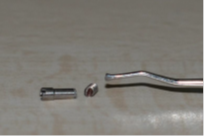
Fig 2:Retrieved fractured abutment screw and the modified end of the spoon excavator used for the procedure.
3.USING ENDODONTIC INSTRUMENTS
This technique was described by J. Satterthwaite and L. Rickman. This technique was used when the fixture head was clear .When visualised through a clinical microscope ,a portion of the screw-thread of the abutment fractured was away from the body of the screw and was retained within the implant. It was removed using endodontic instruments.6(Fig 3a,b)
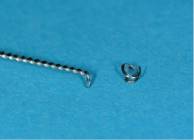
Fig 3a):Endodontic file used to retrieve fractured abutment screw
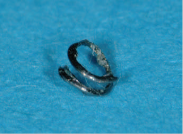
Fig3b)Fractured thread removed from implant
4.USING A MODIFIED TECHNIQUE WITH AN ULTRASONIC SCALER
Manpreet S Walia et al described this technique to retrieve a fractured screw . In this an access hole was made occlusally through the crown by a Tri Hawk carbide bur to access the screw head and retrieve the crown along with the abutment. A notch on the occlusal surface of abutment screw between the center of the screw and its periphery was made by fine tapered carbide bur for the mechanical interlocking of scaler tip and screw head.Care was taken not to touch the internal threads of the implant with the bur, and at the same time the notch was not at the center. An ultrasonic scaler tip was then inserted into the implant and was made to engage the notch created. The ultrasonic scaler was started at a very low speed, and mechanically the tip of the scaler was moved counterclockwise to retrieve the abutment screw.3(Fig 4)
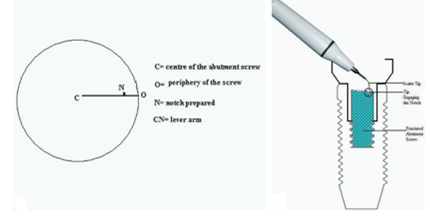
Fig 4 Use of ultrasonic scaler for retrieving screw
5.USING EASILY AVAILABLE DENTAL INSTRUMENTS
Litty Francis et al described how to retrieve a fractured abutment screw using an easily available dental instruments.In this fractured segment was within and below the head of the implant and other half of the fractured screw along with the abutment was in the dislodged crown.A fine ultrasonic endodontic tip was placed on the screw and vibrated at a low setting. This caused the screw to move .A very small round bur was placed on the screw face and rotated at a medium speed in an anticlockwise direction to place a dimple .After the depression was created, a bur head was shaped to form a screwdriver head. The depression helped to position it centrally on the screw. Friction, from the anticlockwise rotation of the screwdriver end, moved the screw anticlockwise and this made it come out of the implant.7
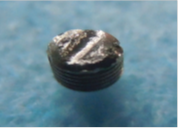
Fig 5 Screw segment showing the groove
6.USING POST AND CORE
K Harshkumar et al used post and core to salvage an implant with abutment screw fracture. In this the abutment screw fracture was below the level of implant head.The internal threads of the impant was eliminated using a tungsten carbide bur (170 L) in a high speed air rotor handpiece under copious saline irrigation .
Coronal fragment of the fractured segment was removed using a 8mm round ended tapered diamond and carbide bur to provide space for sufficient length of post.An acrylic resin pattern for the post was fabricated directly in the post space with an autopolymerizing acrylic resin and plastic pin using a brush-on technique.(Fig 6a,b)
Care was taken to prevent locking of the pattern in the screw hole by removing it before it was completely polymerized. After the polymerization was completed, the pattern was replaced and the core portion was fabricated with resin, trimmed, finished and polished to appropriate length and shape.
The pattern was sent to the lab for fabrication of titanium cast post and core(Fig 6c)
The titanium dowel core was tried in the screw hole. It was cemented into the implant using zinc phosphate cement. The crown was cemented after eliminating the interferences in all protrusive and lateral excursive movements.1
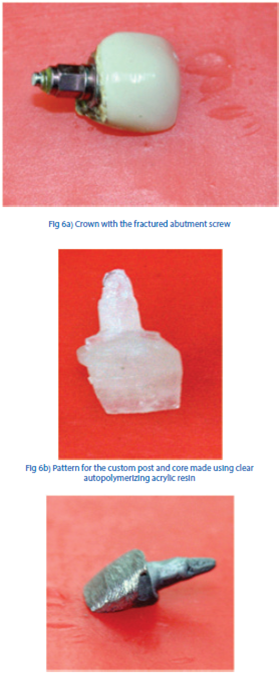
Fig 6c)Custom post and core
7.Using a cotton driver
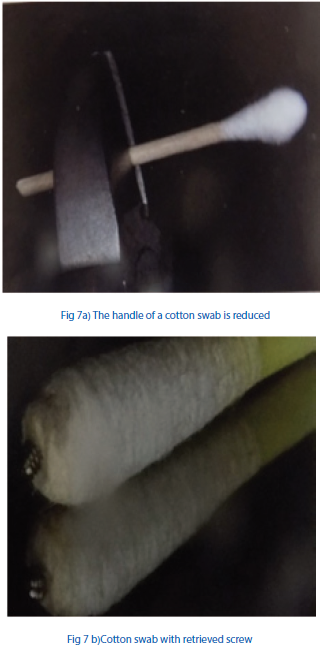
The level of the screw fractured is verified by directly examining the remaining fragment or with magnification if necessary. If the fracture level is low , an explorer with counterclockwise movements is used to raise the screw fragment closer to the implant platform level.The handle of a cotton swab is reduced so that it is short enough to be used vertically as a screwdriver. Now the cotton swab is pressed into the implant head and twististed slowly counterclockwise.(Fig 7a,b)In case of unsuccessful retrieval , the screw fragment is vibrated with an ultrasonic device under copious irrigation and the procedure is tried again. Now the retrieved screw to make sure no other fragments remain in the screw chamber.7
8.Various Retrieval Instruments
Decision for abutment screw retrieval should be made as follows:
If abutment fractures at screw head then hemostat/ pliers are used.
• If it is not fractured at screw head then,
– If the fragment is rotatable then abutment screw remover is used.
– If it is not rotable then reverse drilling instruments are used.
Abutment Screw Remover
It is a basic procedure. It has following steps:
• Select abutment screw remover: Appropriate abutment screw remover should be attached to the handpiece.
• Remove the screw: To remove the screw shaft from implant, the end of the abutment screw is placed onto the fractured screw and is rotated counterclockwise while applying light pressure at maximum speed of 50 rpm.
Reverse Drilling Instruments
It is an advanced procedure with following steps :
Proper rescue drill guide is selected and is attached to the handle and is then connected to the interface of the implant. The rescue drill guide helped in the abutment screw retrieval during reverse drill on the screw.Appropriate abutment screw retrieval reverse drill is selected and
a hole of approximately 1 mm is drilled into the fractured screw at a speed of 2000 rpm with generous cooling.The abutment screw is loosened and is connected with retrieval instrument
The abutment/clinical screw is then removed.The implant threads are cleaned at 50 rpm.(Fig 8a,b)5

Fig 8a ) Reverse drilling procedure: Reverse drilling and screw removing
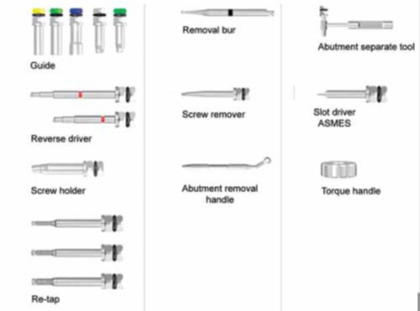
Fig 8 b) Abutment screw retrieval kit
9.Salvaging an implant-supported single restoration that has a nonretrievable implant screw fragment
PROCEDURE
The coronal fragment of the implant screw is removed. A new implant screw and a flat stainless washer (620C stainless washers; #0 Flat Washer SS, .099, .063, .016;)is selected (Fig 9).The screw head and the thread diameter with a Boley gauge is measured. The washer’s external diameter should not be larger than the screw head’s diameter and that the internal diameter of the washer should be large enough for the screw threads to go through it.
The restoration is hand tightened using 1 washer around the new screw(Fig 9), and is checked if the screw meets resistance and stops turning. If the restoration is not tightly engaged on the implant, additional washers are used until a tight engagement is achieved between the restoration and the implant.Once the restoration is secured on the implant, the screw is torqued with a torque wrench, following the manufacturer’s instructions, to finalize the seating of the restoration on the implant. A piece of cotton on top of the screw head is placed and the access hole is sealed with a temporary restorative material (Fermit, IvoclarVivadent, Schaan, Liechtenstein) or with a composite resin restorative material.8
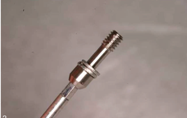
Fig 9) Washers on the new implant screw.
10. ER:YAG LASER
A ‘V’ shape incision was made with the Er:YAG laser with wavelength 2,940 .Broken abutment screw was seen on radiograph. V’ shaped incision was given by laser.The buccal and palatal flaps were lifted and the area was explored, there was granulation tissue around the neck of the implant.The granulation tissue was ablated using the laser. The broken hexagon slot was straightened, using a round diamond bur and the head of the implant was rendered smooth. A slot was created with a surgical drill on the head of the fractured screw .Screwdriver was successfully used to unscrew the broken abutment screw.(Fig 10) Decortication of the buccal bone was then performed. A new abutment was then inserted into the implant.The mucoperiosteal flap was re-positioned and sutured.5
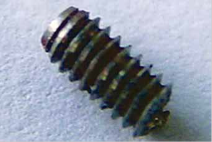
Fig 10) Retrieved screw fragment
11. using an implant repair kit.
Ilser Turkyilmaz described a technique in which a fractured locater abutment screw fragment was successfully removed using an implant repair kit.
An implant repair kit (ITI Dental Implant System; Institute Straumann AG, Waldenburg, Switzerland) including an initial drill, 2 instrument guides, and 3 manual tapping instruments was used according to the manufacturer’s instructions. After the first drill guide was inserted on the implant, the corresponding initial twist drill with diameter of 1.3 mm was used to perforate the screw fragment centrally, rotating clockwise at a maximum speed of 800 rpm under copious irrigation with standard saline solution . The drill guide was stabilized in position directly on the top of the implant to allow strong axial preparation, which helped not to damage the internal aspect of the implant body during drilling. The manual tapping instruments to retrieve the fragment were coated with vaseline and inserted into the hole drilled into the fragment through an additional larger diameter guide . The fragment was taken out under gradual manual rotation. If the threads inside the implants are damaged, they are recut with the successive manual tapping instruments. The inner wall of the implant body was rinsed with saline solution and evaluated thoroughly. The implant screw hole was flushed with an air/water spray, and dried with air. A new locater abutment was inserted on the implant and tightened with 30 Ncm of torque. The implant has been salvaged and the patient returned to her dentist for a mandibular overdenture treatment.(Fig 11a,b)9
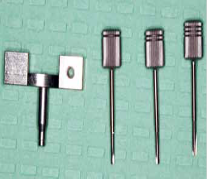
Fig11 a)Drill guide and tapping instruments
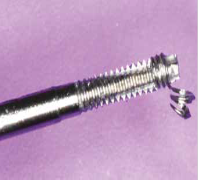
Fig11b) Remaining fractured locater abutment screw fragment
CONCLUSION
Abutment screw fracture is a complication, which may occur during rehabilitation of the implant. Various management modalities regarding retrieval of fractured screw and subsequent restorations of such cases have been presented in this review article.
REFERENCES
1.)K Harshakumar et al Salvaging an Implant with Abutment Screw Fracture by a Custom Titanium Post and Core Supported Prosthesis - A Novel Technique. International Journal of Scientifi c Study ;2014; 2
2.)Parth Satwalekar et al A Simple and Cost Effective Method used for Removal of a Fractured Implant Abutment Screw: A Case Report; Journal of International Oral Health. Sept- Oct 2013; 5(5):120-3
3.)Manpreet S. Walia et al Removal of Fractured Dental Implant Screw Using a New Technique: A Case Report; Journal of Oral Implantology;2012;38
4.) Litty Francis et al Implant screw fracture; Journal of Dental Implants;2013;3
5.) Siddharth Priyadarshi et al Various Treatment Modalities for Retrieval of Broken
Abutment Screw in Implant Prosthodontics; Int J Clin Implant Dent 2015;1(2):60-65.
6.) J. Satterthwaite and L. Rickman ;Retrieval of a fractured abutment screw thread from an implant: a case report; British Dental Journal;2007; 204
7.) Joao Malta Barbosa et al.The Cotton Driver : An Alternative Technique for Removing Fractured Screw Segment;J Prosth Dent;2013
8.) Burak Yilmaz, and Edwin McGlumphy; A Technique to Salvage a Single Implant-Supported Fixed Dental Prosthesis Having a Nonretrievable Implant Screw Fragment; Journal of Oral Implantology;2013;39
9) Ilser Turkyilmaz et al Removal of a Fractured Locator Abutment Screw Fragment; J Contemp Dent Pract 2013;14(5):968-972.
Disclaimer from Guident
The views and opinions expressed in articles published in Guident are solely those of the authors and do not necessarily reflect the views of the editors, the editorial board or the publisher, Ivory India. Guident does not endorse any product, technique or treatment described. Clinical content is intended for qualified dental and medical professionals and is not a substitute for individual clinical judgement. Guident, its editors and the publisher accept no liability for any consequence arising from the use of information published in the journal.
How to cite this article
Dr. Manesh Lahori, Dr. Shipa Arora, Dr. Lijo Mathew. Retrieval of Fractured Abutment Screw : An Insight. Guident. 2016 May;9(6). Available from: https://guident.in/articles/implantology/retrieval-of-fractured-abutment-screw-an-insight.html