Cortico Basal Implantology-Today: A Case Report
Chief Clinician, V. K Dental, Bangalore, Bangalore, KAR. India
INTRODUCTION
Basal Implants are an advanced implantology system which utilizes the deep and highly mineralized portion of the jaw bone, called basal or cortical bone, for the retention of the dental implants. Basal implants are made of a single piece of Titanium metal uniquely designed to be accommodated in the basal (cortical) bone areas. The basal bone area provides excellent bone quality for the retention and long-term viability of these unique and highly advanced implants. The teeth are usually situated in the less dense bone portions of the jaw bone called the Alveolar bone. This less dense Alveolar bone will gradually recede once the teeth are lost In contrast the basal bone is less prone to resorption and infections. It is highly dense and offers excellent support to implants. Basal implants are considered to be the best choice for individuals with moderate or severe bone loss and atrophy of the jaw without the necessity for Bone Graft or Sinus Lift.

Picture showing the alveolar bone, Cortical bone and basal bone
Basal implants are the most advanced implants, successful for any condition of bone. It can be used on patients with any bone density and any bone volume. These implants engage the highly dense cortical bone which has least propensity for resorption. Basal-bone is present in everyone, despite severe bone loss due to gum disease or loss of teeth. As such, they are highly recommended for patients who are in need of bone grafts .
CONCEPT OF THE TECHNOLOGY
From a technical perspective, the treatment approach associated with corticobasal implantology mirrors the procedures conducted in osteosynthesis, maxillofacial traumatology, and orthopedic surgery. Unlike traditional dental implants that aim for "osseointegration," corticobasal implants are secured within cortical bone by the surgeon, with their success not contingent on osseointegration. Nonetheless, osseointegration may gradually occur over time, involving all endosseous implant components.
Consequently, it is impractical to apply the standards, indications, and contraindications of conventional dental implantology directly to corticobasal implant treatment. Rather, it is more rational to align the principles of traumatology and orthopedic surgery with corticobasal dental implantology. By making this adjustment, a set of new, explicit, and coherent regulations and recommendations specific to such implants emerge, warranting their application in practice.
KEY BENEFITS OF THE PROCEDURE
The primary advantage of Cortico-Basal implantolog lies in its streamlined approach:
- Minimally Invasive Procedure: This method eliminates the need for incisions, resulting in a swift and clean process with minimal bleeding, no cuts, and no stitches required.
- Treatment Feasibility: It is effective even in cases with minimal bone structure, a scenario often challenging for traditional implants.
- Immediate Functional Loading: Patients can resume eating within 3-5 days post-implant placement, eliminating prolonged waiting periods.
- Reduced Infection Risk: The cortico basal implantology approach significantly lowers the chances of peri-implantitis, reducing the risk of post-implant infections.
- Avoidance of Complex Procedures: Bone grafting and intricate surgeries are unnecessary with cortical implantology, as it leverages the patient's existing bone structure, minimizing complications and costs.
- Minimal Discomfort: Due to its minimally invasive nature, patients experience reduced post-procedural symptoms like pain and swelling.
- Suitability for Diabetic and Heavy Smoker Patients: cortical implants can be successfully utilized in patients with diabetes or heavy smoking habits.
PERIODONATL DIASEASE - CORTICO BASAL IMPLANTS AND TISSUE ADOPTABALITY
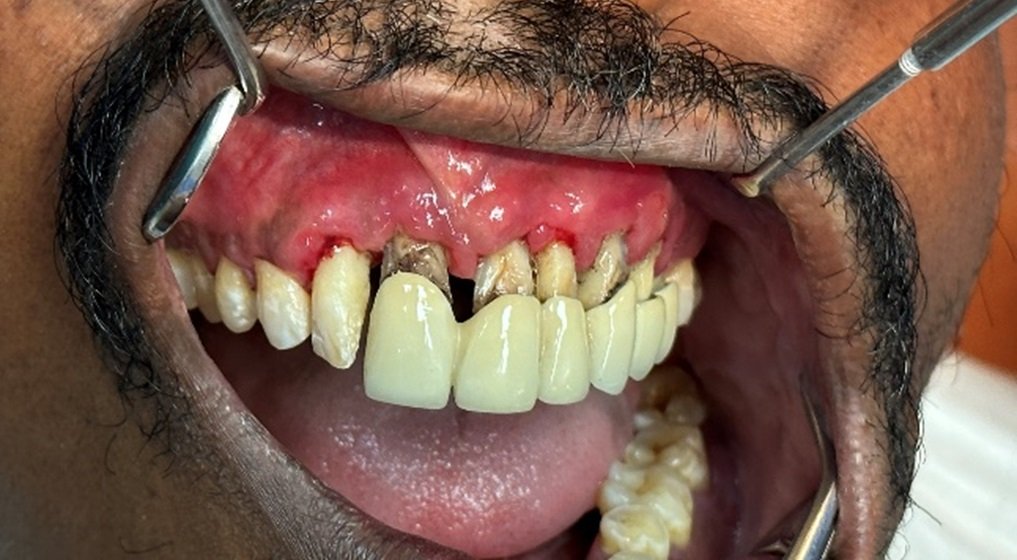
Severe Periodontal Disease
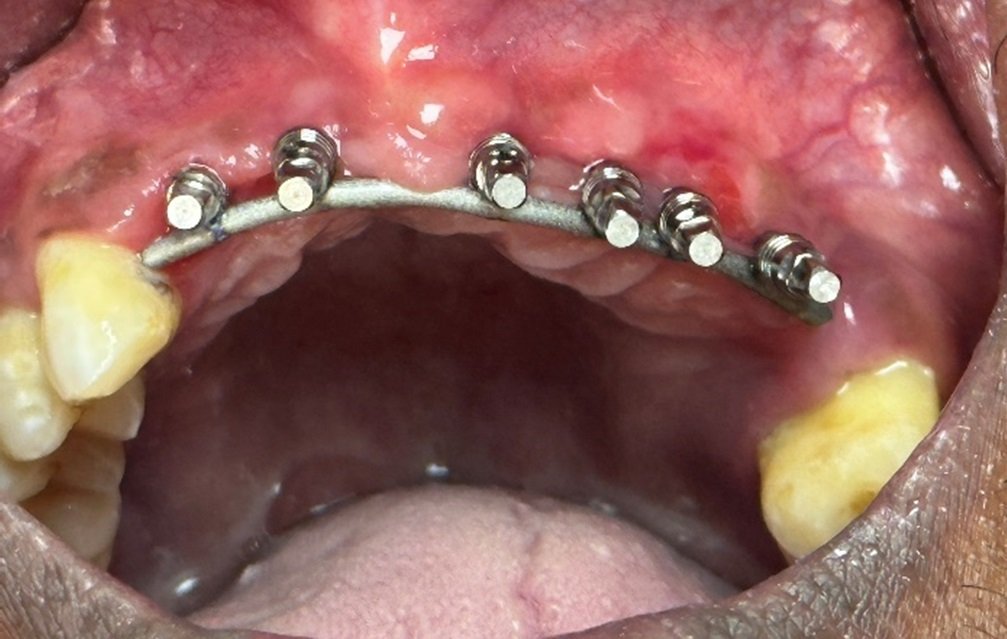
Post 3 Months Situation for The Same Patient

PMMA fabricated with digital lab flow inserted immediately after the surgery and exchanged later again after 3months
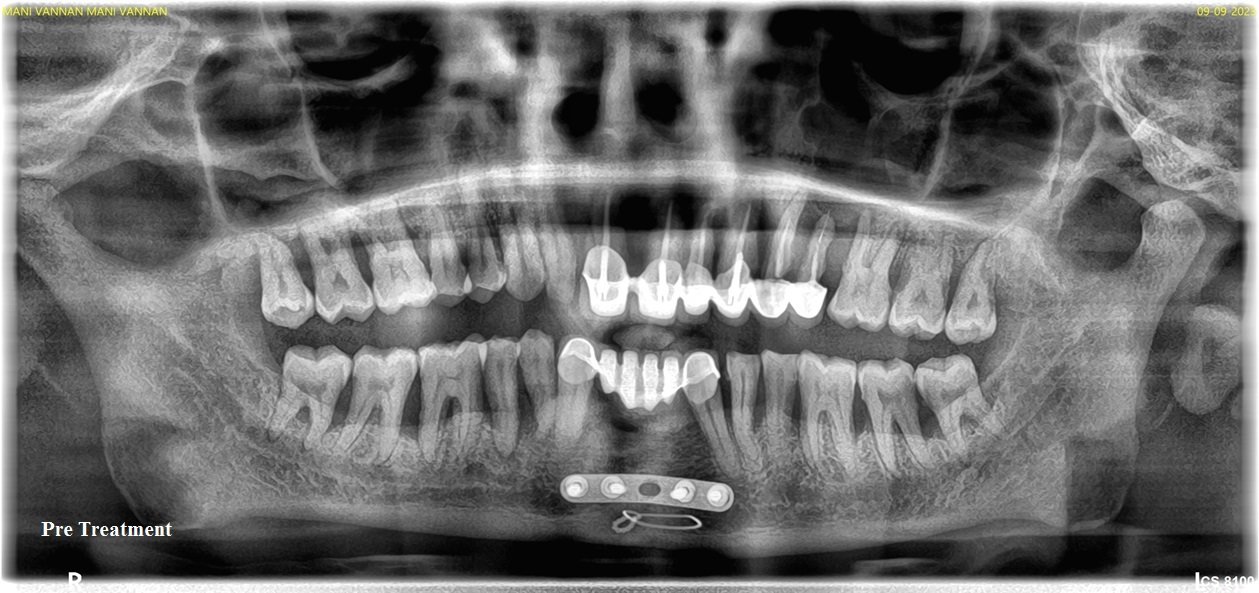

OPG -Pre Treatment and Post Treatment

Smile Restored and from the day one after the extractions were done patient was immediately given a functional loading prosthesis
RATIONALE BEYOND CHOOSING THIS PROSTHESIS
The patient is diagnosed with advanced periodontal disease necessitating extensive tooth extraction and dental implants. However, the patient declined this comprehensive treatment plan and opted solely for the replacement of anterior teeth. This scenario poses a challenge for the clinician, given the future need for additional extractions and subsequent implant placements. To address this, a pragmatic approach involving the utilization of PMMA-based prostheses was chosen. This choice allows for easy removal and replacement as more implants are integrated, facilitated by the process of syncretization or intraoral welding. This method ensures cost-effectiveness in removals and guarantees the safety of implants by providing rigid stabilization to withstand immediate functional demands.
Disclaimer from Guident
The views and opinions expressed in articles published in Guident are solely those of the authors and do not necessarily reflect the views of the editors, the editorial board or the publisher, Ivory India. Guident does not endorse any product, technique or treatment described. Clinical content is intended for qualified dental and medical professionals and is not a substitute for individual clinical judgement. Guident, its editors and the publisher accept no liability for any consequence arising from the use of information published in the journal.
How to cite this article
Dr. Veerendrakumar SC., Prof. Dr. Ulhas Amasi. Cortico Basal Implantology-Today: A Case Report. Guident. 2024 Apr;17(5). Available from: https://guident.in/articles/implantology/cortico-basal-implantology-today-a-case-report.html