Resin Cements - Simplified
Department of Prosthodontics MIDSR Dental College, Latur, India
ABSTRACT
One of the big changes in recent years has been the development of all-in-one resin cements. Because of the large number of systems, the dental team faces questions and decisions when choosing the appropriate system and the appropriate means of cementation. This article provides information on resin cements that can guide clinicians in determining which type of cement is best suited to their clinical needs regarding cementation of indirect restorations.
INTRODUCTION
Resin luting agents are unique in that polymer matrix forms to fill and seal the tooth restoration gap whereas other luting agents are true cements derived from mixing powder and liquid which form a hydrogel matrix.1 Methyl methacrylate based resin luting agents appeared in early 1950s, they did not adhere to tooth structure, underwent consid-erable polymerization shrinkage, had high COTE and absorbed water which contributed to micro leakage at tooth resin interface and excess removal was difficult.2 The only superior property was extremely low solubility.Modern resin cements are huge part of today’s dental market due to their versatility, high compressive and tensile strength, low solubility and very favourable aesthetic qualities. Their major shortcomings are difficult excess removal, technique sensitive, relatively expensive per unit.
Its chemistry is similar to resin based composite direct filing whereby a silver or glass particle filled matrix seals and provides mechanical retention for restoration. If tooth is etched and bonding agent is used and restore is etched or air abraded the retention becomes micromechanical which takes greater advantage of resins high mechanical strength.
Resin luting agents are used for bonding aesthetic all ceramic or lab processed resin restorations or veneers ,for luting metal on metal ceramic restoration to tooth preparation that have reduced retention and resistance form (i.e. short tapered crown preparation or resin bonded FPD ) and for post cementation in endodontically treated teeth.)
Resin cements used today are composed of resin matrix of bisgma or methacrylate and filler of five inorganic particles (20-80%).to ensure thin film thickness.3 They are available as P/L, encapsulated or paste system and are classi-fied into 3 types based on polymerization as –chemical, light cured and dual cured.
ADVANTAGES
- Superior compressive and tensile strength (20-50Mpa) with low solubility
- Micromechanical bonding to prepare enamel, dentin, alloys and ceramic surface.
- Available in wide range of shades ad translucencies.
DISADVANTAGES
- Meticulous and critical manipulation technique
- High film thickness
- Marginal leakage due to polymerization shrinkage
- Severe pulpal reactions when applied to cut vital dentin
- Offers no fluoride release or uptake
- Low modulus of elasticity, so cannot support long span prosthesis
- Difficulty in removing hardened excess resin cement from inaccessible areas thus not used in sub gingival margin.
- Use of eugenol based provisional luting agents inhibits complete polymerization of resin cements.4
- Due to low early bond strength and maturation period of 24 hrs. , patient is advised to avoid loading restoration with chemically cured resin immediately after cementation.
RESIN CEMENT CLASSIFICATION
Resin cements may be classified according to their polymerization mechanisms or according by their adhesive scheme.5According to polymerization
• Light cured
• Chemical cured
• Dual cured
According to adhesive scheme
• Total etch
• Self-etching
• Self-adhesive (all in one cement or universal cement)
1) Light cure resin cements
- Curing method –photo initiation ,activated by light
- Characteristics –
- Increased working time.
- decreased finishing time.
- color stability.
- Aesthetic restoration.
- Metal free restoration.
- Cementing thin translucent ceramic.6
Examples:- RelyX™ Veneer Cement (3M ESPE) ,Variolink® Veneer (Ivoclar Vivadent Inc.), Choice™ 2 Light-Cured Veneer Cement (BISCO, Inc.)

2) Dual cure
- Curing method –chemicals and light
- Characteristic- bond strength, aesthetics, ease of use
Examples:- NX3 Nexus® Third Generation (Kerr Corporation), RelyX™ ARC Adhesive Resin Cement (3M ES-PE), Variolink® II (Ivoclar Vivadent Inc.)

3) Chemical cure
- Curing – chemical reaction of 2 materials mixed (self-curing )
- Characteristics – useful in areas where light curing is difficult.7
Indications– metal restoration, endodontic posts, ceramic restoration that prohibit luting cement from pol-ymerizing resin cement.
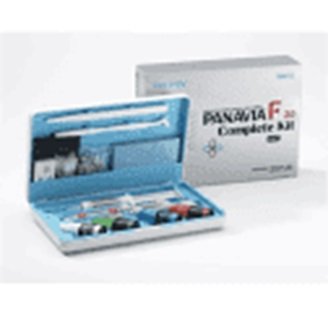
Examples:- Panavia™ (Kuraray Dental), C&B™ Cement (BISCO, Inc.).
4) Total etch
- Adhesive scheme -30 -40% phosphoric acid etch , removes smear layer, then adhesive is applied.
- Characteristics – excellent cement to tooth bod strength, reduced micro leakage, long term predictability, requires multi step application technique
Examples:- RelyX ARC (3M ESPE), Variolink II, Choice 2, Calibra (dentsply)

5) Self-etch
Self etching primer, then mixed cement applied
Characteristic – ease of use, less technique sensitive
Good bond strength (but weaker than total etch).8
6) Self-adhesive
These cements contain phosphoric acid, which is grafted into the resin.
Characteristic:- able to bond to untreated tooth surface
Selective etching can be incorporated for improved bond strength
Note :- Because self-adhesive cements bond to tooth structure, excess cement should be removed before setting to avoid damaging weaker early bond
Disadvantage :- dual cured reduced stress, decreased colour stability and wear resistance.
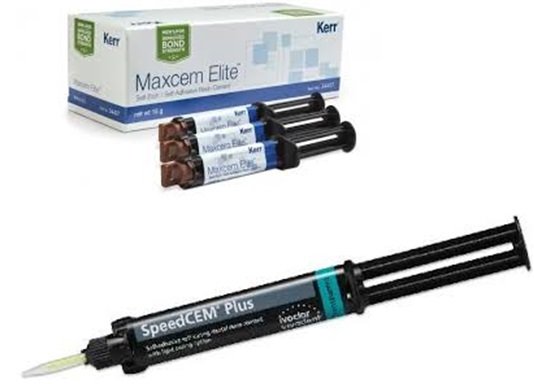
Examples:- RelyX™ Unicem (3M ESPE), BisCem® (BISCO, Inc.), Maxcem Elite™ (Kerr Corporation), SpeedCEM™ (Ivoclar Vivadent Inc.).
COMPOSITION OF RESIN CEMENTS
1) Rely Arc – primer:- water, HEMA copolymer of acrylic and itaconic acid
Activator:- ethyl alcohol, sodium benzene sulfonate
Catalyst – bis GMA, HEMA, benzyl peroxide
Rely Arc:- paste A silane treated ceramic ; TegDMA, bis GMA, silane treated silica .
Paste B:- silane treated ceramic, bisGMA, functionalized dimethacrylte polymer

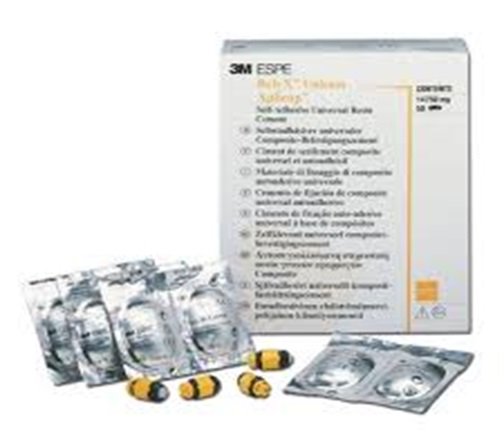
2) Rely Unicem (capsules) :- Liquid –methacrylate phosphoric acid esters, TEGDMA
Powder – silane treated silica, Ca(OH)2 substitute pyrimidine, sodium persulphate
3) Clear filesthetic cement :- Liquid –HEMA, BISGMA, DIBENZOYL PEROXIDE, camphoroquinie, initiators
Paste A and B: bisGMA TEGDMA silinated silica, hydrophobic aromatic dimethacrylate, silinated barium glass filler, colloidal silica, accelerators, pigments

4) Clearfil SA cement :- Paste A and Paste B – bisGMA, sodium fluoride, TEGDMA, hydrophobic aro-matic dimethacrylate aliphatic dimethacryate, silinatd colloidal silica, camphoroquinone, initiator, catalyst, pigments

5) Smart Cem 2 : urethane dimethacrylate, di and trimethacrylate resin, phosphoric acid, modified acry-late resin, phosphoric acid modified acrylate resin, initiators, accelerators, UV stabilizer, barium baron fluoroaluminoslicate glass

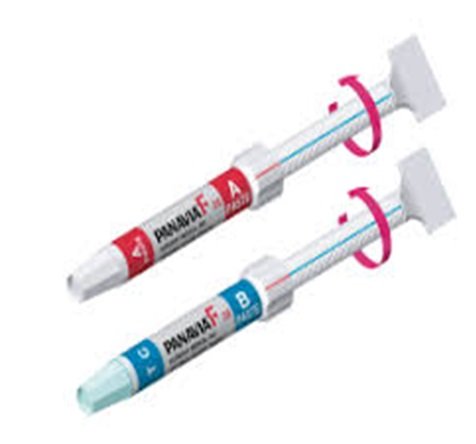
6) Panavia F 2:- Paste A :- BPEDMA / 10 –methacryloxydecyl dihydrogen phosphate
Paste B: - Al-Ba-B-Si-glass / silica containing composite
7) Duo link– BisGMA, urethane dimethacrylate, triethylene glyoldimethacrylate, glass filler
Others: - Speed Cem, Max Cem Elite, Bis Cem Rely X U 100, Rely X Unicem

APPLICATION OF RESIN CEMENTS
All ceramic crowns, bridges, inlay, onlay, veneers, cast alloy crown and bridge, ceramo-metal crown and bridge, high strength ceramic, implant supported crow and bridge, fiber post, cast metal post.Additional Clinical Consideration:-
When using resin based cements, internal surface of restoration must be treated with hydrofluoric acid, sandblasting and silanization and surface of tooth with phosphoric acid.9- Self etched total etch resin have adequate marginal adaptation compared to GIC and RMGIC, Zn PO4.
Self-adhesive cements are dual cured and have reduced bond strength, color stability, wear resistance, hence should be light activated at accessible restorative margin to improve marginal integrity, wear resistance and reduced staining .
Presence of H2O at interface between adhesive and cement compromise total bonded area and proper polymerization of cement. Water droplets may accumulate at interface and may function as stress raisers, leading to failure of adhesive cement interface.10 This permeability problem could be solved by application of an intermediate layer of relatively more hydrophobic, non-acidic, low viscosity resin separating acidic layer of adhesive form composite resin, however this layer may create a thick film which may be concern during cementation of esthetic restoration.
PROPERTIES
- Compressive strength:- 180 Mpa
- Tensile Strength:- 30 Mpa
- Film thickness:-10-25um
- Biological properties:- irritating to pulp protection with GIC or Ca (OH) 2 liner necessary for areas close to pulp.
- Solubility:- Insoluble in oral fluid
- Polyshrinkage – High
- Bond strength to enamel – 7.4Mpa
REFERENCES
- Hill EE, Lott J. A clinically focused discussion of luting materials. Aust Dent J. 2011 Jun;56 Suppl 1:67-76.
- RW Phillips, ML Swartz, RD Norman. Materials for the practicing dentist. St Louis:Mosby. 1969:53–54.
- Ladha, K., Verma, M. Conventional and Contemporary Luting Cements: An Overview. J Indian Prosthodont Soc 10, 79–88 (2010).
- EE Hill, B Rubel. Vital tooth cleaning for cementation of indirect restorations: a review. Gen Dent. 2009;57:392–395.
- Burgess JO, Ghuman T, Cakir D. Self-adhesive resin cements. J Esthet Restor Dent. 2010;22(6):412-419.
- Stamatacos C, Simon JF. Cementation of indirect restorations: an overview of resin cements. Compendium of Continuing Education in Dentistry (Jamesburg, N.J. : 1995). 2013 Jan;34(1):42-4, 46.
- Simon JF, Darnell LA. Considerations for proper selection of dental cements. Compend Contin Educ Dent. 2012;33(1):28-36.
- Cekic I, Ergun G, Lassila LV, Vallittu PK. Ceramic-dentin bonding: effect of adhesive systems and light-curing units. J Adhes Dent. 2007;9(1):17-23.
- Peumans M, Van Meerbeek BV, Lambrechts P, Vanherle G. Porcelain veneers: a review of the literature. J Dent. 2000;28(3):163-177.
- Manso AP, Silva NR, Bonfante EA, Pegoraro TA, Dias RA, Carvalho RM. Cements and adhesives for all-ceramic restorations. Dent Clin North Am. 2011 Apr;55(2):311-32.
Disclaimer from Guident
The views and opinions expressed in articles published in Guident are solely those of the authors and do not necessarily reflect the views of the editors, the editorial board or the publisher, Ivory India. Guident does not endorse any product, technique or treatment described. Clinical content is intended for qualified dental and medical professionals and is not a substitute for individual clinical judgement. Guident, its editors and the publisher accept no liability for any consequence arising from the use of information published in the journal.
How to cite this article
Dr. Rashmi R. Shah. Resin Cements - Simplified. Guident. 2021 Feb;14(3). Available from: https://guident.in/articles/general/resin-cements-simplified.html