
Vital Pulp Therapy Using Mineral Trioxide Aggregate-a Conservative Approach
Department of Conservative Dentistry & Edodontics K.D Dental College & Hospital, Mathura
INTRODUCTION
Vital pulp therapies aim to maintain tooth vitality, and functionality and to render the tooth asymptomatic. Pulpotomy is a procedure in which the coronal pulp that presumed to be inflamed and/or infected is removed, and the remaining radicular dental pulp is covered at the orifices with a suitable material that protects the pulp from further injury and permits and promotes healing.1Traditionally, the term "pulpotomy" has implied removal of the pulpal tissue to the cervical line, to be differentiated from “Cvek type” pulpotomy or “partial pulpotomy” in which just a portion of the coronal pulp is removed.2
The best root canal filling is the healthy pulp tissue, and it should not be assumed that every damaged pulp must be extirpated and that pulp conservation is not satisfactory procedure. MTA has attracted attention since its introduction to the field of endodontics.3 It has a lot of advantages compared to other conventional endodontic materials; e.g. its excellent sealing ability, biocompatibility, dentin bridge formation in cases of pulp capping and pulpotomyin addition to inducing proliferation of the pulpal cells.4 Although many studies showed that MTA is the material of choice for vital pulp therapy in primary and permanent teeth, other studies found no significant differences.5
CASE REPORT
An 18-year-old female patient reported to the Department of Conservative Dentistry and Endodonticswith a chief complaint of decayed tooth in left lower back region since 6 months. The tooth was not tender on percussion, and vitality testing showing positive response. The patient’s medical history was unremarkable. The radiograph revealed the carious lesion involving coronal pulp with no PDL widening (Fig.1&5).
After extensive clinical and radiographical examination, the diagnosis of symptomatic reversible pulpitis was made and decision was taken to perform vital tooth therapy. Local anesthesia with 2% lidocaine 1:80000 epinephrine (KwangMyung, Korea) was administrated and rubber dam isolation was done. Caries excavation was done using a high speed airotor with water coolant. The roof of the pulp chamber along with coronal pulpal tissue was removed using high speed air motor under water coolant. The bleeding was controlled using a small piece of sterile cotton pellet for about 5 minutes. After the stoppage of bleeding, MTA (ProRoot; Dentsply, Tulsa, OK, USA) was mixed according to the manufacturer`s instructions and was applied on the floor of the pulp chamber with a thickness of approximately 3-4 mm and root canal orifices; then a wet cotton pellet was placed on the layer of MTA. Temporary filling (Litark, Lascod, Italy) was applied till the next appointment after2 days (Fig: 2). Onnext appointment, the patients reported no signs of discomfort. Temporary restoration was removed and MTA was checked to confirm setting using a small rounded burnisher. Then, accordingly, a GIC liner followed by composite restoration was done. (Fig: 3&6)The patientwas re-evaluated after 3month for evaluation of clinical signs and symptoms and radiograph showed no signs of any changes (Fig4)
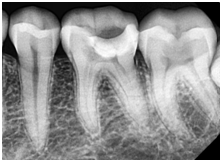
Fig:1 Pre-operative radiograph

Fig:2 MTA Placement

Fig:3 Permanent restoration
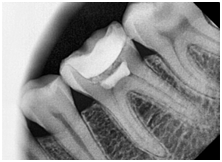
FIG:4 After 3months follow up
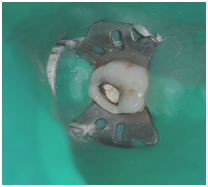
FIG:5 Pre-operative photograph
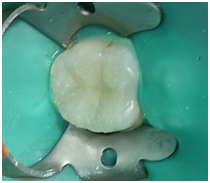
FIG:6 Post- operative photograph
DISCUSSION
The vital pulp therapy should be considered as an alternative treatment. Overall, the success of vital pulp therapy techniques in curiously exposed teeth is dependent upon the technique.6Successful outcomes have been demonstrated for partial pulpotomy in curiously exposed permanent teeth.7Pulpotomy which is a vital pulp therapy procedure in which the coronal portion of the pulp is removed and the radicular pulp is preserved with the aim of maintaining the pulp vitality can be performed in such teeth with no periapical lesions. On the remaining radicular pulp, a suitable biocompatible material is packed to protect the pulp from further insult and initiate healing and repair.8
MTA is bioactive silicate cement consisting of tricalcium silicate, tetracalcium aluminate, tricalium oxide and silicate oxide. MTA has been reported to induce pulpal cell proliferation and hard tissue formation such as osteogenesis and dentinogenesis. It can stimulate immune cells to release lymphokines and stimulate bone coupling factors necessary for biomineralization and healing of osseous periapical defects, inducing the regeneration of cementum and PDL. Furthermore, in most studies there was decreased inflammation associated with MTA when compared to other materials used for the same purpose.Dentin bridging and pulp health were more predictable with MTA pulpotomy.
In a review by Aguilar and Linsuwanont, the success rate for partial pulpotomy was 99.4% and for full pulpotomy was 99.3% in vital permanent teeth with closed apices.9In another study, Asgary and Ehsani performed pulpotomy with new endodontic cement on 12 permanent molars with established irreversible pulpitis. They demonstrated 100% success in all the teeth with the presence of a hard dentinal tissue bridge and normal pulp. Simon et al., performed pulpotomy on permanent molar teeth using proRoot MTA and showed 82% success at the end of 24 months.10
CONCLUSION
In conclusion, pulpotomy using MTA could be a good alternative for RCT for managing symptomatic mature permanent teeth with carious exposure.
REFERENCES
- Farooq NS, Coll JA, Kuwabara A, Shelton P. Success rates of formocresolpulpotomy and indirect pulp therapy in the treatment of deep dentinal caries in primary teeth. Pediatr Dent. 2000;22(4):278-86.
- Kojima K, Inamoto K, Nagamatsu K, Hara A, Nakata K, Morita I, Nakagaki H, Nakamura H. Success rate of endodontic treatment of teeth with vital and nonvital pulps. A metaanalysis.Oral Surg Oral Med Oral Pathol Oral RadiolEndod. 2004;97(1):95-9.
- Asgary S, Eghbal MJ, Ghoddusi J, Yazdani S. One-year results of vital pulp therapy in permanent molars with irreversible pulpitis: an ongoing multicenter, randomized, noninferiority clinical trial. Clin Oral Investig. 2013;17(2):431-9.
- Bender I. Reversible and irreversible painful pulpitides: diagnosis and treatment. AustEndod J. 2000;26(1):10-4.
- Eghbal MJ, Asgary S, Baglue RA, Parirokh M, Ghoddusi J. MTA pulpotomy of human permanent molars with irreversible pulpitis. AustEndod J. 2009;35(1):4-8. 6.Witherspoon DE, Small JC, Harris GZ. Mineral trioxide aggregate pulpotomies: a case series outcomes assessment. J Am Dent Assoc. 2006;137(5):610-8.
- Pitt Ford TR, Rhodes JS, Pitt Ford HE. Endodontics: problem-solving in clinical practice. London, UK: Martin Dunitz; 2002: pp. 46-8.
- Amini P, Parirokh M. The importance of long time follow-up after vital pulp therapy: A case report. Iran Endod J. 2008;3(3):90-2.
- Aguilar P, Linsuwanont P. Vital pulp therapy in vital permanent teeth with cariously exposed pulp: a systematic review. J Endodon. 2011;27(5):581–87.
- Simon S, Perard M, Zanini M, Smith AJ, Charpentier E, Djole SX, et al. Should pulp chamber pulpotomy be seen as a permanent treatment? Some preliminary thoughts. IntEndodon J. 2013;46:79–87.
Disclaimer from Guident
The views and opinions expressed in articles published in Guident are solely those of the authors and do not necessarily reflect the views of the editors, the editorial board or the publisher, Ivory India. Guident does not endorse any product, technique or treatment described. Clinical content is intended for qualified dental and medical professionals and is not a substitute for individual clinical judgement. Guident, its editors and the publisher accept no liability for any consequence arising from the use of information published in the journal.
How to cite this article
Dr.Himadri Sharma Dr.Rohit Paul, Dr.Ajay NAgpal. Vital Pulp Therapy Using Mineral Trioxide Aggregate-a Conservative Approach. Guident. 2018 Jul;11(8). Available from: https://guident.in/articles/endodontics/vital-pulp-therapy-using-mineral-trioxide-aggregate-a-conservative-approach-17.html

