Dental Loupes -1
Director, Upskill Dental Academy Mumbai, India
The role of magnification with good illumination is clear to all of us.
PARAMETERS
Several parameters influence the successful use of dental loupes.
- Fixed parameters
- Adjustable parameters
FIXED PARAMETERS
- Magnification
- Working distance
- Head lamp
- Prescription insert and its power.
Magnification:
The choice of intensity of magnification depends on the type of clinical work done. Finer work requires higher magnification.
WORKING DISTANCE :
The working distance is the distance from the lens of the loupes to the object being observed.
The working distance is variable and is adjustable according to operator convenience,it can be in wide range 380mm to 500mm.the working distance is relatively easy to determine.
 :
Head lamp:
A good head lamp providing spot focus with LED light is a useful accessory with loupes.
Prescription insert:
People with refraction errors can consult an optician determine the error and send the prescription to have a prescription insert in their loupes.
ADJUSTABLE PARAMETERS
- Inter Pupillary distance
- Convergence angle
- Declination angle
Inter pupillary distance:
The interpupillary distance is the distance between the centre of the pupils in mm.
This measurement is necessary to ensure the correct positioning of the loupes by the operator in order to view the objects clearly.
The illustration below helps to set the inter pupillary distance.

Convergence angle:
The convergence angle is a pivotal angle set on both the oculars so that they are pointing at a certain distance away
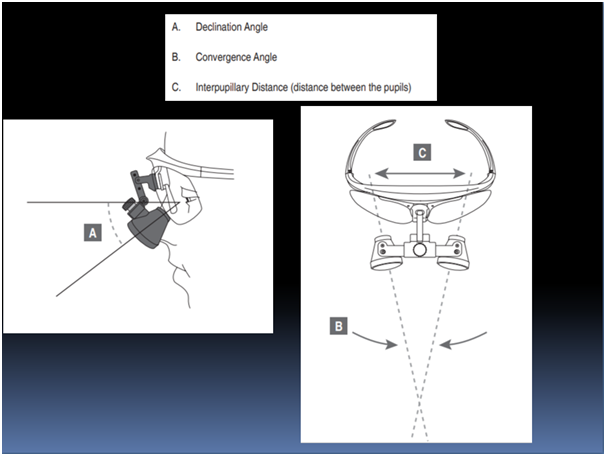
Declination angle:
The angle between the reference line which connects the top of the ears to the corner of the eye and the optical axis of the loupe oculars.
The role of declination angle in loupes selection and its influence in ergonomics is easily recognisable it decides how much does the user tilt his head when in use .the goal is to have minimum tilt of head when at work and thereby maintain good health of the musculo skeletal system of the operator.
Recommended posture model for dental practioners:
It has been reported that excessive head tilt can cause chronic pain or injuries.according to the recommendation maximum head tilt should be less than 20 degrees.
Properly designed adjusted ergonomic loupes it is possible to eliminate the incidence of upper back and
Neck problems.

Loupe design
There are two optical systems used in loupes: Galilean and Prismatic .

Types of loupes
- Single lens loupes
- Galilean loupes
- Keplerian loupes
Single lens loupes (Amsted) are the simplest form of magnification and are low powered ,clip on magnifying lenses that attach to glasses or a headband .they are inexpensive solutions ,but have limited magnification (upto about 3x)and limited depth and diameter of field of vision.
Galilean loupes are used for 2x to 2.5x magniï¬cation in that they use 2 or more lenses to focus the image. The systems are more expensive than single lens loupes and although the level of magniï¬cation is limited, the depth and diameter of the ï¬eld of view as well as the resolution of the image are improved2 . Often this level of magniï¬cation is desirable for someone just beginning a journey into magniï¬cation, as it is easier to learn to use, lighter in weight, and does not require additional illumination in most instances. The practical range is limited to x3.5 or less, as the system is limited by spherical aberration: the flatness of the field from top to bottom and left to right begins to distort the image quality as magnification increases. An additional consideration is that all Galilean lens systems produce a halo effect at the periphery of the visual field which, in some cases, may be bothersome.
Prismatic (Keplerian) loupes have multiple lenses (around 5 as well as 2 prisms) to focus the image and give greater clarity. The price is more expensive to make these, and the lenses are larger and heavier, resulting in a smaller depth of ï¬eld as the magniï¬cation increases . In Prismatic loupes the passage of light is lengthened through a series of internal reflections via a Schmidt prism, thus allowing the barrel of the loupe to be shortened sufficiently for spectacle or headband mounting. These loupes provide improved quality of magnification, wider fields of view and greater depth of field. The disadvantages are that they are heavier, have long barrels and are more costly. They can be used for all levels of magnification.
The lenses of both types can be mounted on to the spectacle frame , or embedded in the spectacle lens.
Loupes can be of the flip up or the TTL variety
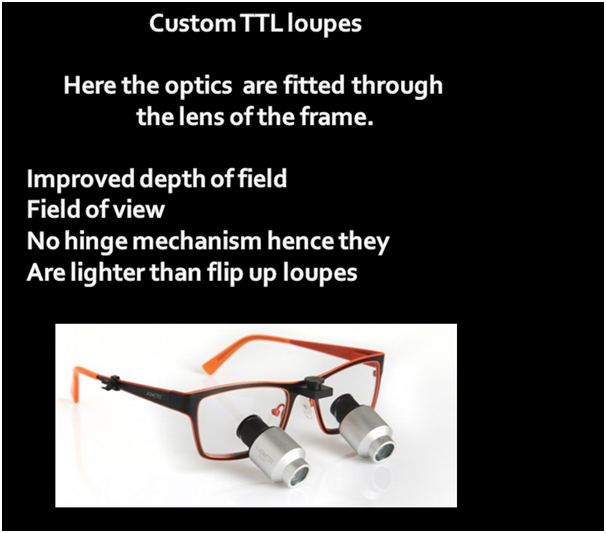

The following chart elaborates the difference between the flip up variety and the TTL variety.They shall be discussed in more detail in the next article.

Numerous options are available to clinicians to choose and work with based on their work requirements and their budget.The most important requisite is that they are well fitted to minimize the eye strain.Understanding the parameters for their effective use is prime. The next article will discuss in detail on how to choose the right pair of loupes ,the accessories and how to use them to maximum advantage .The life of dental loupes depends upon usage and maintanence .The next article will also discuss the life of dental loupes and its maintanence.
REFERENCES
- Magnifying loupes in Modern Dental Practice :An Update ,Teresa James ,Alan SM Gilmour.Dental Update ,November 2010.
- Magnification Alternatives:Seeing is Believing Part 1 Written by Glenn A. van As, BSc, DMD Dentistry Today June 2013.
Disclaimer from Guident
The views and opinions expressed in articles published in Guident are solely those of the authors and do not necessarily reflect the views of the editors, the editorial board or the publisher, Ivory India. Guident does not endorse any product, technique or treatment described. Clinical content is intended for qualified dental and medical professionals and is not a substitute for individual clinical judgement. Guident, its editors and the publisher accept no liability for any consequence arising from the use of information published in the journal.
How to cite this article
Dr. Pavana Kamath. Dental Loupes -1. Guident. 2018 Jul;11(8). Available from: https://guident.in/articles/endodontics/dental-loupes-1.html