
Post Endodontic Restoration with Placement of Polyethylene Fibres- a Case Series
Department of Conservative Dentistry and Endodontics, Seema Dental College And Hospital, Rishikesh
ABSTRACT
Root canal therapy significantly reduces the tooth's strength. A post-endodontic restoration is then required to strengthen the tooth. Occlusal loading occurs on teeth as a result of normal oral processes as chewing, biting, and some parafunctional behaviours .Therefore, after endodontic treatment, it is essential to provide them with adequate and appropriate restorative material in order to prevent tooth fractures.This article outlines a procedure using polyethylene fibres as post endodontic restoration to build a tooth.
Key words- polyethylene fibres, post endodobtric restorations , elastic modulus. Tooth fracture
INTRODUCTION
Large cavity designs and access cavities have an impact on the tooth's ability to resist fracture after endodontic treatment, thus choosing a material that can do so is crucial. Adhesive restorations enable dentists to do minimum invasive preparations, protecting healthy tooth structure. Curiously, as resin bonded composite (RBC) qualities continue to advance, dentists are gradually moving away from amalgam. Composites reinforced with polyethylene fibres help to change the stress pattern and distribute and transfer the stresses. These woven fibres are intended to create a monoblock dentin-post-core system, allowing for better force distribution along the root. Their elastic modulus is similar to that of dentin.
CASE REPORT 1
A 28 years old male patient came to the department with the chief complaint of old restoration in his lower left back tooth region and wanted permanent for the same. On clinical examination composite restoration was done i.r.t 37 and radiographic examination showed root canal treated teeth i.r.t 37 . Treatment plan of polyethylene fibres placement followed with composite restoration.
Isolation was done with rubberdam followed by removal of old restoration and 3-4mm of gutta percha was removed . Etching was done with 37% orthophosphoric acid followed by placement of one layer of ribbond fibres with flowable composite followed by light curing . after this second layer of polyethylene fibres with composite is placed followed by packable composite placement.

Fig 1: Preoperative Image

Fig 2: Etchant Applied

Fig 3: Polyethylene Fibres Placed

Fig 4: Condensed Polyethylene Fibres
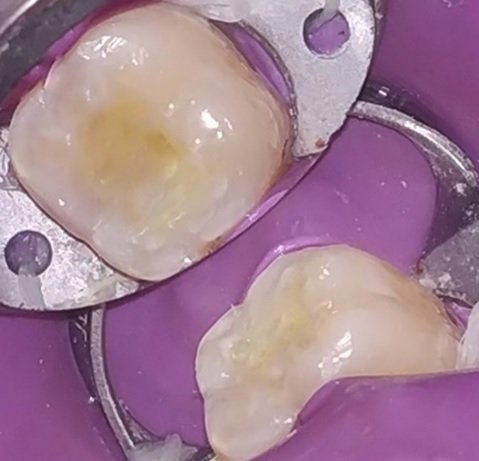
Fig 5: Post Operative Image
CASE REPORT 2
A 42 year old female patient reported to the Department of Conservative Dentistry and Endodontics, Seema Dental College and Hospital, Rishikesh with a chief complaint of broken teeth in lower right back tooth region 1 day back. Patient gave dental history of root canal treatment in the same tooth 5 years back. Patient had no pain. On clinical examination, there was root stump w.r.t. 44. On radiographic examination, no periodontal ligament widening was present. On the basis of clinical and radiographic findings, treatment planned was post endodontic restoration and buildup using ribbond fibers and composite. A written consent was taken from the patient after explaining the treatment protocol. The post endodontic restoration was done using Ribbond Fibers. The gutta percha was sheared till 4-5 mm below the CEJ. Ribbond fibers were dipped in the bonding agent. After etching and conditioning, the ribbond fibers were packed in the canal along with flowable and packable composite and buildup was done.

Fig 1: Preoperative Image

Fig 2: Polyethylene Fibers

Fig 3: Polyethylene Fibres Placed

Fig 4: Post Operative Image
DISCUSSION
When choosing material for a restoration of a non-vital tooth after endodontic treatment, it is important to understand the reduced flexibility of the tooth and the morphology of the lost tooth structure.
It is good to use composites that have been strengthened with macro inserts or micro inserts by the manufacturer in order to prevent cuspal and vertical fractures, which are unfavourable side effects of root canal therapy.
Belli et al. (2005) assessed the fracture resistance of teeth repaired with and without fiber-reinforced composite following root canal therapy. They contrasted unrestored teeth that had been filled with composite resin, flowable composite, and buccolingually positioned polyethylene fibres. The researchers came to the conclusion that the use of polyethylene fibres in teeth with mesio-occlusal-distal (MOD) cavities that had undergone endodontic treatment considerably increased the fracture resistance.
Fibers have the ability to change stress by producing a monoblock effect. This in turn aids in reducing stress along the tooth's long axis. Additionally, they can stop cracks from forming, which are brought on by the distribution of stress from the polymer matrix to the fibers. Core materials have included fibres like polyethylene fibers, glass fibers, and short fiber-reinforced composites. Polyethylene fiber-reinforced composites can help to distribute and transfer stresses as well as change the stress pattern (Tekçe et al., 2016).
In the above case series preservation of residual dentin is possible with the placement of fibre reinforcement. Therefore, the risk of the remaining root dentin to resist fracture is optimized.
REFERENCES
- Shah, Eshani H et al. “Effect of fibre-reinforced composite as a post-obturation restorative material on fracture resistance of endodontically treated teeth: A systematic review.” The Saudi dental journal vol. 33,7 (2021): 363-369. doi:10.1016/j.sdentj.2021.07.006
- Belli S., Erdemir A., Ozcopur M., Eskitascioglu G. The effect of fibre insertion on fracture resistance of root filled molar teeth with MOD preparations restored with composite. Int. Endod. J. 2005;38(2):73–80
- Garoushi S., Vallittu P.K., Lassila L.V.J. Direct restoration of severely damaged incisors using short fiber-reinforced composite resin. J. Dent. 2007;35(9):731–736
- Luthria A., Srirekha A., Hegde J., Karale R., Tyagi S., Bhaskaran S. The reinforcement effect of polyethylene fibre and composite impregnated glass fibre on fracture resistance of endodontically treated teeth: An in vitro study. J. Conserv. Dent. 2012;15(
- Ilday N., Seven N. The influence of different fiber-reinforced composites on shear Bond strengths when bonded to enamel and dentin structures. J. Dental Sci. 2011;6(2):107–115
- Göktürk H., Karaarslan E.?., Tekin E., Hologlu B., Sar?kaya I. The effect of the different restorations on fracture resistance of root-filled premolars. BMC Oral Health. 2018;18:196.
- Robbins, J.W., 2006. Restoration of endodentically treated teeth. In: Summitt, J.B., Robbins, J.W., Hilton, T.J., et al, eds. Fundamentals of operative dentistry—A contemporary approach. 3rd ed. Chicago: Quintessence, 570–587
- Singh S., Chandra A., Tikku A.P., Verma P. A comparative evaluation of different restorative technique using polyethylene fibre in reinforcing the root-filled teeth: An in vitro study“ J Res Dent. 2013;1:60–65.
Disclaimer from Guident
The views and opinions expressed in articles published in Guident are solely those of the authors and do not necessarily reflect the views of the editors, the editorial board or the publisher, Ivory India. Guident does not endorse any product, technique or treatment described. Clinical content is intended for qualified dental and medical professionals and is not a substitute for individual clinical judgement. Guident, its editors and the publisher accept no liability for any consequence arising from the use of information published in the journal.
How to cite this article
Dr. Sugandha Sati, Dr. Aryama Balodi, Dr. Anil Dhingra. Post Endodontic Restoration with Placement of Polyethylene Fibres- a Case Series. Guident. 2023 Jan;16(2). Available from: https://guident.in/articles/endodontics/post-endodontic-restoration-with-placement-of-polyethylene-fibres-a-case-series.html


