Esthetic Management of Fractured Anterior Teeth Using Direct Composite: A Case Report
Department of Conservative Dentistry & Endodontics, K.D. Dental College & Hospital, Mathura
ABSTRACT
One of the consequences of traumatic injury is an uncomplicated crown fracture. Direct composite restorations have become an essential component of modern dental practice as they provide excellent esthetic and involve minimal invasive preparations. This case report presents a case of permanent maxillary central incisors with an uncomplicated crown fracture treated with a composite resin restoration by applying the natural layering concept. It is based on the recognition of actual dentine and enamel optical properties.
INTRODUCTION
Direct adhesive methods provide nearly endless possibilities to restore function and aesthetics while conserving healthy tooth tissue.1 The 'natural layering concept' has been proposed for anterior tooth restoration since it is a simple and successful approach capable of mimicking natural tooth structure.2 In this procedure, different colours of composite were used for enamel and dentine in order to match the optical properties of these structures and provide an outstanding aesthetic3. This case report aims to describes a case of a permanent maxillary central incisors with an uncomplicated crown fracture treated with a composite resin restoration.
CASE REPORT
A 32-year-old male patient reported to the college, with a complaint of fracture in upper front tooth (Figure. 1). Dental history revealed that he met with an accident 6 months back resulting in an injury. Extra-oral examination revealed no significant findings. During the intra-oral examination, a class II Ellis fracture of left and right maxillary central incisor was diagnosed. There was no other pathology associated with the injury. Intraoral periapical radiograph shows enamel and dentin fracture without involvement of pulp in the tooth 11 and 21.
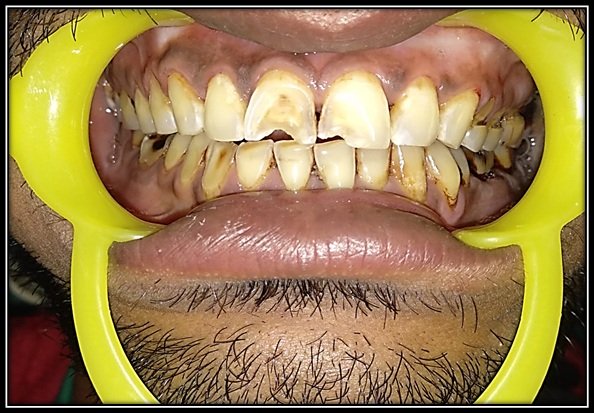
Fig-1 Pre- Operative Photograph
An alginate impression of maxillary arch was made and the stone model was constructed. Wax-up of the fractured teeth 11,21 was done. Thereafter, mould with a heavy silicon base impression material was made, reproducing the shape and contour of the needed restoration. The restorative material and the matching shade were selected.

Fig-2 Rubber dam application
After application of rubber dam (figure2), the teeth were etched and bonding agent was applied. (figure 3,4). The silicon index was then placed to the palatal surface of the teeth (figure 5). A3 enamel shade restorative material (3M ESPE Filtek Z350 XT) was applied to the palatal portion of the silicon index, and light-cure was applied for 40 s. After obtaining palatal shelf, a layer of dentin was made using A2 dentin shade (3M ESPE Filtek Z350 XT) composite restorative material. Thereafter, final contouring of the proximal and labial surface was done by applying enamel shade A2 composite resin (3M ESPE Filtek Z350 XT). Finishing, polishing and adjustments were performed with abrasive burs and polishing paper discs. (Figure 6,7,8)

Fig 3- Etchant applied

Fig-4- Bonding Agent applied

Fig 5- Silicon index placed over palatal surface
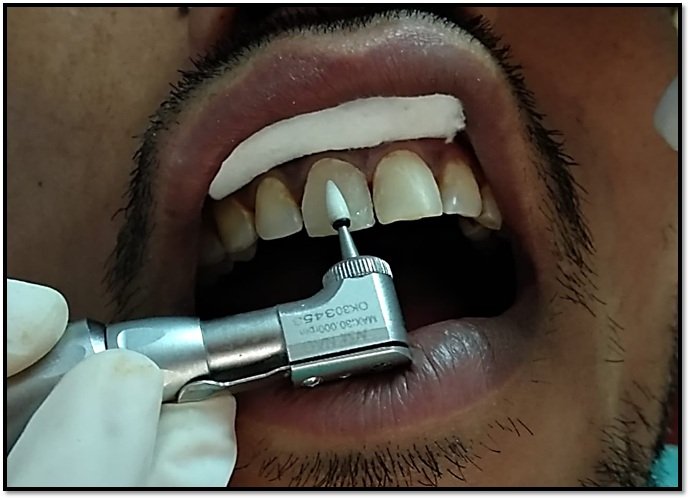
Fig 6- Finishing done with stone bur
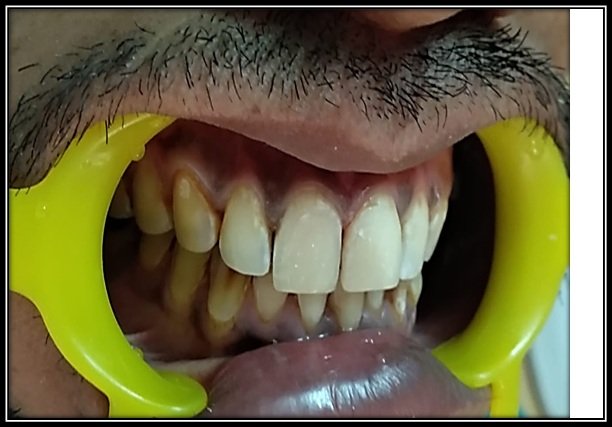
Fig 7-Post-operative view-lateral
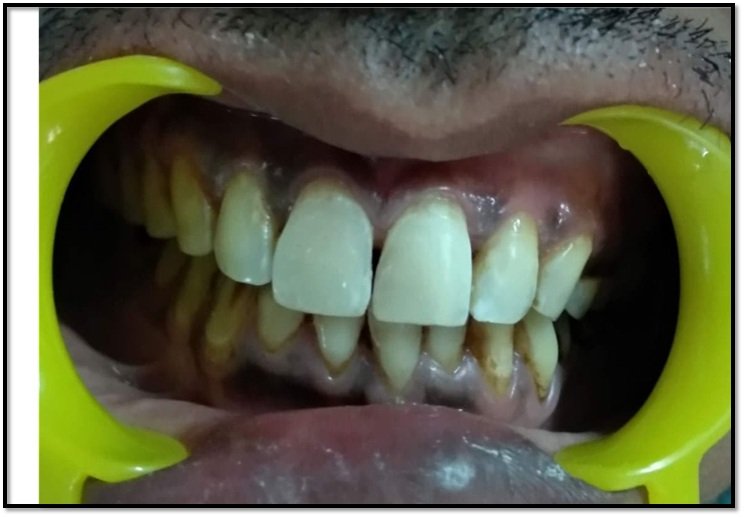
Fig 8- Post-operative view -front
DISCUSSION
The appearance of a patient's teeth is a well-established psychological element impacting his or her attractiveness and self-confidence.4 Direct adhesive restorations are widely utilised for the rehabilitation of uncomplicated crown fractures involving enamel and dentin fractures without pulpal involvement.5,6 The silicon index was used as a reference guide in this case, which aided in the reconstruction of damaged anterior teeth Then, using a dentine shade composite, a layer of dentine was built up. On the proximal and labial surfaces, a final layer of enamel was applied. Following the conclusion of the restoration build up, finishing and polishing were done.
CONCLUSION
A lost tooth structure can be rebuilt with composite resin restorative material using natural layering approach to create a natural-looking repair. However, this procedure requires a complete knowledge and good expertise of the operator to provide a highly beautiful repair.
REFERENCES
- Mackenzie L, Parmar D, Shortall AC, Burke FJ. Direct anterior composites: a practical guide. Dent Update. 2013;40(4).
- D Dietschi. Br Dent J. 2008; 204:181-5.
- G Oliveira, A Ritter. Pediat Dent 2009;31.
- Baldwin DC. Appearance and aesthetics in oral health. Community Dent Oral Epidemiol 1980; 8: 244–256.
- Traebert J, Almeida IC, Garghetti C, et al. Prevalence, treatment needs, and predisposing factors for traumatic injuries to permanent dentition in 11–13-year-old schoolchildren. Cad Saude Publica 2004; 20:403–10.
- Andreasen JO, Andreasen FM. Textbook and color atlas of traumatic injuries to the teeth. 3rd edn. Copenhagen: Munsksgaard, 1994.
Disclaimer from Guident
The views and opinions expressed in articles published in Guident are solely those of the authors and do not necessarily reflect the views of the editors, the editorial board or the publisher, Ivory India. Guident does not endorse any product, technique or treatment described. Clinical content is intended for qualified dental and medical professionals and is not a substitute for individual clinical judgement. Guident, its editors and the publisher accept no liability for any consequence arising from the use of information published in the journal.
How to cite this article
Dr. Deepika, Dr. Ajay Kumar Nagpal. Esthetic Management of Fractured Anterior Teeth Using Direct Composite: A Case Report. Guident. 2022 Feb;15(3-4). Available from: https://guident.in/articles/endodontics/esthetic-management-of-fractured-anterior-teeth-using-direct-composite-a-case-report.html