Composite Restoration Using Stamp Technique in Posterior Teeth: A Case Series
Department of Conservative Dentistry and Endodontics, Seema Dental College And Hospital, Rishikesh, U.K
ABSTRACT
Background: Reproducing ideal occlusal anatomy in posterior composite restorations is technique sensitive. The stamp technique helps in duplicating the pre-operative occlusal morphology accurately.
Aim: To evaluate the clinical applicability of the stamp technique in Class I posterior composite restorations.
Materials and Methods: This case series included multiple patients with Class I carious lesions in posterior teeth. Stamp impressions were recorded using putty impression material, flowable composite, and gingival barrier. Composite restorations were completed using the stamp technique.
Results: All restorations showed accurate occlusal anatomy with minimal occlusal adjustments and good patient acceptance.
Conclusion: The stamp technique is a predictable and time-efficient method for restoring posterior teeth.
INTRODUCTION
Posterior composite restorations demand precise reproduction of occlusal anatomy. Conventional incremental techniques are time-consuming and often result in occlusal discrepancies. The stamp technique enables replication of pre-operative occlusal morphology, thereby improving efficiency and predictability.
Restoration of posterior teeth with direct composite resin poses a significant clinical challenge, primarily due to the complexity of occlusal anatomy and the need to achieve proper cusp–fossa relationships. Inadequate reproduction of occlusal morphology may result in premature contacts, postoperative sensitivity, and increased wear of the restoration or opposing dentition. Conventional freehand incremental techniques require considerable operator skill and are often associated with prolonged chairside time.
The stamp technique was introduced as a minimally invasive and operator-friendly approach to accurately replicate the preoperative occlusal anatomy of posterior teeth. By transferring the original occlusal topography onto the final composite increment, this technique minimizes finishing and occlusal adjustments. The present case series demonstrates the clinical applicability of the stamp technique using different stamp materials in Class I posterior restorations.
MATERIALS AND METHODS
Patients diagnosed with Class I caries in posterior teeth were selected. After isolation, a stamp impression of the intact occlusal surface was recorded prior to cavity preparation. Caries excavation was followed by etching, bonding, and composite placement. The stamp was positioned over uncured composite and light cured to achieve accurate occlusal anatomy.
A total of multiple posterior teeth diagnosed with Class I carious lesions were included in this case series. Patients aged between 14 and 37 years were selected after obtaining informed consent. Teeth with intact occlusal anatomy and without pulpal involvement were included, whereas teeth with extensive structural loss or occlusal wear were excluded.
Following rubber dam isolation, a separating medium was applied on the occlusal surface. Stamp impressions were recorded using three different materials—putty impression material, flowable composite resin, and gingival barrier—based on clinical convenience. Standardized cavity preparation was performed, followed by 37% phosphoric acid etching, application of bonding agent, and incremental composite placement. The stamp was positioned over the final uncured increment and light cured to reproduce the occlusal anatomy accurately.
CLINICAL IMAGES

Figure 1: Composite restoration using stamp technique (PUTTY).

Figure 2: Composite restoration using stamp technique (FLOWABLE COMPOSITE).
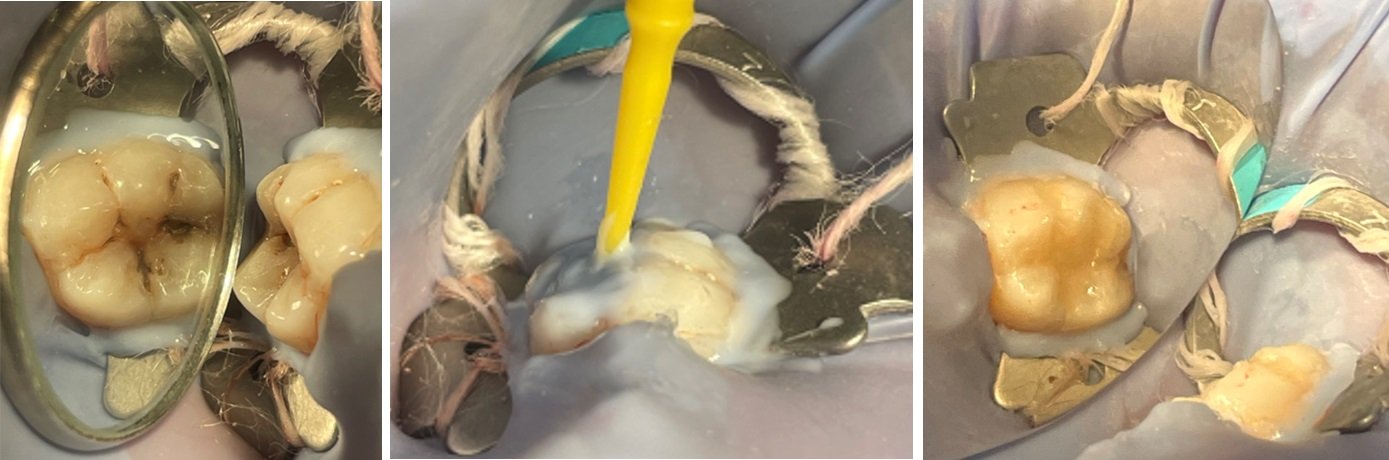
Figure 3: Composite restoration using stamp technique (GINGIVAL BARRIER).
DISCUSSION
The stamp technique simplifies posterior composite restorations by preserving occlusal morphology. It reduces chairside time and improves predictability. The technique is particularly useful in Class I lesions with intact occlusal anatomy.
The findings of this case series support the clinical usefulness of the stamp technique for restoring Class I posterior cavities. Preservation of preoperative occlusal morphology is the primary advantage of this technique, which directly translates into reduced occlusal discrepancies. The use of different stamp materials provides flexibility to the clinician, allowing customization based on availability and clinical scenario.
Previous studies have reported similar benefits of the stamp technique, emphasizing reduced finishing time and improved occlusal accuracy when compared to conventional freehand techniques. However, the technique is best indicated in cases with intact occlusal surfaces and requires careful handling to avoid distortion of the stamp. Long-term clinical studies are recommended to evaluate the durability of restorations placed using this technique.
CONCLUSION
The stamp technique is a reliable and efficient method for restoring posterior composite restorations with predictable functional and esthetic outcomes.
REFERENCES
- Liebenberg WH. Occlusal index-assisted restitution of lost tooth structure. J Esthet Dent. 1996;8:53–59.
- Nagaveni NB, et al. Stamp technique for posterior composites. J Conserv Dent. 2018;21:123–127.
- Dietschi D, Devigus A. Adhesive composite restorations in posterior teeth. Quintessence; 2002.
- Deliperi S, Bardwell DN. Posterior composite restoration techniques. Oper Dent. 2002;27:209–21
- Vijayalakshmi R, et al. Clinical evaluation of stamp technique. Int J Conserv Dent. 2020;25:45–50.
- Van Ende A, et al. Bulk-fill composites: a review of the current literature. J Adhes Dent. 2017;19:95–109.
- Opdam NJM, et al. Longevity of posterior composite restorations. Dent Mater. 2014;30:137–145.
- Ilie N, Hickel R. Resin composite restorative materials. Aust Dent J. 2011;56 Suppl 1:59–66.
- Ferracane JL. Resin composite—state of the art. Dent Mater. 2011;27:29–38.
- Da Rosa Rodolpho PA, et al. Clinical performance of posterior composites. J Dent. 2011;39:137–145.
Disclaimer from Guident
The views and opinions expressed in articles published in Guident are solely those of the authors and do not necessarily reflect the views of the editors, the editorial board or the publisher, Ivory India. Guident does not endorse any product, technique or treatment described. Clinical content is intended for qualified dental and medical professionals and is not a substitute for individual clinical judgement. Guident, its editors and the publisher accept no liability for any consequence arising from the use of information published in the journal.
How to cite this article
Dr. Aashi Mittal, Dr. Deepti Kushwaha, Dr. Seema Dixit. Composite Restoration Using Stamp Technique in Posterior Teeth: A Case Series. Guident. 2026 Jan;19(2). Available from: https://guident.in/articles/endodontics/composite-restoration-using-stamp-technique-in-posterior-teeth-a-case-series.html