Maxillary Tooth Supported Overdenture: A Case Report
Department Of Prosthodontics And Crown & Bridge, Seema Dental College and Hospital, Rishikesh
ABSTRACT
Retained Teeth and Residual edge gives backing to the tooth upheld overdenture. It assists with keeping up with the proprioception and protection of alveolar bone. Rather than extraction, a clinician can save and use the leftover teeth of an almost edentulous patient as projections for an overlay denture. This can be depicted as any removable dental prosthesis that covers and lays on at least one leftover normal teeth, the foundations of regular teeth, as well as dental inserts. The principle benefits of traditional tooth upheld overdenture are the conservation of the excess tooth structure alongside its proprioception, safeguarding of the alveolar bone, extra help to the false teeth separated from the mucosa. Here we have shown one case report where patients were effectively restored with regular tooth supported overdentures with metal copings.
INTRODUCTION
In prosthodontics, its preventive aspect focus on techniques which may prolong and get rid of any possible issues. To overcome any such eventuality, the overdenture treatment modality has shown promising results. A completely edentulous person encompasses certain activities, which may be the loss of proprioception, gradual alveolar bone loss leading to a decline in self – esteem of the patient. An overdenture minimizes resorption, maintains denture base foundations and improves the patient’s masticatory efficiency.1
An overdenture is a denture prosthesis that can be removed by the patient at will and which covers and rests on one or more remaining natural teeth, or their roots and / or dental implants. An overdenture is among the most conservative option available. This treatment is among the most conservative option available.
Older age groups today has higher information about maintaining their dental health and have a good concern for their treatments, as and when required. Therefore prosthodontics are also ought to be adequetly aware of different treatment options available for the aged patients.2
Fabrication of a complete denture is a vital tool in the hands of a prosthodontist that provides support, retention, stability and very importantly gives satisfaction and self esteem to the patient.
The residual ridge resorption process is slowed down and the chewing efficiency is increased. An overdenture is perhaps, on of the most progrmatic measure utilized in prosthodontics.3
BENEFITS AND DRAWBACKS OF AN OVERDENTURE
- Maintenance of alveolar bone volume i e quality and quantity.4
- Provide better denture support & stability.5
- Psychological upliftment of the patient due to preservation of remaining teeth.6
- If any problem occurs with the existing abutments, the teeth can be extracted and can be converted to a conventional complete denture.6
DRAWBACK
- The potential for plaque retention on the denture base increases caries susceptibility and periodontal disease for the abutment teeth.7
- Needs more inter-ridge space.
- More maintenance required.
INDICATIONS
- Patients with few natural teeth.8-10
- Congenitally defective teeth.
- Highly worn teeth (severe attrition or bruxism).
- Xersotomic patient to increase denture retention.
CONTRAINDICATIONS
- Poor oral hygiene
- Grade III mobility.
- Reduced inter ridge space leading to interference with placement of artificial teeth and the underlying abutments.
- Bony undercuts unless no denture flange is required.
- When endo and periodontal treatment cannot be performed satisfactorily.
- Differently abled patients as they can’t maintain good oral hygiene.
CASE REPORT
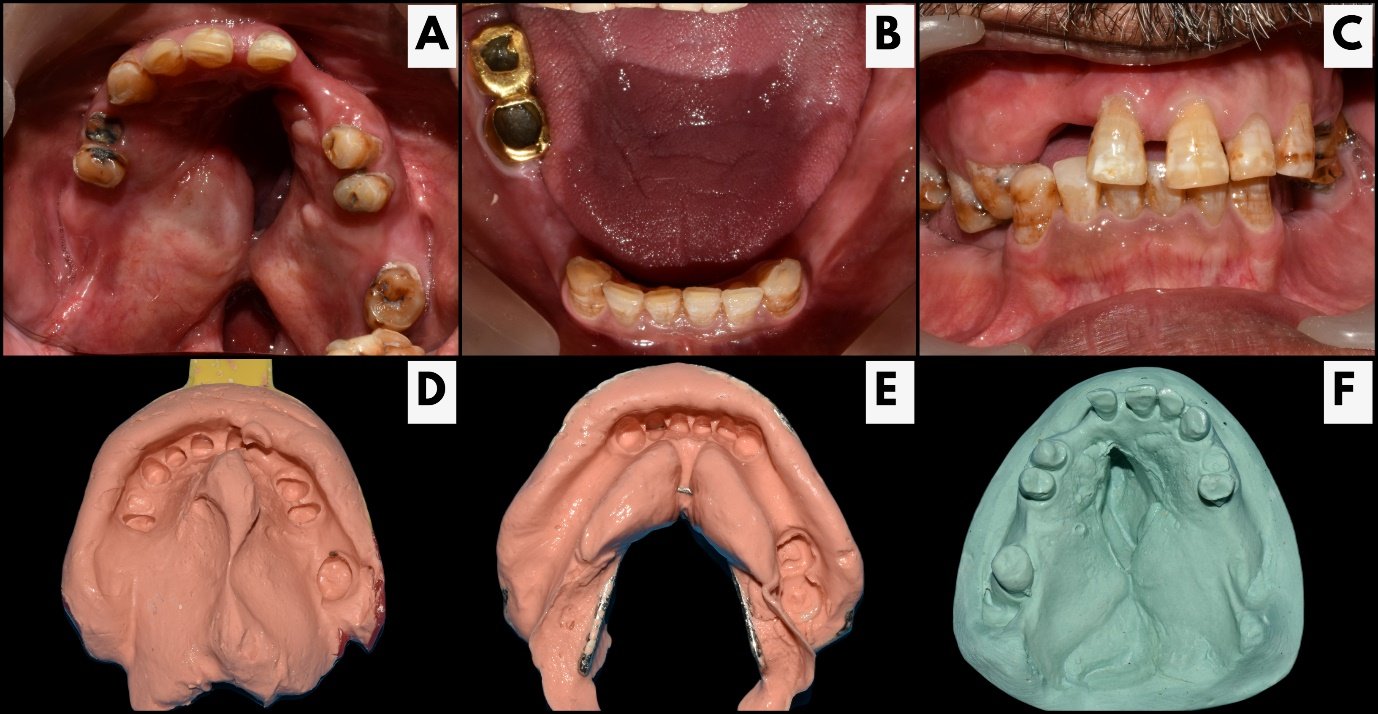
A female patient aged 60 year came to the clinic with the chief complain of difficulity while eating because of missing maxillary upper and lower teeth. No relevant medical history was there. The duration of missing teeth was 20 years and the reason for missing tooth loss are caries and periodontal problems.Extraoral assessment showed loss of vertical aspect & unsupported lips. On intraoral assessment, a halfway dentulous maxillary or mandibular arch was with 11, 14 and 25 and to some extent dentulous mandibular arch where 32,33, 34, 42,43, 44 and 24 teeth remaining (fig.1).
TREATMENT PLAN
Different choices of treatment available for the patient were implant supported overdenture or conventional complete denture after extraction of teeth. As the patient was not willing for implant supported overdenture due to long duration and surgical intervention involved in the treatment. Tooth supported denture with metal coping was decided as the treatment modality of choice.
Radiographic assessment was done to assess the crown-root proportion. Interarch space was viewed as sufficient.
Mounted diagnostic casts were evaluated .patient was explained the treatment plan in detail and her informed consent was taken. Elective root canal treatment was done for 11, 14 or 25. Teeth was prepared leaving behind 2-3 mm tooth structure above the gingiva (fig 2).
Metal coping were fabricated and try in was done. After ensuring adequate marginal integrity, the permanent cementation of metal coping using glass inomer cement was done (Fig 3). The metal coping had a uniform thickness of around 1mm throught. After this the final impression was made by using elastomers, poured with type v die stone and a special tray was fabricated (fig 4).
Tissue molding of upper maxillary arch by using green stick compound in conventional manner was done. After which, the final impression was made with elastomeric impression material, poured with type iv gypsum after an hour and master cast was obtained (Fig 5).
Blockout of the abutments on the cast was done with wax after which the denture base was fabricated with autopolymerising resins. Than the occlusal rims were made and the jaw relations were recorded after the facebow transfer. The maxillomandibular relation were transferred to the semi adjustable i,e the hanau articulator and arrangement of teeth was done. A complete try-in was done. waxed-up denture were checked for occlusion, esthetics, phonetics, visibility, centric relation & proper vertical dimension (fig 6). Trial dentures were waxed up, flasked and dewaxed. Heat cure acrylc resin was packed. Final finishing, polishing was done. The case was given routine postinsertion instructions and was motivated to make an effort to learn to acclimatize to the new dentures.

Figure 1: Preoperative
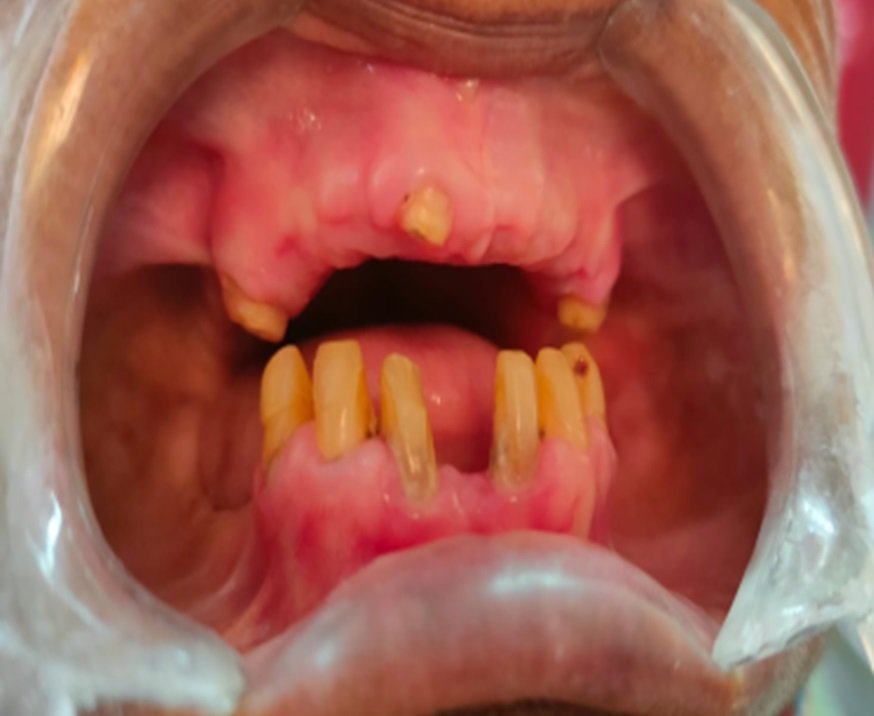
Figure 2: Reduction of the upper teeth
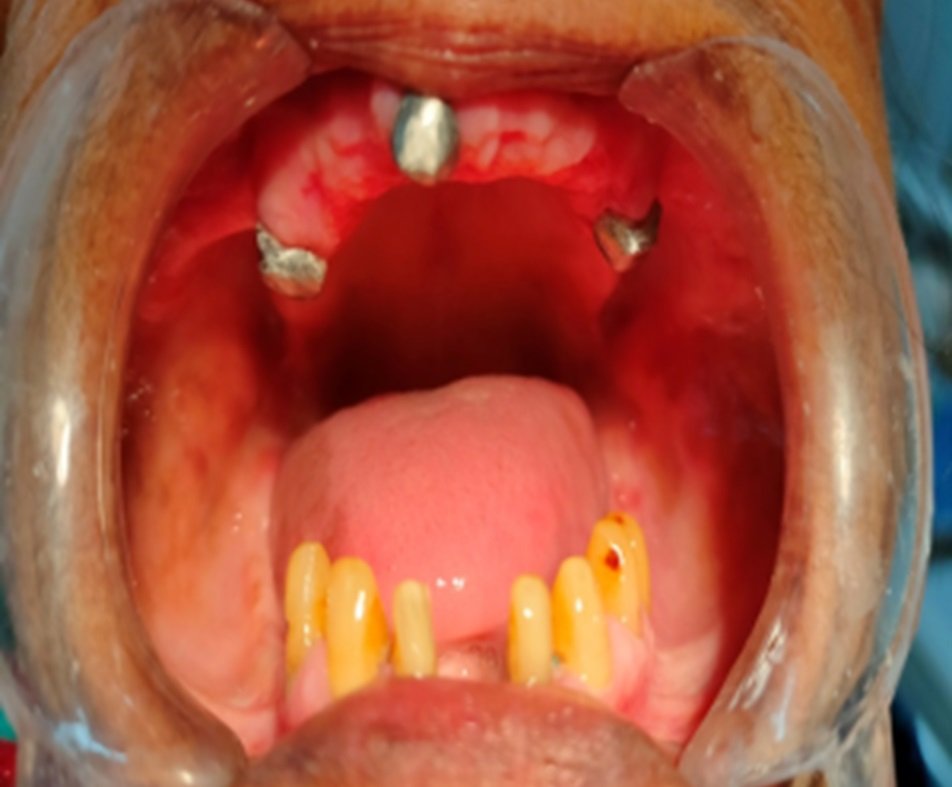
Figure 3: Placement of metal copings

Figure 4: Impression of prepared cast copings
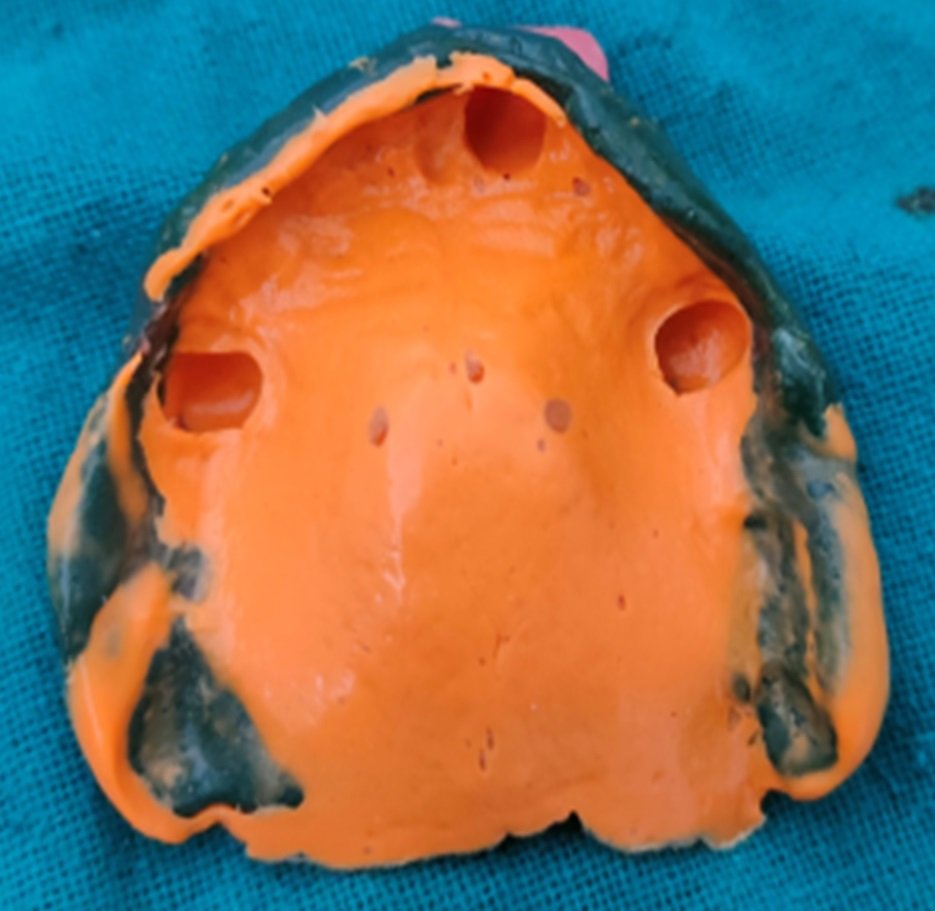
Figure 5: Secondary impression

Figure 6: Wax try-in
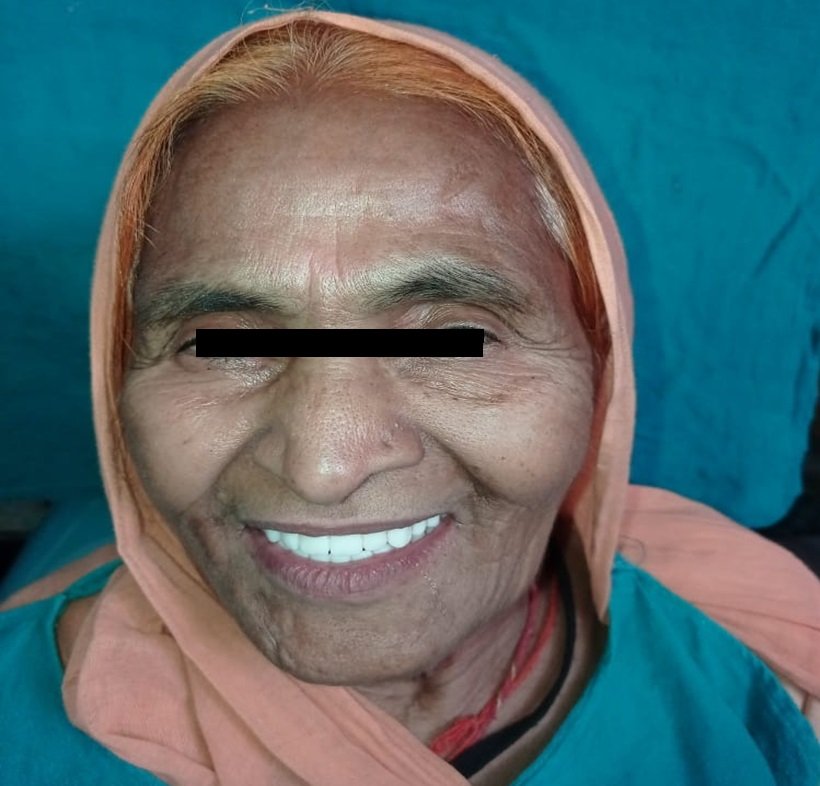
Figure 7-Final denture insertion
DISCUSSION
The scenario of loosing natural teeth can be psychologically & socially traumatic for patient. Teeth supported overdenture being a very conservative and non- invasive treatment modality, should be an integral part of our routine prosthodontic practice. Preservation of remaining alveolar bone is major advantage. As it is clearly documented by a, longitudinal study that in a time period of 5 year, only 0.6 mm of bone loss in anterior part of mandible was found with overdenture treatment in contrast to 5.2 mm loss in complete denture patients.11
Another advantage of overdenture treatment is leads to higher chewing efficiency which is about three times higher than those in patient with conventional denture.12
Even with recent advancements in dental implantology, root preservation remains a conservative technique. Greater focus should be on correct case selection. Utilization of overdenture as a treatment modality is in direct synchronization with the universally accepted Muller De Van’s dictum.
REFERENCES
- Renner RP, Gomes BC, Shakun ML, Baer PN, Davis RK, Camp P. Four-year longitudinal study of the periodontal health status of overdenture patients. J Prosthet Dent 1984;51:593-8.
- Dable RA, Gaikwad BS, Marathe SS, Badgujar MS, Dole VR. A simplified technique for custom made overdenture semi-precision attachments. Indian J Dent Res 2013 SepOct;24(5):622-626.
- Preiskel HW. Precision Attachments in Prosthodontics: Overdentures and Telescopic Prostheses. Vol 2. 2nd ed. Chicago,IL: Quintessence Publishing Co.; 1985. 7.
- Schweitzer, J. M., Schweitzer, R. D., and Schweitzer, J.: The Telescoped Complete Denture, J. PROSTHET. DENT. 26: 357-372, 1971.
- Preiskel, H. W.: Precision Attachments in Dentistry, St. Louis, 1968, The C. V. Mosby Company, pp. 87-116.
- Dodge CA. Prevention of complete denture problems by use of "overdentures". J Prosthet Dent 1973;30:403-11.
- Samra RK, Bhide SV, Goyal C, Kaur T. Tooth supported overdenture: A concept overshadowed but not yet forgotten!. J Oral Res Rev 2015;7:16-21.
- Brewer AA, Morrow RM. Overdentures Made Easy. 2nd ed. St. Louis: The C. V. Mosby Co.; 1980.
- Rahn A, Heartwell C. Textbook of Complete Dentures. 5th ed. Philadelphia: WB Saunders Co.; 1993.
- Preiskel HW. Overdentures Made Easy: A guide to Implant and root supported prostheses. London, UK: Quintessence Publishing Co.; 1996.
- Renner RP, Gomes BC, Shakun ML, Baer PN, Davis RK, Camp P. Four-year longitudinal study of the periodontal health status of overdenture patients. J Prosthet Dent 1984;51:593-8.
- Rissin L, House JE, Manly RS, Kapur KK. Clinical comparison of masticatory performance and electromyographic activity of patients with complete dentures, overdentures, and natural teeth. J Prosthet Dent 1978;39:508-11
Disclaimer from Guident
The views and opinions expressed in articles published in Guident are solely those of the authors and do not necessarily reflect the views of the editors, the editorial board or the publisher, Ivory India. Guident does not endorse any product, technique or treatment described. Clinical content is intended for qualified dental and medical professionals and is not a substitute for individual clinical judgement. Guident, its editors and the publisher accept no liability for any consequence arising from the use of information published in the journal.
How to cite this article
Dr. Himanshu Aeran, Dr. Varun Singla, Dr. Archana Panwar. Maxillary Tooth Supported Overdenture: A Case Report. Guident. 2022 Oct;15(11-12). Available from: https://guident.in/articles/prosthodontics/maxillary-tooth-supported-overdenture-a-case-report.html