Management of a Cleft Palate Patient with Hollow Obturator
Guru Nanak Dev Dental College & Research Institute, Sunam
Abstract
The cleft palate deformity is a ‘‘congenital defect of the middle third of the face, consisting of fissure of palate. Patient with cleft palate present with difficulty in swallowing, speech, altered appearance, many dental problems and psychological problems.’’ This article described cleft palate patients rehabilitated with closed hollow obturators.
Key words: hollow bulb obturator, palatal insufficiency, prosthetic rehabilitaion
INTRODUCTION
Cleft palate with or without cleft lip is the most common malformation of the orofacial region [1].Their prevalence among general population depends on race, ethnicity, geographic and socioeconomic factors. It is present in around 1:500 to 1:2500 live births, among which cleft lip occurs in 20-30%,cleft palate in 30-45% and both cleft lip and palate in about 35-50% [2]. The etiology of the cleft lip and palate is unknown.
Malnutrition and irradiation during pregnancy, psychic stress, teratogenic agents, infectious agents and heredity have been reported as causes of cleft palate. Difficulties associated with cleft palate are eating, breathing, speaking and more importantly psychological well being. Any treatment should aim at improving both physical and psychological performances and also quality of life [3].
The basic goal of any approach to treatment of cleft lip, alveolus, and palate repair, whether for the unilateral or bilateral anomaly is to restore normal anatomy [4]. Palatal defects that are treated prosthodontically need to seal congenital or acquired tissue openings of the palate and contiguous structures.
A prosthesis used to close a palatal defect in a dentate or edentulous mouth is referred to as an obturator. The obturator prosthesis is used to restore masticatory function and improve speech, deglutition and cosmetics for maxillary defect patients [5].
This clinical report describes the prosthetic rehabilitation of a cleft palate patient using a heat polymerizing acrylic resin obturator with the objective of providing satisfactory esthetics and function
CASE REPORT
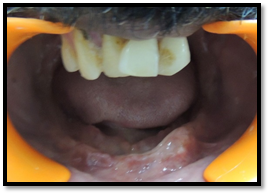
A 38 year male patient reported to the outpatient department of prosthodontics, Guru Nanak Dev Dental College and Research Institute,Sunam complaints of inability to masticate, swallow and slurred speech with nasal regurgitation. History revealed that the patient had an oro-nasal communication since birth. The patient was wearing a plate that acted as an obturator but with the loss of few teeth the plate could not be retained and patient faced problems of inability to masticate and swallow. Considering chief complaint of the patient, function, esthetic requirement, and retention, a closed hollow bulb obturator were planned for the patient for palatal defect.
PROCEDURES
A gauze piece lubricated with petroleum jelly was packed into the alveolar cleft prior to impression making to avoid any impression material from being forced into nasal cavity. Preliminary impressions were made in irreversible hydrocolloid impression material with stock tray. Study cast was obtained. All undercuts were blocked with wax.
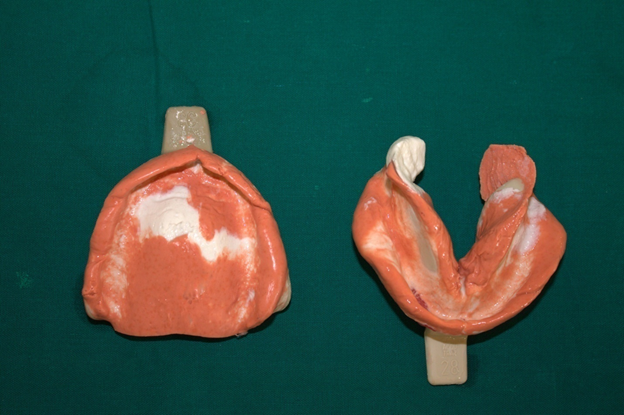
The tray of uniform thickness was fabricated with self-cure acrylic resin material with 2mm spacer given in it. The tray was adjusted in patents mouth and borders were molded with low fusing compound and special care was taken at defect area for better adaptation and retention. Final impressions were made with low viscosity poly-vinyl siloxane rubber base impression material and were poured in type IV die stone. The defect was covered with modelling wax to block the undercut areas.
An autopolymerised acrylic resin record bases and wax occlusal rims were made. The maxillomandibular relations were recorded and mounted on the articulator; teeth were arranged in wax and verified clinically. Waxed and finished trial denture was sealed to the cast. A groove was made around the defect area for the lid. Impression of the lid area was made with irreversible hydrocolloid impression material and poured in type IV die stone. 2mm thick modeling wax was adapted on the die stone cast of lid for the fabrication of the lid. Beveling was done on lid wax (defect side) to facilitate seating the assembly.
These were invested and processed with heat cured acrylic resin separately, that covers the maxilla with defect and lid would cover the hollow part of the obturator. The denture was then polymerized in the conventional manner and the lid was polymerized separately.
The lid was joined with autopolymerising resin to the main prosthesis. The finished obturator was inserted to an accurate fit into the patient's mouth and necessary adjustment was carried out. Phonetics of the patient was evaluated, the speech showed definite improvement. The patient was given training for placement of the prosthesis and post insertion instructions for maintenance. The patient was recalled for periodic follow up visits.
DISCUSSION
Obturator prostheses are commonly used in the rehabilitation of total or subtotal maxillectomy patients. It helps in separating the oral and the nasal cavities and restores normal deglutition and speech and further improves the midfacial esthetics by supporting the soft tissues [6,7]. Prosthodontic management of palatal defects has been employed for many years, Ambroise Pare probably was the first to use artificial means to close a palatal defect - as early as the 1500’s [8]. The early obturators were used to close congenital rather than acquired defects. The early objectives of treatment were artificial closure of the defect and adequate retention of the artificial closure. The ingenious designs of the early pioneers accomplished these objectives.
As time progressed newer and better concepts of obturator evolved. All prosthodontists are aware of the basic objectives of prosthodontic therapy. A comfortable, cosmetically acceptable prosthesis that restores the impaired physiologic activities of speech, deglutition and mastication is a basic objective of prosthodontic care.
The most important objective of prosthodontic care, As DeVan’s stated, our objective should be “The perpetual preservation of what remains rather than the meticulous restoration of what is missing.” This principle is most important in the treatment of the cleft-palate patient.
The success of obturator depends upon the volume of the defect, positioning of the remaining hard and soft tissues to be used to retain the prosthesis and also the weight of the prosthesis. Thus hollow obturator provides advantages of being light in weight apart from its features of retention, stability, comfort and cleanliness.
Various materials were used for the fabrication of obturator but for the permanent obturator, Brown states, “heat-curing methyl methacrylate resin still remains the material of choice for tissue compatibility, environmental resistance and ease of adjustment. The patients who have open end bulb obturator may complaints of food, fluid and mucus accumulations that results in bad odour and altered taste sensation, whereas closed end hollow obturator favors rapid recovery of speech and swallowing and their construction is less stressful.
CONCLUSIONS
Prosthetic rehabilitation of the dentate maxillectomy patient is a lengthy and time involved process. A well-planned prosthetic treatment will result in satisfactory function and aesthetics, alleviating deformities. However, it is essential that patients take responsibility for maintaining their own oral health.
 |
 |
| FIG 1. Intraoral view of defect | FIG 2. Final impression of defect with polyvinylsiloxane impression material |
 |
 |
| FIG 3. Master cas | FIG 4. Try –in |
 |
 |
| FIG 5. Wax-up of maxillary obturator nad groove made for cover lid | FIG 6. lid impression |
 |
 |
| FIG 7. Lid cast with type IV die stone | FIG 8. Wax-up for Lid |
 |
 |
| FIG 9. Flasking of maxillary obturator and lid | FIG 10. Dewaxing of the maxillary obturator and lid |
 |
 |
| FIG 11. Final prosthesis | FIG 12. Frontal view of prosthesis |
 |
 |
| FIG 13. Sealing of lid to obturator with autopolymerizing resin | FIG 14 Post operative view |
REFERENCES
- Proffit WR, Fields HW, Sarver DM. Contemporary Orthodontics. 4th ed. India: Mosby (an imprint of Elsevier); 2007. p. 287-8.
- Marti SS, Tessore MDM, Henar TE Prosthetic assessment in cleft lip and palate patients: A case report with oronasal communication. Med Oral Patol Oral Cir Bucal 2006;11:E493-6.
- Alan Joseph Hickey, Margery Salter. Prosthodontic and psychological factors in treating patients with congenital and craniofacial defects; J prsothet dent 2006 vol 95,392-396.
- Taylor TD. Clinical maxillofacial prosthesis. China: Quintessence; 2000. p. 63-84.
- Abadi B, Johnson JD. The prosthodontic management of cleft palate patients. J prosthet dent 1982;48:297-302.
- Desjardins RP. Obturator prosthesis design for acquired maxillary defects. J Prosthet Dent 1978;39:424-35.
- Wang RR. Sectional prosthesis for total maxillectomy patients: a clinical report. J Prosthet Dent 1997;78:241-44.
- Bali S, Thukral P approach followed for hollow obturator. Guident October 2011
Disclaimer from Guident
The views and opinions expressed in articles published in Guident are solely those of the authors and do not necessarily reflect the views of the editors, the editorial board or the publisher, Ivory India. Guident does not endorse any product, technique or treatment described. Clinical content is intended for qualified dental and medical professionals and is not a substitute for individual clinical judgement. Guident, its editors and the publisher accept no liability for any consequence arising from the use of information published in the journal.
How to cite this article
Dr. Anmol Mahajan, Dr. Happy Bajaj Department of Prosthodontics. Management of a Cleft Palate Patient with Hollow Obturator. Guident. 2016 Oct;9(11). Available from: https://guident.in/articles/prosthodontics/management-of-a-cleft-palate-patient-with-hollow-obturator.html