Complete Dentures- the Unconventional One. a Review (Part- II)
MP, India, Reader, Rama Dental College, Kanpur, Up, India, and Dr. Mahinder Singh (Senior Lecturer), Senior Lecturer, ITS Dental College, Muradnagar, Ghaziabad, UP, India
Abstract:
The various complication faced by the Prosthodontist during fabrication of complete denture are: atrophic ridge, microstomia, flabby tissue, xerostomia, bony exostosis, labially inclined premaxilla, aesthetic demand, bruxism, systemic disorders, patient’s demand for duplicating dentures, etc. Proper incorporation of suitable materials and advanced techniques helps in managing these complications. This article is a continuation of previous article which describes the unconventional approaches to various modalities so as to provide ultimate satisfaction for the patient.
Keywords:
complete dentures, unconventional.
INTRODUCTION
Conventional complete denture is a removable dental prosthesis that replaces the entire dentition and associated structures of maxillae and mandible. Many edentulous patient regardless of the excellence of professional skills, techniques and humanitarian concern are maladaptive to complete dentures. Transforming conventional into unconventional approach is a peculiar feature of advancing prosthodontics. The increasing demand of patients and revolutionary thought of prosthodontists have led to the outcome of the special, i.e. the unconventional approach for fabricating complete dentures. The unconventional complete dentures is known as starring new techniques based on same old fundamentals of Prosthodontia. It has been prove to be a manifestation of new vision in prosthesis construction. There are some routine complication faced by the prosthodontist include atrophic ridges, microstomia, flabby tissue, xerostomia, bony exostosis, labially inclined premaxilla, aesthetic demand, bruxism, systemic disorders, etc. Proper incorporation of suitable material and advancing techniques can be used to manage these difficulties. Sometimes the conventional approach may not fulfil the five basic principles of complete denture like retention, stability, support, aesthetics and preservation of supporting structures which are of utmost importance for the complete satisfaction of the patient. When complete denture does not suit patient’s needs, certain modifications are made to meet his requirements. This article has reviewed some simple, effective and non-invasive alternative treatment to the classical conventional technique in a completely edentulous patient.
Commonly used unconventional dentures are:
- immediate Denture
- Flexible Denture
- Hollow Denture
- Sectional Complete Denture
- Liquid Supported Complete Denture
- Metal Reinforced Denture Base
- Denture with characterization
- Gum fit Dentures
- Denture for flabby ridge
- Customized attachment retained Cheek Plumper prosthesis
- Dolly Dentures
- Denture with mechanical retentive components
- Single complete denture
- Single denture with metal mesh
- Split denture technique (Xerostomia)
- Denture with identification markings
Immediate, Flexible, Hollow, Sectional Complete denture, Liquid supported denture, Metal reinforced denture base and Denture with characterization was reviewed in previous article. Gum fit dentures, Cheek plumper prosthesis, Dolly dentures, Dentures with mechanical retentive components, Single complete dentures, Single denture with metal mesh, Split denture technique and Denture with identification markings will be covered in this article.
GUMFIT DENTURES (Modified Flange Technique)
Residual ridge anatomy of different patients have different contour and forms of residual ridges that may range from severely resorbed to well-formed to bulky ridges. Usually resorption pattern in maxilla is in upward & inward and mandible in outward &downward direction, which leads to small maxilla & large mandible.1 But in certain cases, maxilla is overdeveloped, irrespective of resorption. This could be developmental or pathological & could be exaggerated by minimum bone resorption & expansion of labial cortical plate during extraction. Arrangement of artificial teeth in these cases results in esthetic problem as the placement of labial flange of the denture over the already overdeveloped maxilla pushes the upper lip out giving a swollen lip appearance.
Aesthetic principle was compromised with the complete denture fabricated by conventional approach because of the excessive fullness by thick labial flange. Preprosthetic surgery might reduce the foundation for denture support. To avoid these difficulties, modification in labial flange is required. The upper anterior teeth may be fitted directly on to the ridge without any labial flange. These denture called as Gum-fit denture or Open faced denture.
Types
 |
|
| FIGURE: 1 (a).Open faced denture | FIGURE: 1 (b). Wings orTuerkheim retainers |
ADVANTAGES
- Esthetic improved Proper lip fullness is maintained Patient comfort
DISADVANTAGE
- On the counterpart, retention.
- But, it can be increased by winged retainers.
DENTURE FOR FLABBY RIDGES (PRESSURELESS IMPRESSION TECHNIQUE)
One of the common difficulty faced by the dentist is the mobile fibrous tissue in maxillary ridge, which is termed as “flabby” or “soft hyperplastic” tissue. This can be explained as a sequeale to tooth loss i.e. residual alveolar ridge resorbs and is replaced by mobile fibrous tissue.
PROBLEMS ASSOCIATED
- Compromised retention/stability of the maxillary complete denture
- Lack of posterior interocclusal space.2
Fibrous tissues are easily displaced labially, buccally, or lingually &they do not supply stability or support for dentures. They must not be displaced when impressions are made because patient will experience pain when denture are worn and tissue will tend to lift the denture when the teeth are not in contact.
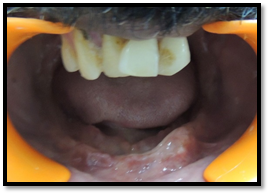
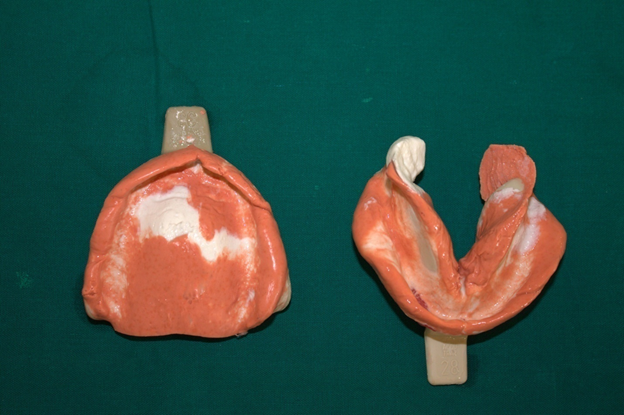
Watson described the 'window' impression technique where a custom tray is made with a window or opening over the (usually anterior) flabby tissues. (FIGURE 2 a & b).A muco-compressive impression is first made of the normal tissues using the custom tray with zinc-oxide and Eugenol. A low viscosity mix of Plaster of Paris/Alginate is then painted onto the flabby tissues through the window.3Kelly in 1972 coined the term “combination syndrome” and described changes caused by mandibular removable partial denture opposing maxillary complete denture.4
 |
|
| FIGURE: 2 (a). Window cut in an area of flabby tissue | FIGURE: 2 (b). Pressureless impression made with alginate |
Management of flabby tissue:
Flabby tissue can be managed by following approach
- Surgical excision of flabby tissue before conventional prosthodontic treatment.
- Implant retained prosthesis which can be fixed or removable.
- Conventional prosthetic treatment without surgical excision.
Surgical excision depends on several factors:
- Patient’s general health. Patients presenting with this type of prosthodontic problems are often elderly & may have complex medical histories.
- Because of cost factor, patient may not be able to afford this type of treatment.
Implant retained prosthesis
- If there has been excessive resorption & replacement by fibrous tissues, then there will be little bone remaining into which dental implants can be placed. While it would be possible to augment the remaining ridge with bone grafts, prognosis of such treatment would be questionable.
- Furthermore, medically compromised patients are also unsuited for dental implant treatment.
Mucostatic impression technique:
- Technique employed should be such that it displacesfibrous tissue as least as possible during impression. Primary impression should be recorded by amucostatic impression technique. Secondary impression should be “selective pressure” providing relief to the flabby tissue.2
- <
CUSTOMIZED ATTACHMENT RETAINED CHEEK PLUMPER PROSTHESIS
Aesthetic factor confined to both teeth and facial appearance. Facial aesthetic may be compromised due to lack of support from the internal structures, i.e. teeth, ridge, denture, etc. This results in slumped or hollow cheek proving detrimental to facial aesthetics.5 Cheek plumper help to enhance facial appearance by supporting the slumped cheeks. It can be a part of conventional denture forming a single unit or can be attached to complete denture by customized attachment or magnets.
INDICATIONS
Provide a youthful appearance in patients with hollow cheeks Restore aesthetics in patient with maxillofacial defect.
DRAWBACKS
Excessive weight added to the upper denture thus compromising retention Interference with masseter muscle and the coronoid process of the mandible Difficulty in chewing, difficulty in insertion and removal
 |
| FIGURE: 3 (a& b). Cheek plumper prosthesis attached to complete denture with magnets |
 |
| FIGURE: 3.1 (a& b). Magnets attached to the maxillary denture |
 |
|
| FIGURE: 5 (a). Suction disc attached to palatal surface of maxillary complete denture | FIGURE: 5 (b & c). Palatal hyperplasia due to suction chamber |
DOLLY (DUPLICATE) DENTURE
Many completely edentulous patients ask the dentist to provide them with two sets of dentures instead of one. They cannot face the embarrassment of being without a denture, even for a short period of time, in case of denture fracture or in case of any technical procedure. Aesthetics of previous denture can be duplicated hence restoring the previous appearance of the patient.6
INDICATIONS
- For older patients, to have replacement dentures (with improved fit) similar to those to which patients are accustomed.
- To renew old deteriorated and stained denture base material, duplicate denture will have the appearance of a new one.
- For physically or psychologically impaired patients who cannot adapt to new dentures.
 |
|
| FIGURE: 4 Duplicate Denture | |
DENTURE WITH MECHANICALRETENTIVE COMPONENTS
There are various mechanical factors which aid in retention of the denture. These are retentive springs, magnetic forces, suction chambers and suction discs, etc. In the past Suction chambers which creates a negative pressure in the maxillary dentures were used to aidin retention. They are avoided now due to their potency of creating palatalhyperplasia. Intramucosal magnets aid in increasing retention of highly resorbed ridges.
 |
| FIGURE: 5 (a).Suction disc attached to palatal surface of maxillary complete denture |
 |
| FIGURE: 5.Intra mucosal magnet in mucosa. |
 |
| FIGURE:5 (f). Magnet counter parts attached to the denture. |
SINGLE COMPLETE DENTURE
The prevalence of the condition where one edentulous arch opposes a natural or restored dentition is quite common. A single conventional denture may be desirable when it is to oppose any one of the following:- - Natural teeth that are sufficient in number not to necessitate a fixed or removable partial denture. - A partially edentulous arch in which the missing teeth have been replaced by a FPD/RPD. - An existing Complete Denture. Edentulous maxilla is always an advantage because: - It is easier to retain, maxillary CD in position. - It is more stable, better tolerated by patients & easier to fabricate than mandibular dentures.
Edentulous mandible is always at a disadvantage because:
- Limited quantity of mucosa.
- -
- Amount of denture border adjacent to moveable mucosa.
- Impact of occlusal forces from moving mandible contacting static dentate maxillary arch.
- Endosseous implant prove to be best in these conditions, as it provide retention & support for mandibular complete denture & to retard residual bone resorption.
Single maxillary complete denture
May be opposing all or some of mandibular natural dentition. Difficulties can be due to:-
- Malposed or supraerupted teeth in lower making it differ to achieve a harmonious balanced occlusion.
- The position of mandibular anterior teeth may make the esthetic & phonetic placement of maxillary anterior teeth difficult without introducing anterior interference in eccentric functional movement.
- Abrasion of artificial teeth if acrylic resin used or of natural teeth if porcelain artificial teeth are used.
Common occlusal disharmonies
- A common pattern of tooth loss involves the complete edentulous maxillary area opposing a mandibular partially edentulous arch with missing first molars or second premolars.
- Remaining molar - severely mesially inclined with distal halves supraerupted.
- If this situation left unaltered, there would be no occlusion in protrusive & lateral excursions except for contact on distal half of lower molar.
- The maxillary denture being easily dislodged during functional movements.
- If the molars not severely tilted, then reshaped by selective grinding.
Treatment
- Mandibular RPD should provide positive occlusal support from remaining natural teeth and have maximum coverage of basal seat beneath distal extension bases.
- Design should be rigid providing maximum stability and minimizing excessive stress on the remaining teeth.
- Occlusal scheme should be of proper vertical and centric relation.
- Anterior teeth be used for cosmetic and phonetic purposes only.
- Posterior teeth in balanced occlusion.
 |
| FIGURE: 6 Mandibular single complete denture opposing maxillary natural teeth. |
SINGLE DENTURE WITH METAL MESH
Reinforcement of acrylic denture base materials is done to improve the mechanical strength (Meng et al. 2005). Reinforcing agents may be in the form of metallic wires (Vojdani et al. 2006), cobalt-chromium wires (Uzun et al. 1999). Fracture is a result of the initiation and propagation of a crack and this requires the presence of a stress raiser or a point of localized stress. Midline palatal fractures of acrylic dentures occur because the midline of the palate serves as a fulcrum and superior displacement of the dentures results in fracture into two halves of the denture.7
Cyclic deformation of the denture base during function results in midline fracture of denture base due to flexural fatigue. The denture base can be reinforced in two ways, i.e., the entire denture base can be reinforced or reinforcement can be done at the weak region of the denture.7 Incorporation of metal mesh in the denture during packing of heat cure acrylic increases the strength of the denture.8
ADVANTAGES:
- Provides strength with metal frame for narrow dentures so less prone for fractures.
- Denture can be relined as and when required.
- Resistant to midline fracture due to metal reinforcement.
- Weight of the metal frame provides added strength and increases stability to the denture.
- These dentures are dimensionally stable as compared with conventional dentures, as processing changes are less.
- Less occlusal discrepancies.
- Long term cost efficiency.
- For patients who are medically compromised and for whom surgery is not indicated with flabby tissues in the denture bearing area, reliners can be used safely.
- Easy to adjust for the dentist and also for the patient.
- Prevention of chronic soreness from hard denture surface by using soft liners.
INDICATIONS
- Patients with atrophied ridges.
- Patient with compromised neuromuscular coordination, who may drop their dentures.
- Patients with increased rate of residual ridge resorption.
- a. Like postmenopausal women
b. Diabetic patients - Patients with flabby tissues which may require soft liner
- Patients who are allergic to metal, with a history of denture fractures.
 |
| FIGURE: 7 (a & b). Occlusion and palatal surface of maxillary denture incorporaed with metal mesh. |
SPLIT DENTURE TECHNIQUE (XEROSTOMIA)
Xerostomia, a clinical condition characterized by the dry mouth, difficulty in normal oral and oropharyngeal functions. Common complaint associated with it is extreme discomfort in wearing dentures.
CAUSES
- Old age
- Anxiety
- Depression
- Salivary gland diseases
- Sjogren’s syndrome
- Medication related side effects
- Head and neck radiation and
- Medically compromised conditions like diabetes mellitus.9
- Different approaches have been used to supply a moist oral environment. These include:
- Increasing the frequency of water intake,
- Changing dietary habits by including more citrus fruits in the diet,
- Salivary stimulants which include sugar free chewing gumsor lozenges,
- Salivary substitute.
One method of using salivary substitutes is incorporating salivary reservoir in the dentures like palatal reservoir and reservoir in mandibular complete denture.10-12
CASE SELECTION CRITERIA:
- Should be sufficient vertical dimension for placement of reservoir.
- Patients must have manual dexterity to separate and re-join the two segments of the split denture.
- Minimal undercuts should be present in the mandibular denture base area for reseating of the clear acrylic base section.
ADVANTAGES
- Ready access to the reservoirs, both by the patient and for professional attention.
- It allows easy cleaning and adjustment of the reservoirs as needed.
- The use of clear acrylic for the base section permits the clinician to determine the best size and position for placement of the reservoirs.
- Enables the patient to clearly visualize the levels of saliva substitute within the chamber.
DISADVANTAGES
- Laboratory stages are time consuming
- Precision is essential to ensure accurate and smoothly fitting segments
- Repairs and relines of the split denture become complex.

FIGURE: 8 (a).Preparation of reservoir
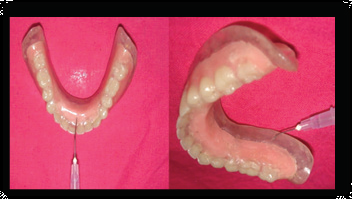
FIGURE: 8 (b).Lower denture with a clear acrylic base and a removable, pink acrylic upper section
DENTURE WITH IDENTIFICATION MARKINGS13-14
Presence of some markings on denture……
BENEFITS:
- Used for forensic and medico-legal investigation.
- Important for patients in long term care facilities.
- Misplacement of denture can be prevented.
- Personal identity in memory loss cases.
- Identification of dead and injured in mass disaster cases.
- According to American Board of Forensic Odontology guidelines, most dental identifications are based on restorations, caries, missing teeth and/or prosthetic devices. The purpose of denture marking therefore not only helps in the return of a lost denture, but also it facilitates the identification of edentulous persons who are either living or deceased.
Five requirements of marking dentures were suggested by Kruger- Monson. They were as follows:
- The strength of the prosthesis must not be jeopardized.
- It must be easy and inexpensive to achieve.
- The identification system must be efficient.
- The marking must be durable and visible.
- The marking must withstand fire and humidity.
Other requirements are:
- Biologically inert when incorporated into the denture. Inexpensive.
- Easy and quick to apply.
- Possible to retrieve after an accident.
- Acid resistant and survive elevated temperatures.
- Aesthetically acceptable.
- Visible (readable) and durable without jeopardizing the strength of the prosthesis.
- The marking should be permanent
- Resistant to everyday cleansing and disinfecting agents.
The recommended areas for marking therefore are the posterior regions of the lingual flange and the palate.
CLASSIFICATION
- Surface markings
- Inclusion
SURFACE MARKINGS
- Scribing or Engraving Embossing
- Embossing
INCLUSION
- Denture bar coding
- Lenticular card method
- ID band method
- Paper strip method
- T bar method
- Laser etching
- Electronic Microchips
- Photographic method
- Radio frequency identification tags
- Incorporation of lead foil
- Incorporation of transparency sheet
- Incorporation of sim card
REFERENCES
- Keni Nandita N, Aras Meena A, Chitre Vidya, Modified flange complete denture for labially inclined premaxilla. Indian journal of dental advancements. IJDA, 2(2), April-June, 2010 223.
- Finbarr Allen, Management of the flabby ridge in complete denture construction. Dent update, 2005; 32; 524-528.
- Watson R M. Impression technique for maxillary fibrous ridge. Br Dent J 1970; 128: 552.
- Kelly E. Changes caused by a mandibular removable partial denture opposing a maxillary complete denture. J Prosthetic Dent 1972; 27: 140-150.199: 715-719.
- Nandita N. Keni, Meena A. Aras, Vidya Chitre. Customised Attachments Retained Cheek Plumper Prosthesis:A Case Report J Indian Prosthodont Soc (July-Sept 2012) 12(3):198–200.
- Sandra L. McCarthy. Fabrication of a Duplicate Denture from an Existing Complete Denture Journal of Posthodontics. March 1995; Vo1 4: pp 54-57.
- Murthy HB, Shaik S, Sachdeva H, Haralur S, Sumit K, Rupa KT. Effect of reinforcement using stainless steel mesh, glass fibres, and polyethylene on the impact strength of heat cure denture base resin - An in vitro study. J Int Oral Health 2015; 7(6):71-79.
- Pasam et al. Relining a metal denture base. The Journal of Indian Prosthodontic Society March 2006; Vol 6(1):51-53.
- Dabas N, Phukela SS, YadavH. The Split Denture: Managing Xerostomia in Denture Patients: A Case Report. J Indian Prosthodont Soc. 2011 Mar; 11(1): 67–70.
- Hirvikangas M, Posh J, Makila E. Treatment of xerostomia through use of dentures containing reservoirs of saliva substitute. Proc Finn Dent Soc 1989;85:47–50.
Disclaimer from Guident
The views and opinions expressed in articles published in Guident are solely those of the authors and do not necessarily reflect the views of the editors, the editorial board or the publisher, Ivory India. Guident does not endorse any product, technique or treatment described. Clinical content is intended for qualified dental and medical professionals and is not a substitute for individual clinical judgement. Guident, its editors and the publisher accept no liability for any consequence arising from the use of information published in the journal.
How to cite this article
Dr. Shweta Saini Senior Lecturer Guru Govind Singh Dental College, Dr. Pawanjeet Singh. Complete Dentures- the Unconventional One. a Review (Part- II). Guident. 2016 Oct;9(11). Available from: https://guident.in/articles/prosthodontics/complete-dentures-the-unconventional-one-a-review-part-ii.html