
Dental Avulsion: A Review Article
Department of Pediatric and Preventive Dentistry, K. D. Dental College and Hospital, Mathura (UP)
ABSTRACT
The most serious dental injury is avulsion of a tooth in children. Dental avulsion is complete displacement of a tooth out of its socket with severed periodontium with or without fracture of alveolar bone. Postponement of evaluation by a dentist has been found to have an adverse effect on the prognosis of an avulsed tooth. Thus, storage in a medium until replantation is fundamental. This article is aimed at reviewing readily available storage media and the clinical protocols for the emergency, early and post treatment complications of the avulsed tooth.
INTRODUCTION
Among dental traumatic injuries, avulsion results for major functional and esthetic disturbances for patients. When tooth is exarticulated from the socket, neurovascular bundle and periodontal ligament gets ruptured and tooth is exposed to external environment which makes avulsion a complex traumatic injury (figure 1).1

Figure 1: Clinical presentation of avulsed left central incisor
Frequency of occurrence is 0.5% to 16% of all traumatic injuries with the maxillary central incisor being the most frequently involved tooth followed by maxillary lateral incisor.2 Most commonly affected age group is 7-10 years, when the alveolar bone is resilient and offers minimal resistance to extrusive forces.3 According to Andreasen et al., the erupting teeth exhibit short, incompletely formed roots surrounded by loosely structured periodontal ligament and the elasticity of alveolar bone which favors the avulsion of these teeth.4 Predisposing factors includes overjet, maxillary incisor exposure & interlabial gap.5 Prognosis of avulsed tooth is dependent on the survival of the viable periodontal ligament cells attached to the tooth root surface which is best preserved either when the tooth is immediately replanted into its socket or if it is stored in an appropriate storage /transport medium till a time, the tooth can be replanted into its socket.6 Home and schools are places where traumatic dental injuries occur. So not only dentist, but parents, teachers and coaches must have basic knowledge in emergency treatment of dental avulsion to achieve more successful outcome of the treatment. According to Ellis classification of traumatic dental injury, avulsion is classified as type V (teeth lost as a result of trauma).7 This review article discusses various storage media available for avulsed tooth which would increase the awareness among the healthcare providers and the prompt emergency treatment and guidelines to be followed depending upon the extraoral dry time to reduce post treatment complications of the avulsed tooth.
STORAGE MEDIA
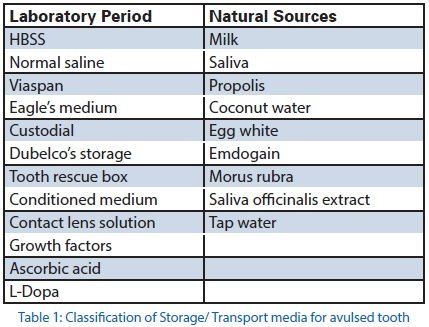
A storage medium may be defined as a physiological solution that closely replicates the oral environment to help preserve the viability of periodontal ligament (PDL) cells following avulsion.8 These solutions are capable of preserving the life of cells from the periodontal ligament during the time they are out of their alveolar socket.9 Ideal requirements of storage media are described in figure 2. The storage media can be classified as Laboratory prepared and Natural source.6 (Table 1)
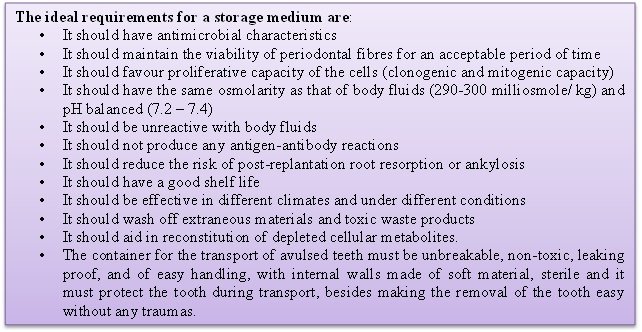
Figure 2: Ideal requirements of storage media
Tap Water: It has shown the least desirable results because it has bacterial contamination, hypotonicity, and non-physiological pH of 7.4 to 7.79 and an osmolality of 30 mOsmol/ kg which causes rapid PDL cells lysis.8 Blomlof et al found that storing cultured human PDL cells in tap water for 1 hour caused more PDL cell damage than the other physiological and non-physiological storage media tested.10 Although, some studies have suggested that it may be accepted as a storage medium for very brief periods when there are no alternatives, however, it should be remembered that it is the least desirable storage medium available and its use will lead to ankylosis and replacement resorption.11
Normal saline: It is a solution of 0.90% w/v of NaCl, and osmolality of 280 mOsm/kg. It lacks essential nutrients such as magnesium, calcium and glucose; necessary to the normal metabolic needs of the cells of the periodontal ligament.12 Cvek et al13 proposed that if an avulsed tooth has been kept dry for more than 15 min, it should be stored in an isotonic saline solution for about 30 min before replantation, presuming that PDL cells might be reconstituted or reconditioned by this procedure but in contrast Andreasen and Schwartz observed that following a 30-min dry period, saline storage under experimental conditions has no effect on development of root resorption and pulpal repair presumably because within 30 min maximal damage to the PDL has been inflicted.14 Thus it can be concluded that storage of the teeth in saline is only acceptable when other storage media (Hank’s Balanced Salt Solution) are not immediately available and when storage time is for a shorter duration.
Gatorade: It is a brand of sports-themed food consist of the mixture of water, sodium, sugar, potassium, phosphate, and lemon juice. Gatorade is hypertonic, it can make cells lose water. Gatorade preserves more viable cells than tap water but fewer than all other media.15 Gatorade, according to Harkacz et al did not turn to be an adequate storing medium for avulsed teeth due to its pH around 2.91 and its osmolality of 407 mOsm/ kg.16 According to Chamorro et al when cells are exposed to Gatorade, it is possible that the delicate cellular membrane gets damaged because of the low pH, which makes it impossible for the cell to grow.17
Saliva: Patients own saliva is the best immediate transport medium for an avulsed tooth.18 Though very readily available, avulsed teeth should not be stored for longer than 30 minutes in saliva as it contains potentially harmful substances, such as enzymes, bacteria and their by-products.19 After trauma, several ml of saliva can easily be collected in a cup and the tooth can be placed inside the patient’s mouth under the tongue or in buccal vestibule. In an animal study, Andreasen showed that saline and saliva were suitable storage medium for protection against root resorption for short extra-alveolar periods.20 Thus saliva can be considered to be an acceptable short-term storage medium (less than 30 min) and its use should be limited to cases where the extra-alveolar duration is less and other superior storage media are not available.
Milk: Milk is the most practical transport medium for the storage of avulsed teeth. It is readily available, contains amino acids and vitamins, capable of inactivating enzymes harmful to the PDL cells.21 Milk has a pH of 6.5 to 7.2 and osmolarity of 270 mOsmol kg-1, which is similar to extracellular fluid.10 Milk can potentially maintain PDL cell viability for up to 2 hours. The disadvantages are that milk needs to be fresh and kept refrigerated, it does not replace depleted cell metabolites, and it does not facilitate cell mitosis.22 Blomlof et al, Trope and Friedman recommend milk as an excellent storing solution for 6 hours, however, milk cannot revive the degenerated cells.10 According to Lekik et al,23 at a cellular level, milk is ranked equal to HBSS as a storage medium although it loses its effectiveness after 2 hours. Milk is superior to saliva with regard to the number of viable cells and the ability of the cells to recover and heal wounds.
Coconut water: Coconut water is biologically pure, sterile and rich in amino acids, proteins, vitamins and minerals. This natural isotonic fluid having pH of 4.1 is available in its natural form. Gopikrishna et al24 have recently reported that coconut water had a greater capacity to maintain cell viability when compared to propolis, HBSS and milk. However, Moreira-Neto et al25 observed that coconut water has an acidic pH of 4.1, which is deleterious to cell metabolism and concluded that the capacity of the storage media in maintaining human fibroblast cell viability in a decreasing order was milk > saline and coconut water with sodium bicarbonate > coconut water > still mineral water.
Hank’s Balanced Salt Solution (HBSS): This solution is non-toxic; it is biocompatible with periodontal ligament cells, pH balanced at 7.2 and has an osmolality of 320 mOsm/kg. It is composed of 8 gram/litre sodium chloride; 0.4 g/L of D-glucose; 0.4 g/L potassium chloride; 0.35 g/L sodium bicarbonate; 0.09 g/L sodium phosphate; 0,14 g/L potassium phosphate; 0.14 g/L calcium chloride; 0.1 g/L magnesium chloride and 0.1 g/L magnesium sulphate. Ashkenazi et al26 showed that Hank’s balanced salt solution was the most effective medium for preserving viability, mitogenicity and clonogenic capacities of periodontal ligament cells for up to 24 hours at 4â—¦C, when compared with culture medium (Eagle’s medium supplemented with 15% fetal calf serum and antibiotic solution [100 UI/mL Penicillin, 50μg/mL Gentamicin and 0,3μg/mL Fungizone]), Eagle’s medium, milk, ViaSpan and conditioned medium. Krasner and Person27 have developed an avulsed tooth storage system and emergency tooth preserving system (Save-A-Tooth), which contains HBSS, a net for holding the teeth atraumatically and a container for taking the submerged tooth to a clinician. It is a desirable storage medium for avulsed teeth, even when the extra-alveolar period is extensive (between 72 and 96 hours).17
Honey Milk: Honey milk has 8% non-fat solid milk, 3grams protein, 11grams carbohydrate, 0.1grams calcium, 0.6 grams minerals and 0.12 grams phosphorous and natural honey (5%). This product has extended storage capability of at least 6 months without the need for refrigeration. In a study fresh milk revealed the best outcome after 1 hour. After 9 hours, long-shelf life honey milk showed better results in comparison to fresh milk. This is in agreement with the study by Marino et al which showed that after 8 hours, the cells’ viability was higher in milk compared to HBSS. Long-shelf life honey milk may be considered as appropriate storage media which are comparable to HBSS and better than fresh milk medium.28
Egg white: Khademi et al have compared milk and egg white as solutions for storing avulsed teeth, and the results have shown that teeth stored in egg white for 6 to 10 hours had a better incidence of repair than those stored in milk for the same amount of time (p < 0.05). The osmolality of the egg white is between 251 and 298 mOsm/kg. The authors suggest that egg white can be the perfect medium for storing avulsed teeth.18
Oral Rehydration Salt-Liquid: Subramaniam et al found oral rehydration solution-liquid as storage medium to be as efficient as HBSS to maintain the viability of PDL cells, however, found it to be better than milk.29
Tooth Rescue Box (DENTOSAFE): It contains a culture medium similar to the medium used during islet cell transplantation containing salts, amino acids, glucose, and vitamins. It has been shown to maintain the vitality of PDL cells for up to 48 hours at room temperature in vitro. At room temperature, the unopened box has a shelf life of 3 years. According to Pohl et al, Dentosafe should be the standard equipment in first aid kits but this solution and device are not readily available in all countries.29
Various studies conducted on different storage medias for avulsed tooth in past 10 years has been shown in Table 2.

Table 2: Review of literature of experimental studies on various storage medias from year 2010 -2019
Treatment guidelines for avulsed permanent teeth 30
Recommended guidelines of the American Academy of Pediatric dentistry for the Treatment of avulsed permanent teeth is given in figure 3 and 4.
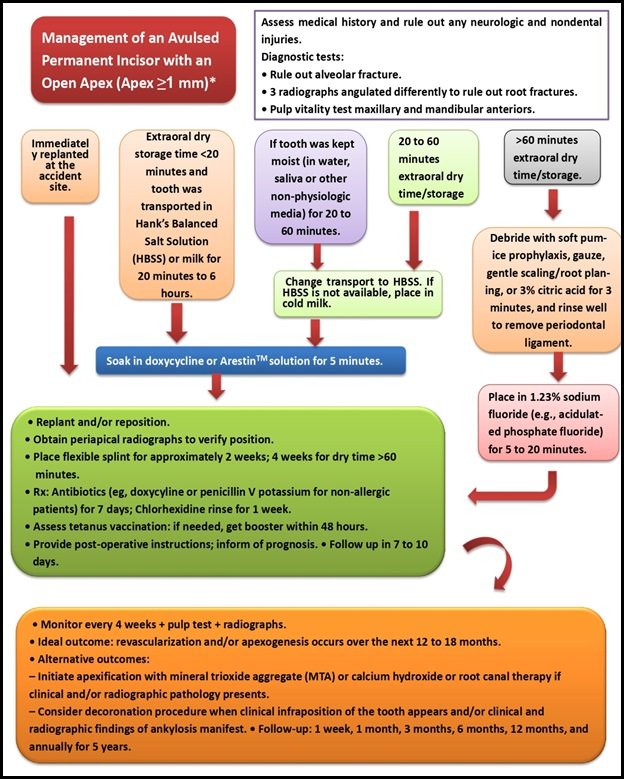
Figure 3: AAPD decision tree for management of avulsion of permanent teeth with open apex
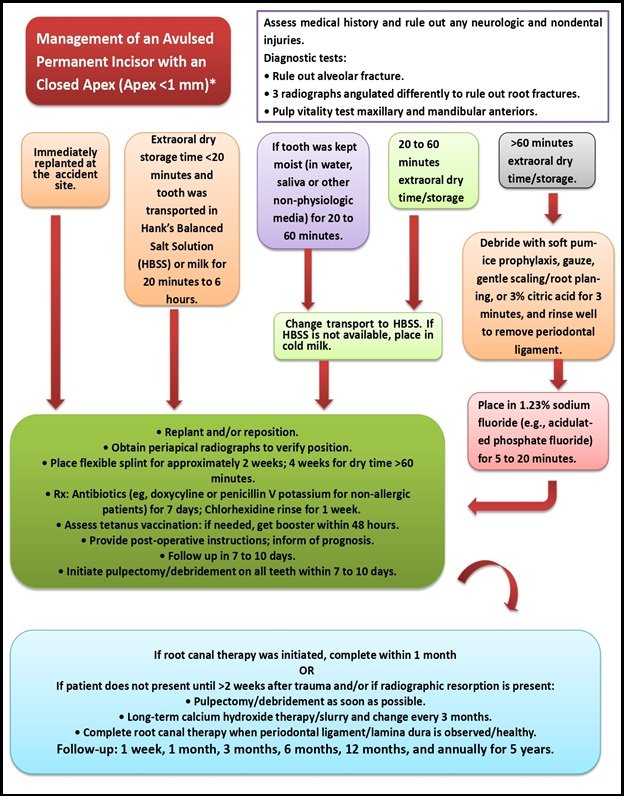
Figure 4: AAPD decision tree for management of avulsion of permanent teeth with closed apex
CONCLUSION
An appropriate storage medium can provide immediate protection from desiccation of PDL cells following trauma. Several storage media have been proposed, HBSS being the optimal. Gatorade, saline, saliva and tap water have been considered non-physiological and are not recommended due to factors, such as pH and osmolarity. Pasteurized milk, egg white, propolis, and coconut water have shown promising results and are readily available but their clinical effectiveness has yet to be determined further in vivo. HBSS and chilled milk are the most appropriate, clinically recommended storage media for avulsed teeth. The combination of prevention and educational actions is expected to diminish the avulsion accident rates and improve the long-term prognosis of replanted teeth.
REFERENCES
- Guedes OA, Borges ÁH, Bandeca MC, de Araújo Estrela CR, de Alencar AG, Estrela C. Analysis of 261 avulsed permanent teeth of patients treated in a dental urgency service. J Dent Res Rev 2015; 2: 25-9.
- Narayana Rao V, Suresh S, Viswanath V, Srinivas P, Devaki T, Zaheer A. Assessment of Knowledge about Management of Tooth Avulsion among 7-14 Years Old School. Children In Nalgonda, Andhra Pradesh. J Indian Assoc Public Health Dent 2013; 11 (3): 68-7
- Hegde S, Roma M. Current developments in transport media for avulsed teeth: An Update. Asian J Pharm Clin Res 2017; 10(2):43-46.
- Petti S, Tarsitani G. Traumatic injuries to anterior teeth in Italian schoolchildren: prevalence and risk factors. Dental Traumatology 1996;12:6:294-97.
- Namdev R, Jindal A, Bhargava S, Bakshi L, Verma R, Beniwal D. Awareness of emergency management of dental trauma. Contemp Clin Dent 2014; 5: 507-13.
- Siddiqui F, Karkare S. Storage Media for an Avulsed Tooth: Nature to the Rescue. Br J Med Health Res 2014;1(3).
- Ellis, RG & Davey, KW. The classification and treatment of injuries to the teeth of children. 5th edn, Year Book Publisher, Chicago, 1970; 1-231.
- Sangappa SK, Kumar AP, Shruti, Srivastava P. Extra-alveolar storage media for teeth: A literature review. Int J Adv Res 2014; 2(7):963-972.
- Naveen HK, Veena A, Rakesh CB, Prasanna KB. Advances in storage media for avulsed tooth : a review. I J Pre Clin Dent Res 2015;2(3):41-47.
- Blomlof L, Andersson L, Lindskog S, Hedström KG, Hammarström L. Periodontal healing of replanted monkey teeth prevented from drying. ActaOdontolScand 1983; 41: 117–23.
- Bibby KJ, McCulloch CA. Regulation of cell volume and [Ca2+] in attached human fibroblasts responding to anisosmotic buffers. Am J Physiol 1994; 266: C1639–49.
- Alacam T1, Gorgul G, Omurlu H, Can M. Lactate dehydrogenase activity in periodontal ligament cells stored in different transport media. Oral Surg Oral Med Oral Pathol Oral RadiolEndod. 1996 Sep;82(3):321-3.
- Cvek M, Granath L, Holender L. Treatment of nonvital permanent incisors with calcium hydroxide. III.Variation of occurrence of ankylosis of reimplanted teeth with duration of extra-alveolar period and storage environment. Odontol Revy 1974;25:43-56.
- Andreasen JO, Schwartz O. The effect of saline storage before replantation upon dry damage of the periodontal ligament. Endod Dent Traumatol 1986;2:67-70.
- Adnan S, Lone MM, Khan FR, Hussain SM, Ehsan S. Which is the most recommended medium for the storage and transport of avulsed teeth? A systematic review. Dent Traumatol 2018;34(2):59-70.
- Harkacz OM Sr, Carnes DL Jr, Walker WA. Determination of periodontal ligament cell viability in the oral rehydration fluid Gatorade and milks of varying fat content. J Endo1997 Nov;23(11):687-90.
- Chamorro MM, Regan JD, Opperman LA & Kramer PR. 2008. Effect of storage media on human periodontal ligament cell apoptosis. Dent Traumatol, 24: 11–6.
- Human periodontal ligament cell viability in milk and milk substitutes. J Endod 2003; 29: 184–186.)
- Khademi AA, Saei S, Mohajeri MR et al. A new storage medium for an avulsed tooth. J Contemp Dent Pract 2008; 9: 25–32.
- Weine FS. Endodontic emergency treatment. Endodontic therapy, 6th ed. Mosby, 1996:74-103.
- Facade OO. Extra-alveolar storage media for tooth auto transplants and replants. Internet J Dent Sic 2005; 2: 1–10.
- Layup ML, Barrett EJ, Kenny DJ. Interim storage of avulsed permanent teeth. J Can Dent Assoc 1998; 64: 357–63. 365-9.
- Lekic PC, Kenny DJ & Barrett EJ. 1998. The influence of storage conditions on the clonogenic capacity of periodontal ligament cells: implications for tooth replantation. Int Endod J, 31:137-140.
- Gopikrishna V, Thomas T, Kandaswamy D. A quantitative analysis of coconut water: a new storage media for avulsed teeth. Oral Surg Oral Med Oral Pathol Oral Radiol Endod 2008;105:61-65.
- Moreira-Neto JJ, Gondim JO, Raddi MS, Pansani CA. Viability of human fibroblasts in coconut water as a storage medium. Int Endod J 2009;42:827-30.
- Ashkenazi M, Marouni M, Sarnat H. In vitro viability, mitogenic and clonogenic capacities of periodontal ligament fibroblasts after storage in four media supplemented with growth factors. Dent Traumatol 2001;17:27-35.
- Krasner P, Person P. Preserving avulsed teeth for replantation. J Am Dent Assoc 1992;123:80-88.
- Nozari A, Esmaeilpour T, Fijan S, Salmannejad M. Caspian J Dent Res 2013;2(1):42-7.
- Olson et al. Comparison of Transport Media. J Endod 1997; 23 (11): 676-679.
- Decision Trees for Management of an Avulsed Permanent Tooth. AAPD Reference Manual 2017-18; 39(6):482-483.
Disclaimer from Guident
The views and opinions expressed in articles published in Guident are solely those of the authors and do not necessarily reflect the views of the editors, the editorial board or the publisher, Ivory India. Guident does not endorse any product, technique or treatment described. Clinical content is intended for qualified dental and medical professionals and is not a substitute for individual clinical judgement. Guident, its editors and the publisher accept no liability for any consequence arising from the use of information published in the journal.
How to cite this article
Dr. Arundhati Goyal, Dr. Manvi Srivastava, Dr. Ritu Khanduja. Dental Avulsion: A Review Article. Guident. 2020 Jun;13(7). Available from: https://guident.in/articles/pedodontics/dental-avulsion-a-review-article.html


