
"The Evolution of the Spring Aligner for Treating Orthodontic Relapse and Mild Crowding"
Australia
Spring Aligners or Spring Retainers have been used for minor tooth movement for the past 25 years or more1. The original design was developed for very minor tooth movement and mostly for rotations. All spring aligners are fabricated on casts in which model surgery has been performed. The anterior teeth needing correction have been removed and reset in an ideal position in wax on the working cast. The appliance is then fabricated on the corrected cast so that when worn by the patient the “built in” forces correct the misaligned teeth. (figure1)

Fig.1: Model surgery – Anteriors reset
The first spring retainers were Hawley retainers with labial acrylic fabricated on the corrected working models. (figure 2)
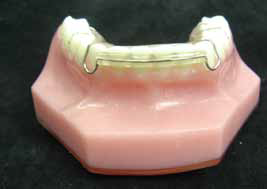
Fig. 2: Spring Hawley Retainer
The first Spring Aligners were Mini Postioners or cuspid to cuspid spring retainers. With the addition of lingual ball clasps the fear of swallowing or aspirating the appliance was reduced. (figure 3)

Fig. 3: Mini-Positioner
Adding loops or helixes to the lingual and labial components, often called a Super Spring Retainer was developed to allow a more aggressive correction of the misaligned teeth. This design flexed more or “opened up more” so that the appliance would be able to be fitted even with a greater correction of the misaligned teeth. These designs had a separate labial and lingual element. (figure 4)

Fig. 4: Super Spring Retainer
Other advances included using more flexible wires such as TMA and eliminating the acrylic such as the Apex Aligner.
All spring aligners will function and correct misaligned teeth if appropriate case consideration and realistic expectations are adhered to.
Two problems are associated with the past designs: First, stainless steel wires providing the skeleton of the appliances, do not have very much flex or spring significantly. This effects how much correction can be accomplished. Stainless steel also exerts an abrupt and uncomfortable force. Secondly, the direction of force created by standard spring aligners creates seating and retention problems. The lingual component can have a mouse trap-like, dislodging effect. Standard Spring Retainers are designed for minor correction only and tend to just tip teeth into a better position.
Inman Orthodontic laboratory in Coral Springs FL felt there had to be a better way to realign teeth. They wanted to be able to correct anterior teeth more aggressively with just one appliance that was both effective and tolerable for the patient.
Inman Orthodontic Laboratory has created an appliance that takes advantage of the gentle steady forces of Nickel Titanium by designing piston like components driven by NiTi coil springs 2. The forces are adjusted by altering the coil size and or compressing the coil to create a stronger force.
Secondly, Inman have designed lingual and labial components to function or move parallel to the occlusion, eliminating the mousetrap de-seating forces and allowing true bodily movement of teeth. (figure 5)

Fig. 5: Standard Inman Aligner
The standard appliance consists of both lingual and labial NiTi driven components.
The forces combine to “squeeze” teeth into alignment. (figure 6)

Fig. 6: Standard Inman Aligner photograph
The before and after photos below depict ideal case selections (figures 7, 7a and 7b)
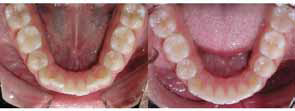
Fig. 7

Fig. 7A
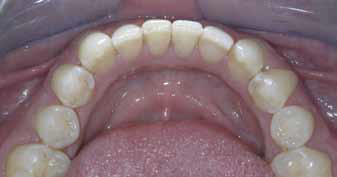
Fig. 7B
A more extreme case selection may also show success, but only in a very compliant patient. The treatment time depicted below was 5 months. (figure 8)

Fig. 8
Another variation of the Inman aligner is the Lingual NiTi driven component that has an adjustment free fixed labial bow. Indications for this design include lingually displaced teeth. (figure 9)

Fig. 9: Inman Fixed Bow
A Lingual NiTi driven component, with posterior bite pads, may be employed to open the bite and allow the anteriors to jump. This appliance eliminates the need for finger springs, screws and adjustments. (figure 10)
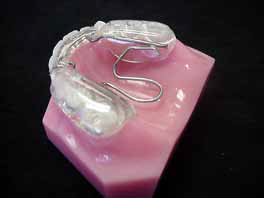
Fig. 10: Inman Cross Bite
In cases of tongue thrust or digit sucking a labial NiTi component can be used in conjunction with a habit crib or roller. As the habit is broken the labial component gently guides the anterior back in and down. (figure 11)
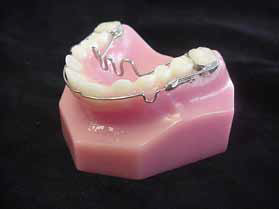
Fig. 11: Inman Habit Appliance
Lingual and labial NiTi driven components may also be incorporated in a fixed banded version when patient compliance is an issue. (figure 12)

Fig. 12: Inman Banded
A general tooth movement guide may be summarised as follows:
- Incisors labially - great potential
- Incisors lingually - great potential
- Incisors rotation - good potential
- Incisors mesially or distally (crowded cases) - difficult, but possible as a "domino effect"
- Incisors mesially or distally (excess space cases with no retraction, just mesial or distal shifting) - impossible
- Incisor angulation correction (mesial or distal root torque) - very difficult
- Incisors vertically - impossible
- Incisors labial or lingual tipping - great potential
- Canines lingually - difficult
- Canines distally - possible
- Canines labially - nearly impossible
- Canines laterally - nearly impossible
- Canine angulation correction (mesial or distal root torque) - nearly impossible
- Canine mesio-labial rotation - difficult
- Canine disto-labial rotation - impossible
- Canines vertically - impossible
Space availability is of course a major consideration. All corrections are entirely dependant on the space being present. Space creation may be achieved through interproximal reduction3, 4 or through arch expansion5. Further research is being undertaken at Great Lakes Orthodontics to predict and programme expansion into the Inman appliances.
CONCLUSION
Inman Laboratory is four years into fabricating the Inman Aligners. They have many of their very first trial or beta Orthodontists, including myself, using the appliances on a weekly basis. The appliance can be used for cases in which a clinician would normally prescribe two or three standard spring appliances. The Inman Aligner may be used to treat mild to moderate adult relapse cases when patients don’t want brackets or can’t afford Invisalign aligners. Case selection is very important as moving cuspids can be difficult.
REFERENCES
- Barrer Hg. Protecting the integrity of mandibular incisor positioning through keystoning procedure and spring retainers appliance. J Clin Ortho 9:486-494, 1975)
- Bowman SJ. The Inman Aligner. J Clin Ortho 37: 438-442, 2003
- Warunek SP and Willison BD. Incisor Alignment with the Inman Aligner. J Clin Ortho 20: 80-98, 2005
- Proffit WR. Contemporary Orthodontics (3rd ed.) St Louis, MO: Mosby; 2000
- Graber TM Vanarsdall RL. Orthodontics: Current principles and techniques (3rd ed.) St. Louis, MO: Mosby; 2000
Disclaimer from Guident
The views and opinions expressed in articles published in Guident are solely those of the authors and do not necessarily reflect the views of the editors, the editorial board or the publisher, Ivory India. Guident does not endorse any product, technique or treatment described. Clinical content is intended for qualified dental and medical professionals and is not a substitute for individual clinical judgement. Guident, its editors and the publisher accept no liability for any consequence arising from the use of information published in the journal.
How to cite this article
Dr Derek Mahony 49 Botany Street Ranswick NSW 2031 Sydney. "The Evolution of the Spring Aligner for Treating Orthodontic Relapse and Mild Crowding". Guident. 2015 Dec;9(1). Available from: https://guident.in/articles/orthodontics/the-evolution-of-the-spring-aligner-for-treating-orthodontic-relapse-and-mild-crowding.html


