Face Mask Therapy
Department of Orthodontics and Dentofacial Orthopedics Manipal College of Dental Sciences, Manipal, Karnataka, India
Of all the options available for the treatment of Class III malocclusion in children, the orthopaedic face mask may provide the greatest opportunity to correct this problem, whether identified during the late deciduous or early transitional dentition. As the craniofacial complex in juveniles is still malleable, significant changes in all three planes of space may be produced by this type of therapy, especially when combined with rapid maxillary expansion.
Although the facial mask was developed over 100 years ago, this approach was used infrequently until re-introduced by Delaire in the late 1960s for treatment of cleft patients. Interest in the facial mask in the United States later was stimulated by Petit, through his studies conducted at Baylor University.
Following the use of the Petit face mask for over two decades, it has been concluded that the facial mask is effective in most developing Class III patients, because the appliance system affects virtually all areas contributing to a Class III malocclusion (e.g., maxillary skeletal retrusion, mandibular prognathism, decreased lower anterior facial height). Thus, this treatment protocol can be applied to most developing Class III patients regardless of the specific etiology.
Nanda1introduced a modified protraction headgear in 1980, which allowed changes in the direction of force and point of force application on the maxilla as well as the chin. The study showed that use of a modified protraction headgear for 4-8 months can displace the maxilla 1-3mm and maxillary dentition 1-4mm. These changes were accompanied by remodelling at point B, lingual tipping of the mandibular incisors, and downward rotation of the mandible. The cumulative effect of these changes was the correction of the Class III malocclusion. Nanda’s design has two main components: intra- and extra-oral set up. The intra-oral components consist of a removable acrylic plate with occlusal coverage, or a Hyrax-type of non-bonded device. The extra-oral components have two parts – a face mask and an intra-oral to extra-oral connecting force device which utilizes a modified headgear bow instead of intraoral elastics.
Conte and colleagues (1997)2 developed a reverse headgear that exerts a selective propulsive force on the maxilla with no deleterious effect on the temperomandibular joint. It can be used for orthopaedic correction in growing patients or for dentoalveolar correction in adults. This protractor has a simple, anatomically contoured frontal support, held in place with an adjustable strap around the temporal and occipital regions of the head. The propulsive traction is provided by two flexible 2mm stainless steel wires that protrude from the frontal support and are bent to follow the patient’s facial contour when activated. The force delivered by the two wires depends on their distance from the maxillary arch prior to activation. Hooks on the ends of the wires, similar to those of other extraoral appliances, are attached to archwire hooks in the maxillary canine regions. The vertical component of the propulsive force can also be controlled by adjusting the length of the wires.
Merwin et al (1997)3 described the use of a Hyrax-type palatal expander and the Tubinger (Dentaurum, Germany) design of reverse pull headgear in the treatment of Class III malocclusion with maxillary deficiency. The Tubinger reverse-pull headgear delivered 380 gm of maxillary protraction force on each side, 30° downward from occlusal plane.
Both anteroposterior and vertical maxillary deficiency can contribute to Class III malocclusion. If the maxilla is small or positioned posteriorly, the effect is direct. If it does not grow vertically, the mandible rotates upward and forward, producing an appearance of mandibular prognathism that may be due more to the position of the mandible than its size. For children with anteroposterior and vertical maxillary deficiency, the preferred treatment is to move the maxilla into a more anterior and inferior position, which also increases its size as bone is added at the posterior and superior sutures. As with transverse expansion, it is easier and more effective to move the maxilla forward at younger ages, although recent reports indicate that some anteroposterior changes can be produced into early adolescence. When force is applied to the teeth for transmission to the sutures, tooth movement in addition to skeletal change is inevitable.
Cozzani (1981)4 suggested that true Class III malocclusions are difficult to treat because they reflect basal bone discrepancies and there are many limitations to conventional treatment mechanisms. For example, Class III elastics may adversely affect the inclination of the occlusal plane and bite depth. On the other hand, extraoral appliances can be used advantageously. One important application is to move a retrognathically positioned maxilla forward orthopedically by means of the facial mask of Delaire. In addition, extraoral appliances placed against the lower incisor segment can also be used to retract the mandibular incisors and control bite depth during the retraction procedure.
A repetitive weekly protocol of alternate rapid maxillary expansion and constriction (Alt-RAMEC) was presented by Liou5 (2005) to disarticulate the circum-maxillary sutures. With this protocol, the maxilla is expanded 1 mm/day for 1 week, then constricted 1 mm/day for the next week with a two-hinged rapid maxillary expander. The procedure is repeated for 7-9 weeks to disarticulate the maxilla, thus, facilitating the forward movement of maxilla. This is quite similar to simple tooth extraction, in which the tooth is rocked buccally and lingually until it is ‘loosened’ from the alveolar socket.
The use of the facial mask in the mixed dentition is in marked contrast to the treatment of Class III malocclusion in surgical patients in whom surgical intervention must be targeted to the area of the craniofacial complex in which there is a deficiency or excess. In facial mask therapy, because the intervention is accomplished at an early age, the treatment effects produced by the facial mask ultimately are incorporated into the future craniofacial growth that occurs over a long period. Petit describes such patients as having "prognathic syndrome" in which the underlying skeletal relationships may be out of balance in all three planes of space.

Figure showing patient wearing Petit type face mask
BIOMECHANICS OF REVERSE PULL HEADGEAR
Mechanical principles that need to be defined include the following-
- Centre of resistance (CR) - point where resultant of constraining forces when acting will tend to cause pure translation of body in direction of force.
According to Worms et al (1973) - CR of maxillary 1st molar is at trifurcation of roots.
Poulton (1959)- geometric centre of fully banded maxillary arch is between premolar roots- designated as “M”
Barton (1972) - CR of banded maxillary arch will vary according to number of teeth banded & size of their roots.
Braun et al6 (1999) - Holding amalgam plugger in the maxillary vestibular region while the teeth are in occlusion and soft tissues and lips are relaxed. Then facing buccally amalgam plugger is positioned at one half of the distance from inferior border of the orbit to the functional occlusal plane and corresponding to the distal contact of maxillary first molar. A mark is made on the skin and checked for asymmetry. This gives the centre of resistance of maxilla.
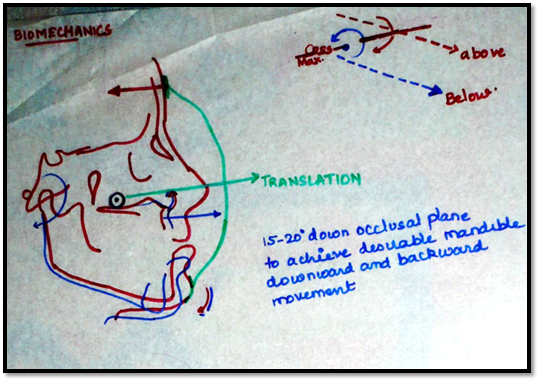
Figure showing centre of resistance of maxilla and associated rotation according to direction of force.
TIMING OF TREATMENT
- Fields recommended that maxillary protraction be initiated before the age of 9 to produce more skeletal change and less dental movement.
- Takada et al(EJO 1993)7 reported that maxillary protraction and chincup therapy were effective through puberty.
- Ngan8 stated skeletal and dental corrections were found to be equally effective when treatment was started between 5 to 8 years old or 9 to 12 years old.
- According to Baccetiet al9, treatment of Class III malocclusion with bonded maxillary expander and face mask in the early mixed dentition results in more favorable craniofacial changes than treatment in the late mixed dentition. In particular, significant forward displacement of maxillary structures was achieved as an outcome of early treatment, whereas the late-treatment group showed no significant improvement in maxillary growth with respect to matched untreated controls.
TREATMENT EFFECTS
The treatment effects produced by this type of appliance include a forward movement of the maxilla and maxillary dentition, a downward and backward rotation of the mandible, and a lingual tipping of the mandibular incisors. In patients with a "pseudo-Class III" malocclusion, any discrepancy between centric occlusion and centric relation is eliminated as soon as the patient wears the appliance. Spontaneous correction of Class III malocclusion occasionally occurs when the patient undergoes orthopaedic expansion of the maxilla. This type of response usually is observed within the first few weeks or months of active expansion and may be due to a slight forward movement of the maxilla.
Skeletal changes
More apposition inthe posterior portion of maxillaà at the maxillary tuberosity attributable to posteroanterior traction àthe opening of the suturesàstretching of sutural connective tissue fibres ànew bone deposition along the stretched fibres.
Dental changes
: related to orthopaedic protraction forces to the maxilla include maxillary incisor protrusion, mandibular incisor retrusion, achievement of normal overjet and overbite, and decrease in the interincisal angle.
Thus, the clinician should monitor the sagittal relationship of the occlusion closely to determine if a spontaneous improvement occurs. This positive response typically occurs in patients with reasonably well balanced faces and mild to moderate malocclusions. If such a response is observed, the facial mask may not be needed, or the hours per day of facial mask wear may be reduced (e.g., nights only.)
CONCLUSION
The nature of the treatment response produced by the face mask and the age at which this therapy is initiated indicate the appropriateness of this appliance in a wide range of Class III problems.
Both early and late orthodontic treatments are associated with compromises that should be anticipated by the practitioner. Earlier treatment, however, increases the overall time the patient will be in treatment. Over-correction is recommended for better stability of a case.
REFERENCES
- Nanda R. Biomechanical and clinical considerations of a protraction headgear. Am J Orthod. 1980; 78: 125-39.
- Conte A, Carano A, Siciliani G. A new maxillary protractor. J ClinOrthod. 1997; 31: 523-30.
- Cozzani G. Extraoral traction and class III treatment. Am J Orthod. 1981 Dec;80(6):638-50.
- Merwin D, Ngan P, Hagg U, Yiu C, Wei SHY. Timing for effective application of anteriorly directed orthopaedic force to the maxilla . Am J OrthodDentofacOrthop 1997;112:292-9.
- Liou EJ. Effective maxillary orthopedic protraction for growing Class III patients: a clinical application simulates distraction osteogenesis. Progress in Orthodontics 2005b;6:154-71.
- Braun et al : A reexamination of various extraoral appliances in light of recent research findings ; Angle Orthod 1999; 69(1):81-4.
- Takada K, Petdachai S, Sakuda M.Changes in dentofacial morphology in skeletal Class III children treated by a modified maxillary protraction headgear and a chin cup: a longitudinal cephalometric appraisal.Eur J Orthod. 1993 Jun;15(3):211-21.
- Ngan PW, Hagg U, Yiu C, Wei SHY. Treatment response and long-term dentofacial adaptations to maxillary expansion and protraction. SeminOrthod 1997;3:255-64.
- Baccetti T, McGill JS, Franchi L, McNamara JA Jr, Tollaro I. Skeletal effects of early treatment of Class III malocclusion with maxillary expansion and face-mask therapy. Am J OrthodDentofacialOrthop 1998;113:333-43.
Disclaimer from Guident
The views and opinions expressed in articles published in Guident are solely those of the authors and do not necessarily reflect the views of the editors, the editorial board or the publisher, Ivory India. Guident does not endorse any product, technique or treatment described. Clinical content is intended for qualified dental and medical professionals and is not a substitute for individual clinical judgement. Guident, its editors and the publisher accept no liability for any consequence arising from the use of information published in the journal.
How to cite this article
Dr. Siddharth Mehta, Dr. Anjali Mehta, Dr. Surendra Lodha. Face Mask Therapy. Guident. 2014 Feb;7(3). Available from: https://guident.in/articles/orthodontics/face-mask-therapy.html