
Immediate Implants and Recession
New Delhi, K.D Dental College, Mathura, India
IMMEDIATE IMPLANTS AND RECESSION
Osseointegrated implants have been used with great success for many years (Blanes et al. 2007). Immediate implant placement became a revolutionary therapy by reducing the time required for rehabilitation with the possibility of preserving the morphologic contour of the ridges (Blanes 2007, Tolstunov 2007, Evans 2008, Lazzara 1989, Kan JY 2003, Chen 2007, Wheeler 2000).
As a recent trend there has been interest in placing dental implants into sockets immediately following the extraction of the tooth. Such placements are still a controversial subject with two entirely opposite school of thoughts. It has been suggested that the immediate placement of implants into extraction sockets may avoid the resorption process of the buccal bone plate and maintain the original shape of the alveolar ridge (Evans & Chen 2008). However, a series of researches conducted in dogs (Araujo & Lindhe 2005; Araujo et al. 2005) failed to support this hypothesis. The placement of an implant in a tooth extraction socket site failed to prevent remodeling that occurred, in particular, in the buccal plate of bone (Araujo & Lindhe 2005; Januario et al. 2011). However, some recent studies in animals have shown pronounced resorption of the buccal bone plate and in some extension of the lingual bone plate after immediate implant therapy (Becker 1998, Paolantonio 2001, Araujo 2005), contradicting the previous studies (Araujo 2006, Bottecelli 2004). In particular, the recession of the facial mucosa is the main complication observed with immediate implants (Blanes 2007, Botticelli 2006, Becker 2005, Schwartz 1998, Chen 2009, Buser 2004, Grunder 2005, Ferrus 2010).
To achieve aesthetic success, it has been suggested to place the implant in an ideal three-dimensional position (Buser et al. 2004), in order to maintain the adequate buccal bone (Grunder et al. 2005; Ferrus et al. 2010) and tissue biotype (Chen et al. 2007). The thickness of the labial bony wall is of utmost importance to determine the most suitable treatment approach (Braut et al. 2011). Especially in the maxillary anterior region that has an aesthetic importance in cases of immediate placement as the buccal bone should be at least 1–2 mm to preclude future bone resorption and to create adequate soft tissue support (Grunder et al. 2005). Due to the fact of naturally occurring biologic events, the thin facial bone wall is prone to resorption which can lead to fenestration and dehiscence following tooth extraction (Schropp et al. 2003). The facial bony walls are essential for the long-term stability of the mucosa around the dental implants, the height of the alveolar crest determines the occluso gingival position of the implant. The facial bony thickness influences the facial convexity of the alveolar process at the emerging crown (Blanes et al. 2007). Thus, it is of utmost importance to examine the facial bone dimension for teeth scheduled for extraction and replaced with an immediate implant. The limited data concerning the thickness of the facial bone thickness in the anterior maxilla could preclude accurate treatment planning. The non-grafted sockets extraction exhibits around 20% loss of crest height (Nevins et al. 2006). Thus, a thin bony wall necessitates the augmentation of the implant site to ensure an aesthetic outcome.
It has been reported that bone to implant contact established during the early phase of socket healing following implant installation was in part lost when the buccal bone wall underwent continued resorption (Araujo 2006). Marginal loss of osseointegration at the buccal aspect may result in poor aesthetics. There has also been an ongoing debate over the appropriate procedure to use for tooth extraction - flapless or following flap elevation (Fickl 2008). Another study in this area showed no difference between the two approaches (Araujo 2009). To overcome these problems, several researchers have recommended placing the implant into the extraction sockets with minimal flap elevation (Becker 2005) or without elevation of surgical flaps (Schwartz 1998). In dog studies, flap exposure during periodontal mucoperiosteal procedures resulted in 2 to 4 mm of crestal bone loss (Pennel 1967, Wilderman 1970). This bone loss may result from bone exposure and trauma during flap reflection and manipulation. On the other hand, it was reported that immediate placement without flap elevation did not prevent marginal mucosal recession from occurring (Chen 2009). It has been suggested that increasing the thickness of the facial mucosa with the addition of a connective tissue graft beneath the facial flap at the time of implant placement may reduce this risk of recession (Kan JY 2005). However, Chen et al. failed to show that the addition of a connective tissue graft at the time of surgery had any influence on the incidence or extent of mucosal recession. They showed that other clinical factors, including initial gingival health, the presence of facial sinus, the condition of the facial bone, and the state of transmucosal contour in the definitive crown, did not have a significant effect on marginal mucosa changes.

Fig. 1 Intra oral view of a fractured central incisor.

Fig. 2 Radiographic view i.r.t. 11
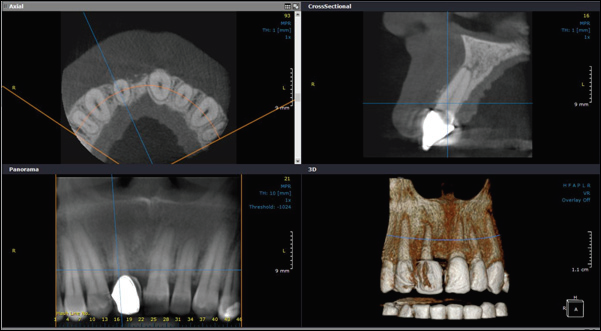
Fig. 3 C.B.C.T. planning for implant placement irt 11.
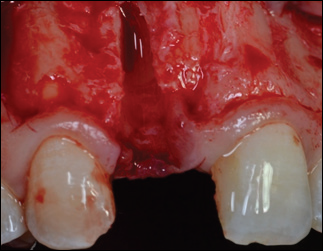
Fig. 4 Complete loss of labial bone observed post- extraction.
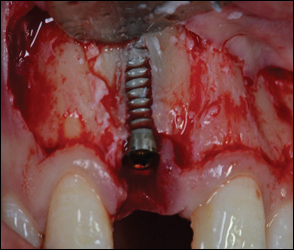
Fig. 5 Immediate implant placed irt 11

Fig. 6: Implant site augmented with alloplastic bone graft material.
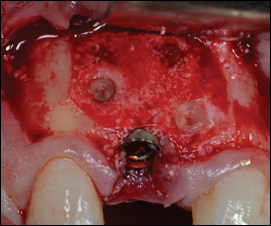
Fig. 7 Implant site augmented with alloplastic bone graft material.
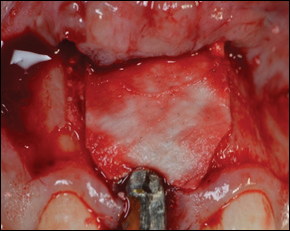
Fig. 8 Collagen membrane adapted over the defect site.

Fig. 9 Flap advanced for soft tissue augmentation and flap sutured.

Fig. 10 Temporary abutment connected and provisional prosthesis cemented irt 11.
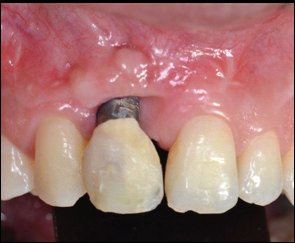
Fig. 11 3 months post-operative, mucosal recession (2-4 mm) evident.
REFERENCES:-
- Araujo, M.G. & Lindhe, J. (2005) Dimensional ridge alterations following tooth extraction. An experimental study in the dog. Journal of clinical periodontology [Internet]. 32: 212–218. http://www. ncbi.nlm.nih.gov/pubmed/15691354 Feb [cited 2013 May 22].
- Araujo, M.G., Sukekava, F., Wennstr€om, J.L. & Lindhe, J. (2005) Ridge alterations following implant placement in fresh extraction sockets: an experimental study in the dog. Journal of clinical periodontology [Internet] 32: 645–652. http:// www.ncbi.nlm.nih.gov/pubmed/15882225 [cited 2013 Jun 5].
- Blanes, R.J., Bernard, J.P., Blanes, Z.M. & Belser, U.C. (2007) A 10-year prospective study of ITI dental implants placed in the posterior region. II: Influence of the crown-to-implant ratio and different prosthetic treatment modalities on crestal bone loss. Clinical oral implants research[Internet]. 18: 707–714. http://www.ncbi.nlm.nih.gov/ pubmed/17697000 [cited 2013 Jun 21].
- Braut, V., Bornstein, M.M., Belser, U. & Buser, D. (2011) Thickness of the anterior maxillary facial bone wall-a retrospective radiographic study using cone beam computed tomography. The International journal of periodontics & restorative dentistry [Internet]. 31: 125–131. http://www.ncbi. nlm.nih.gov/pubmed/21491011
- Buser, D., Martin, W. & Belser, U.C. (2004) Optimizing aesthetics for implant restorations in the anterior maxilla: anatomic and surgical considerations. The International journal of oral & maxillofacial implants [Internet]. 19(Suppl): 43–61.
- Chen, S.T., Darby, I.B. & Reynolds, E.C. (2007) A prospective clinical study of non-submerged immediate implants: clinical outcomes and aesthetic results. Clinical oral implants research [Internet]. 18: 552–562. http://www.ncbi.nlm.nih. gov/pubmed/17608739 [cited 2013 Jul 30].
- Evans, C.D.J. & Chen, S.T. (2008) Aesthetic outcomes of immediate implant placements. Clinical Oral Implants Research[Internet] 19: 73–80.
- Ferrus, J., Cecchinato, D., Pjetursson, E.B., Lang, N.P., Sanz, M. & Lindhe, J. (2010) Factors influencing ridge alterations following immediate implant placement into extraction sockets. Clinical oral implants research [Internet]. 21: 22–29.
- Grunder, U., Gracis, S. & Capelli, M. (2005) Influence of the 3-D bone-to-implant relationship on aesthetics. The International journal of periodontics restorative dentistry [Internet]. 25: 113–119.
- Januario, A.L., Duarte, W.R., Barriviera, M., Mesti, J.C., Ara_ujo, M.G. & Lindhe, J. (2011) Dimension of the facial bone wall in the anterior maxilla: a cone-beam computed tomography study. Clinical oral implants research [Internet]. 22: 1168–1171. http://www.ncbi.nlm.nih.gov/pubmed/21320168 Oct [cited 2013 Mar 15].
- Menezes, C. & Janson, G. (2010) Reproducibility of bone plate thickness measurements with conebeam computed tomography using different image acquisition protocols. Dental Press Journal of Orthodontics [Internet]. 15: 143–149. http:// www.scielo.br/scielo.php?pid=S2176-94512010000500017&script=sci_arttext [cited 2013 Mar 18].
- Nevins, M., Camelo, M., De Paoli, S., Friedland, B., Schenk, R.K., Parma-Benfenati, S., Simion, M., Tinti, C. & Wagenberg, B. (2006) A study of the fate of the buccal wall of extraction sockets of teeth with prominent roots. The International journal of periodontics & restorative dentistry. [Internet]. 26: 19–29. http://www.ncbi.nlm.nih. gov/pubmed/16515093
- Schropp, L., Wenzel, A., Kostopoulos, L. & Karring, T. (2003) Bone healing and soft tissue contour changes following single-tooth extraction: a clinical and radiographic 12-month prospective study. The International journal of periodontics restorative dentistry [Internet]. 23: 313–323. http:// www.ncbi.nlm.nih.gov/pubmed/12956475
- Blanes RJ, Bernard JP, Blanes ZM, Belser UC. A 10-year prospective study of ITI dental implants placed in the posterior region. II: influence of the crown-to-implant ratio and different prosthetic treatment modalities on crestal bone loss. Clin Oral Implants Res. 2007;18:707–714. . Tolstunov L. Implant zones of the jaws: implant location and related success rate. J Oral Implantol. 2007;33:211–220.
- Evans CD, Chen ST. Aesthetic outcomes of immediate implant placements. Clin Oral Implants Res. 2008;19:73–80.
- Lazzara RJ. Immediate implant placement into extraction sites: surgical and restorative advantages. Int J Periodontics Restorative Dent. 1989;9:332–343.
- Kan JY, Rungcharassaeng K, Umezu K, Kois JC. Dimensions of peri-implant mucosa: an evaluation of maxillary anterior single implants in humans. J Periodontol. 2003;74:557–562.
- Chen ST, Darby IB, Reynolds EC. A prospective clinical study of non-submerged immediate implants: clinical outcomes and aesthetic results. Clin Oral Implants Res. 2007;18:552–562.
- Wheeler SL, Vogel RE, Casellini R. Tissue preservation and maintenance of optimum aesthetics: a clinical report. Int J Oral Maxillofac Implants. 2000;15:265–271.
- Becker BE, Becker W, Ricci A, Geurs N. A prospective clinical trial of endosseous screw-shaped implants placed at the time of tooth extraction without augmentation. J Periodontol. 1998;69:920–926.
- Paolantonio M, Dolci M, Scarano A, d'Archivio D, di Placido G, Tumini V, et al. Immediate implantation in fresh extraction sockets. A controlled clinical and histological study in man. J Periodontol. 2001;72:1560–1571.
- Araújo MG, Lindhe J. Dimensional ridge alterations following tooth extraction. An experimental study in the dog. J Clin Periodontol. 2005;32:212–218.
- Araújo MG, Sukekava F, Wennström JL, Lindhe J. Ridge alterations following implant placement in fresh extraction sockets: an experimental study in the dog. J Clin Periodontol. 2005;32:645–652.
- Araújo MG, Wennström JL, Lindhe J. Modeling of the buccal and lingual bone walls of fresh extraction sites following implant installation. Clin Oral Implants Res. 2006;17:606–614.
- Botticelli D, Berglundh T, Lindhe J. The influence of a biomaterial on the closure of a marginal hard tissue defect adjacent to implants. An experimental study in the dog. Clin Oral Implants Res. 2004;15:285–292.
- Botticelli D, Persson LG, Lindhe J, Berglundh T. Bone tissue formation adjacent to implants placed in fresh extraction sockets: an experimental study in dogs. Clin Oral Implants Res. 2006;17:351–358.
- Becker W, Goldstein M, Becker BE, Sennerby L. Minimally invasive flapless implant surgery: a prospective multicenter study. Clin Implant Dent Relat Res. 2005;7(Suppl 1):S21–S27.
- Schwartz-Arad D, Chaushu G. Immediate implant placement: a procedure without incisions. J Periodontol. 1998;69:743–750.
- Chen ST, Darby IB, Reynolds EC, Clement JG. Immediate implant placement postextraction without flap elevation. J Periodontol. 2009;80:163–172.
- Buser D, Martin W, Belser UC. Optimizing aesthetics for implant restorations in the anterior maxilla: anatomic and surgical considerations. Int J Oral Maxillofac Implants. 2004;19(Suppl):43–61.
- Grunder U, Gracis S, Capelli M. Influence of the 3-D bone-to-implant relationship on aesthetics. Int J Periodontics Restorative Dent. 2005;25:113–119.
- Ferrus J, Cecchinato D, Pjetursson EB, Lang NP, Sanz M, Lindhe J. Factors influencing ridge alterations following immediate implant placement into extraction sockets. Clin Oral Implants Res. 2010;21:22–29.
- Katranji A, Misch K, Wang HL. Cortical bone thickness in dentate and edentulous human cadavers. J Periodontol. 2007;78:874–878.
- Kan JY, Morimoto T, Rungcharassaeng K, Roe P, Smith DH. Gingival biotype assessment in the aesthetic zone: visual versus direct measurement. Int J Periodontics Restorative Dent. 2010;30:237–243.
- Araújo MG, Sukekava F, Wennström JL, Lindhe J. Tissue modeling following implant placement in fresh extraction sockets. Clin Oral Implants Res. 2006;17:615–624.
- Pennel BM, King KO, Wilderman MN, Barron JM. Repair of the alveolar process following osseous surgery. J Periodontol. 1967;38:426–431.
- Wilderman MN, Pennel BM, King K, Barron JM. Histogenesis of repair following osseous surgery. J Periodontol. 1970;41:551–565.
Disclaimer from Guident
The views and opinions expressed in articles published in Guident are solely those of the authors and do not necessarily reflect the views of the editors, the editorial board or the publisher, Ivory India. Guident does not endorse any product, technique or treatment described. Clinical content is intended for qualified dental and medical professionals and is not a substitute for individual clinical judgement. Guident, its editors and the publisher accept no liability for any consequence arising from the use of information published in the journal.
How to cite this article
Dr. Prerna Kaushik Associate Dentist Global Health Research Group Consultant max HealthCare, Dr. Manesh Lahori Department of Prosthodontics. Immediate Implants and Recession. Guident. 2017 May;10(6). Available from: https://guident.in/articles/implantology/immediate-implants-and-recession.html


