Universal Health Coverage
Department of Public Health Dentistry, K. D Dental College & Hospital Mathura
INTRODUCTION
The concept of Universal Health Coverage (UHC) began to evolve in Europe with reforms introduced by Bismarck in Germany in the 19th century. The Beveridge Report ushered in British reforms in the 1940’s leading to the introduction of the National Health Service (NHS) by Aneurin Bevan in 1948.1
Since then, universal access to affordable healthcare has become a widely shared aspiration across the globe. Over the last decade many low and middle income countries have advanced along the path. Many Latin American, several Asian and some African nations are reconfiguring their health systems to achieve UHC soon.1
India needs to adopt UHC both as a developmental imperative and as an ethical commitment to equity in a vital area of human welfare.1
The present situation of healthcare is unacceptable, because of low levels of health system performance and high levels of health inequity. Continuation of the present system, without substantial reform, will see an unaffordable escalation of healthcare costs and further increase in health inequity. Therefore, Universal Health Coverage provides a framework for making accessible, affordable and appropriate healthcare available to all Indians, by increasing public financing of health and achieving better results for the money spent.2
The full programmes of Universal Health Coverage will take a few years to evolve but the effort must begin now in real earnest, before it becomes too late to repair a damaged and damaging health system.2
Need is to create the future health system which assures delivery of the essential services that people desire, deserve and demand.2
VISION FOR UNIVERSAL HEALTH COVERAGE
Universal Health Coverage (UHC) propose that every citizen should be entitled to essential primary, secondary and tertiary health care services that will be guaranteed by the Central government. The range of essential health care services offered as a National Health Package (NHP) will cover all common conditions and high-impact, cost-effective health care interventions for reducing health-related mortality and disability. A panel of experts should determine the package of services taking into account the resource availability as well as the health care needs of the country.2
Health care services to all citizens covered under UHC will be made available through the public sector and contracted-in private facilities (including NGOs and non-profits). The High Level Expert Group examined the range of services that could be offered by the institutions participating in the UHC program.2
Two different options emerged:
- In the first option, private providers opting for inclusion in the UHC system would have to ensure that at least 75 per cent of out-patient care and 50 per cent of in-patient services are offered the citizens under the NHP. For these services, they would be reimbursed at standard rates as per levels of services offered, and their activities would be appropriately regulated and monitored to ensure that services guaranteed under the NHP are delivered cashless with equity and quality. For the remainder of the out-patient (up to 25%) and in-patient (up to 50%) coverage, service providers would be permitted to offer additional non-NHP services over and beyond the NHP package, for which they could accept additional payments from individuals or through privately purchased insurance policies.2
- The second alternative entails that institutions participating in UHC would commit to provide only the cashless services related to the NHP and not provide any other services which would require private insurance coverage or out of pocket payment.2
The vision for universal health coverage by 2022 is given in the figure no.1.
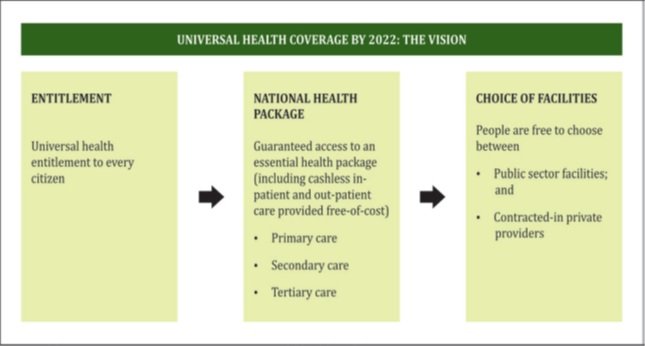
Vision of UHC {Figure no.1}
Expected Outcomes from UHC
India can aspire to achieve greater equity by bridging health disparities and inequities. The creation of a strong and robust health policy platform through the proposed scaling up of public spending and expansion in health service provisioning is likely to improve health outcomes.3 Figure no.2 focuses on the various outcomes of UHC.
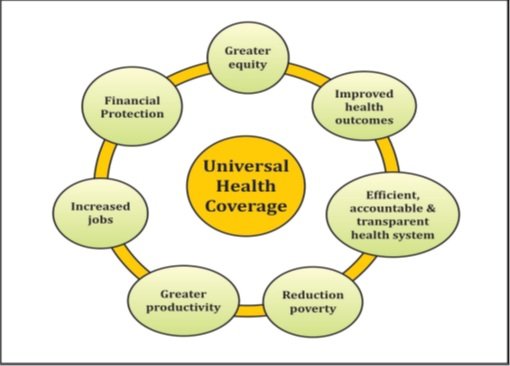
Outcomes for Universal Health Coverage{Figure no.2}
HEALTH FINANCING AND FINANCIAL PROTECTION
The major objective of health financing for UHC is to provide financial protection. For this, adequate financial resources are needed, to support the UHC programme. ‘More money for health and more health for the money’ was a phrase coined by Late Professor V. Ramalingaswami of India, in the 1980’s. This has since been cited or repeated world over. It is important to ensure efficient financing mechanisms which will enable appropriate utilisation of funds for enhancing the outreach and effectiveness of health services.1
Three Objectives:
- Ensure sufficient financial resources for the provision of essential health care to all
- Ensure financial protection and health security against impoverishment
- Put in place financing mechanisms that are consistent with improved wellbeing as well as containment of health care1
Expenditures on primary healthcare, should account for at least 70% of all healthcare expenditures and cover1
- General health information and promotion
- Curative services at the primary level
- Screening for risk factors at the population level1
Six lessons in health system financing to guide progress toward UHC3:
- Move away from out-of-pocket spending toward predominant reliance on compulsory and prepaid funding sources. Figure no.3 shows the out of pocket funding.
- Break or weaken the link between entitlement and contribution
- Expand fiscal space to increase public spending on health
- Build strength in numbers and enable cross-subsidization by consolidating risk pools
- Improve efficiency and equity to ensure more health for the money
- Align purchasing with benefits to turn promises into results.3
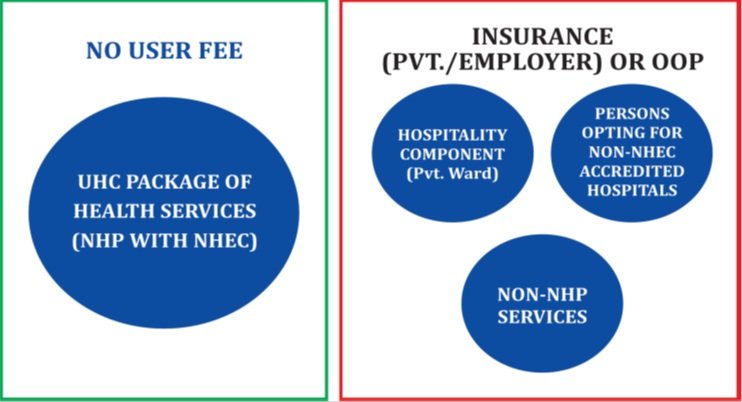
Health financing {Figure no.3}
Three principal objectives of the reforms in health financing and financial protection:2
Objective 1: Ensure adequacy of financial resources for the provision of essential health care to all
Objective 2: Provide financial protection and health security against impoverishment for the entire population of the country
Objective 3: Put in place financing mechanisms which are consistent in the long-run with both the improved wellbeing of the population as well as containment of health care cost inflation. Below figure no.4 shows how to achieve universal health coverage.
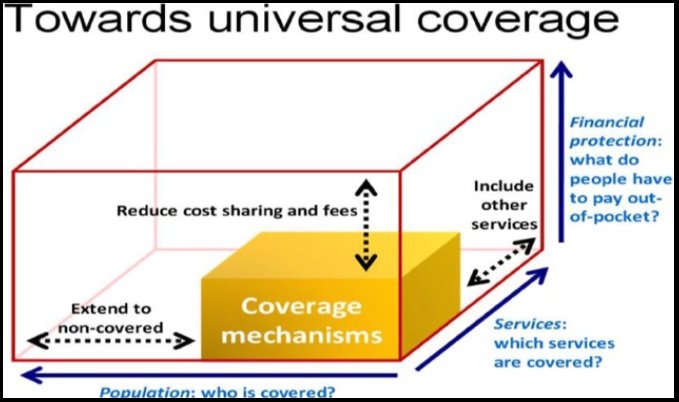
Towards universal coverage {Figure no.4}
Under Health financing, many studies reviewed national experiences in three areas:4
(a) Raising revenues to expand and sustain coverage
(b) Getting more value for money
(c) Managing effective pooling and redistribution of resources to ensure equity and financial protection.
ACCESS TO MEDICINES, VACCINES AND TECHNOLOGY
Medicines deserve particular attention when defining a priority service package, as their availability is a key driver of healthcare-seeking behaviour for people across the world. This has recently been demonstrated in South Africa, a country on the verge of implementing major UHC reforms, where a study showed that people prioritize medicine availability above many other service attributes, including human resources and the state of healthcare facilities.5
There are a range of health system drivers that determine availability of medicines and diagnostic procedures, including information systems, supply chain management capacity, health worker prescribing habits, medicine procurement policies and others. Underpinning the availability of medicines and health commodities to end users are complex policy, governance, regulatory, technical and logistical challenges driven by a systems’ perspective:
who gets access to medicines and diagnostics? And who decides? In those countries not yet well advanced with a UHC approach, even in public sector delivery settings, people in countries across Asia and the Pacific report having to pay for medicines, materials, and tests in order to secure the treatment they need. Perhaps more than in any other aspect of health care delivery, this is the area that is most susceptible to perserve incentives and profit making
motives on the one hand and financial hardship, impoverishment and lack of access on the other.6
HUMAN RESOURCES FOR HEALTH
The number of medical colleges and nursing colleges need to be increased to overcome the shortages in specialist doctors, family practitioners, specialist nurses and general nurses. These new colleges should be located in states with very few colleges and preferably in districts where no such colleges currently exist. Wherever feasible, they should be linked to district hospitals.1
Increase numbers and skills of frontline health workers:1
- Doubling of ASHAs and ANMs
- Male MPW( Multipurpose Health Worker ) and Mid Level Health Professional (3 year trainee)/AYUSH at Sub-Centre level
- Expand Staff (esp. nurses) at PHC and CHC
- Nurse-Practitioners for Urban Primary Health Care
Figure no.5 shows the National health regulatory system and State health regulatory development authority. Figure no.6 shows the three levels of health system.

National Health Regulatory and Development Authority {Figure no.5}
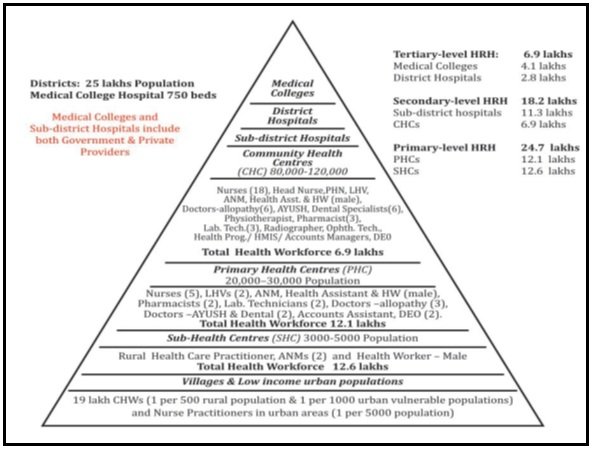
Norms at primary, secondary and tertiary levels {Figure no.6}
Figure no.7 shows the proposed health care trajectories for nurses and ANM’s.

Proposed health career trajectories for nurses and ANMs {Figure no.7}
HEALTH SERVICE NORMS
Summary of India’s health system challenges 7
a) The public health system in India suffers from weak stewardship and oversight, Human resource shortages, weak human resource management and ineffective service delivery.
b) Doctors, nurses and allied health providers are in short supply for the populations they serve. The ratio is often skewed, resulting in the following shortcomings:(i) fewer health providers in rural areas, especially in primary health care settings;(ii) inefficient secondary services in smaller towns; and( iii) a high concentration of tertiary health care services in urban cities.7
Rationale for change
a) Need to address health inequities and impediments to universal care8
b) Need to adopt a primary health care approach9
c) Need to provide adequate hospital beds.10
Figure no.8 shows the distribution of functional beds.

Distribution of functional hospital beds {Figure no.8}
Figure no.9 shows the availability of health care providers within a village to the average village population.

Availability of health care providers within a village to the average village population {Figure no.9}
MANAGEMENT REFORMS IN THE INDIAN HEALTH SECTOR
Since the start of the economic reforms in the 1990s, there have been various initiatives to reform and support the development of the health sector, both at the centre and in different states. Many of these health sector reforms at the state level have been influenced by donor agencies.11 They generally include diverse initiatives to improve the management of the public health system and to support the development of public-private partnerships (PPPs).
A review of various reports by the Ministry of Health and Family Welfare ( MoHFW )and other stakeholders working in the health arena provides a reasonable understanding of the implementation of the different reforms cited. However, there is still a paucity of evaluative evidence to present a strong case on the effectiveness of many of these reforms. An in-depth understanding of the mechanism of implementation of these reforms can serve as the scaffolding on which to build the future framework of management reforms in health for India.12
Figure no.10 shows the conceptual framework of healthcare regulation.
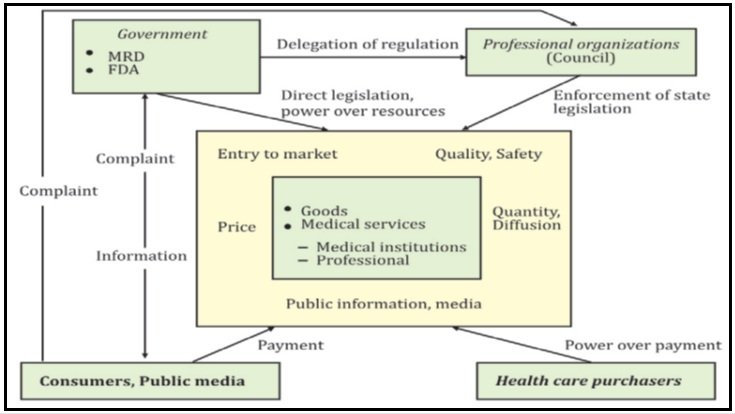
Conceptual framework of healthcare regulation {Figure no.10}
Relevance for Universal Health Coverage
Participatory approaches have been widely reported to have a positive impact on health outcomes.13,14 Participation of communities, local elected bodies and Civil Society Organisations (CSOs) is also a prerequisite for successful implementation of Universal Health Coverage (UHC) and has been shown to be essential for:
- Reducing information asymmetries and increasing awareness of entitlements and rights15
- Engendering inclusive and equitable access to health care16
- Strengthening health services to be accountable and responsive to community needs.17
Participatory approaches also contribute to:
- Increased uptake and quality of health services15
- Financial protection for individuals and communities accessing health care18
- Improving health behaviour and health awareness in communities19
- Strengthening social capital and deepening democratic processes.20
SOCIAL DETERMINANTS OF HEALTH
In a rapidly globalising world, millions continue to experience profound inequities in health, living, working, and too often, dying in conditions of poverty, exclusion, and disenfranchisement. The greatest successes of health system reform- be it primary health care in Cuba, the right to health paradigm of Brazil, or abolishing out-of-pocket spending in Thailand21,22,23 have addressed the wider determinants of health inequities as a national priority, implementing reform through both policy changes and grassroots-based action.
The World Health Organisation’s Commission on Social Determinants of Health (CSDH) embedded the goal of universal health care in strategies that include improving daily living conditions, tackling the inequitable distribution of money, power, and resources, as well as measuring and understanding health inequities.24,25
The Commission’s 2008 report defines health inequities as “systematic differences in health” that are “avoidable by reasonable action,” and are “quite simply, unfair.”26 It proposes to terminate these systematic differences, i.e. close the gap in a generation, the space of 30 to 40 years, through action on the social determinants of health.27
The CSDH defines the Social Determinants of Health (SDH) as “the conditions in which people are born, grow, live, work and age, including the health system.”28
It encourages countries to provide Universal Health Coverage to address health inequity directly. The report acknowledges, moreover, that health inequities arise not only from within but also from beyond the domain of health, through other social determinants, including the “unequal distribution of power, income, goods, and services, globally and nationally, the consequent unfairness in the immediate, visible circumstances of people’s lives - their access to health care, schools, and education, their conditions of work and leisure, their homes, communities, towns, or cities - and their chances of leading a flourishing life.”26
It is already well established that among the most critical social determinants of health is the health system itself.29,30 In India, the movement towards Universal Health Coverage (UHC) will necessitate reform of the health system.
GENDER AND HEALTH
Gender in the context of health implied a discussion on women’s health. However, an inclusive approach to health should attend to the needs and differentials between men, women and other genders, along with the interaction between social and biological markers of health.31 In order to attain such universality in health coverage, it is essential to achieve gender equality. This may be ensured through gender equity (the process of being fair to the different health needs of men, women and other genders), gender mainstreaming (making men’s and women’s health concerns and experiences an integral dimension of the design, implementation, monitoring and evaluation of health policies and programmes) and empowerment (enabling individuals and communities to gain more control over their lives and to shape systems around them).32
A gendered perspective would thus take into account the health needs of all categories of sexual identity; “heterosexual, homosexual, lesbian, gay, bisexual, ‘queer’, transgendered, transsexual, and asexual.”33 The very framework and principles of UHC for India will be severely undermined if gender insensitivity and gender discrimination remain unaddressed. Gender disparities, particularly persistent in anti-female biases, are most glaringly reflected in the declining female-to-male ratios among children below six (with the sex ratio among children declining from 927 girls per 1,000 boys in 2001 to 914 in 2011).34 The World Economic Forum ranked India as 132nd out of 134 nations in terms of gender equity in health.35 Furthermore, there remains a disturbingly high Maternal Mortality Ratio (MMR) of 212 maternal deaths per 100,000 live births,36 despite the country’s rapid economic growth rate.37
CONCLUSION
The goal of Universal Health Coverage (UHC) requires that everyone receive needed health services, and that families who get needed services do not suffer undue financial hardship. Tracking progress towards UHC requires measurement of both these dimensions, and a way of trading them off against one another. The journey towards UHC will require the judicious adoption of creative and new initiatives and methods. Public as well as private stakeholders must create capacity and phase in their interventions. The early gains expected from these changes justify their continued support to ultimately achieve UHC.The UHC’s ultimate aim is to stimulate action to reduce health inequalities within and across nations. By moving towards Universal Health Coverage with action on social determinants, India can contribute to the larger cause of equity and social justice.
REFERENCES
- Universal Health Coverage for India, recommendations of the high level expert group constituted by the planning commission of India, 2011; www.resourcecentre.savethe children.net; accessed on 20/03/2021.
- High Level Expert Group Report on Universal Health Coverage for India Instituted by Planning Commission of India Submitted to the Planning Commission of India New Delhi, November, 2011; www.niti.gov.in; accessed on 20/03/2021.
- Universal Health Coverage: Lessons to guide country actions on health financing; www.who.int; accessed on 20/03/2021.
- Universal Health Coverage for Inclusive and Sustainable Development a synthesis of 11 country case studies. www.researchgate.net; accessed on 22/03/2021.
- Delivering Universal Health Coverage a guide for policymakers; David Nicholson Robert Yates Will Warburton Gianluca Fontana; Report of the WISH Universal Health Coverage Forum 2015; www.imperial.ac.uk , accessed on 23/03/2021.
- Allison Beattie, Robert Yates, Douglas Noble. Accelerating progress towards universal health coverage for women and children in South Asia, East Asia and the pacific; www.unicef.org; accessed on 23/03/2021.
- Ministry of Statistics and Programme Implementation. Health -Morbidity, Health care and the Condition of the Aged-2004. Report (60/25.0/1). New Delhi: Ministry of Statistics and Programme Implementation, Government of India: www.mospi.gov.in; accessed on 05/04/2021.
- Sen G, Iyer A, George A. Structural Reforms and Health Equity: a comparison of NSS surveys, 1986-87 and 1995- 96. Economic and Political Weekly; 2002;37(14):11.
- Task force on health systems research, World Health Organisation. Report of the task force on health systems research; Geneva; World Health Organisation; 2005; www.researchgate.net/pulication; accessed on 06/04/2021.
- Central Bureau of Health Intelligence. National Health Profile of India 2010;New Delhi; Central Bureau of Health Intelligence; www.indiaenvironmentportal.org; accessed on 06/04/2021.
- World Health Organisation, India. Health sector reforms in India: initiative from states. Vol II. New Delhi: WHO.2007; www.whoindia.org; accessed on 09/04/2021.
- Government of India, draft report of the reconstituted task group on public private partnership under NRHM. New Delhi: Ministry of Health and Family Welfare; ND; www.nhm.gov.in; accessed on 09/04/2021.
- O’Rourke K, Howard-Grabman L, Seoane G. Impact of community organisation of women on perinatal outcomes in rural Bolivia; Revista Panamericana de Salud Pública; 1998;3:9-14.
- Tripathy P, Nair N, Barnett S, Mahapatra R, Borghi J, Rath S, et al. Effect of a participatory intervention with women’s groups on birth outcomes and maternal depression in Jharkhand and Orissa, India: a cluster-randomised controlled trial. Lancet; 2010 Apr 3; 375(9721):1182-1192.
- Björkman M. Power to the people: evidence from a randomized field experiment of a community- based monitoring project in Uganda. NC: World Bank Publications; 2007; www.u4.no; accessed on 09/04/2021.
- Lewin SA, Dick J, Pond P, Zwarenstein M, Aja G, van Wyk B, et al. Lay health workers in primary and community health care: A systematic review of trials; 2006; www.citeseerx.ist.psu.edu; accessed on 09/04/2021.
- Varatharajan D, Thankappan R, Jayapalan S. Assessing the performance of primary health centres under decentralized government in Kerala, India. Health Policy Plan; 2004 Jan; 19(1):41-51.
- Ekman, B. Community-based health insurance in low income countries: a systematic review of the evidence.” Health Policy and Planning; 2004; 19(5): 249-270.
- Cornwall A, Shankland A. Engaging citizens: lessons from building Brazil’s national health system. Soc Sci Med; 2008 May; 66(10):2173-2184.
- Saint V. Community participation and planning in health: An exploratory literature review. Forum for Research in Community Health; 2010; www.niti.gov.in; accessed on 10/04/2021.
- Reed, G. Cuba’s primary health care revolution: 30 years on. Bulletin of the World Health Organization; 2008; 86(5): 321-456.
- Brazilian Ministry of Health. Secretariat of Strategic and Participative Management. Department of Participative Management Support. Paths of right to health in Brazil. Brasilia: Ministry of Health;2007; www.bvsms.saude.gov.; accessed on 10/04/2021.
- Limwattananon S, Tangcharoensathien V, Prakongsai P. Equity in Financing: Impact of universal access to healthcare in Thailand. Nonthaburi: International Health Policy Program/Ministry of Public Health; www.equitap.org; accessed on 10/04/2021.
- Birn A. Historicising, politicising, and ‘futurising’ closing the gap in a generation. In Bhattacharya, S., Messenger, S. Overy, C, Editors. Social Determinants of Health: Assessing theory, policy and practice. Hyderabad: Orient Blackswan; 2010; www.dlsph.utoronto.ca; accessed on 10/04/2021
- Smith GD, Krieger N. Tackling Health Inequities. British Medical Journal; 2008; (227):529-530.
- World Health Organization Commission on social determinants of health. Closing the gap in a generation: health equity through action on the social determinants of health. Final report of the Commission on Social Determinants of Health. Geneva: World Health Organization;2008:2. www.who.int; accessed on 10/04/2021.
- World Health Assembly. Reducing health inequities Through action on the social determinants of health. Resolution of the Sixty Second World Health Assembly, WHA 62.14; 22 May 2009; www.iris.paho.org; accessed on 12/04/2021.
- Wilkinson R, Marmot M, Editors. Social Determinants of Health: The Solid Facts. Geneva: World Health Organization; www.euro.who.int; accessed on 12/04/2021.
- Solar O, Irwin A. A conceptual framework for action on the social determinants of health. Paper 2 (Policy and Practice). Geneva: World Health Organisation; 2010:26. www.who.int; accessed on 12/04/2021.
- Jose S, Navaneetham K. Social Infrastructure and Women’s Undernutrition, Economic and Political Weekly; 2010: 45(13); 83-89.
- Sen G, George A, Ostlin P, editors. Engendering international health: the challenge of equity. Cambridge (MA): MIT Press; 2002; www2.ids.ac.uk; accessed on 15/04/2021.
- World Health Organization. Gender mainstreaming for health managers: a practical approach. www.whqlibdoc.who.int; accessed on 15/04/2021.
- Krieger N. A glossary for social epidemiology. J Epidemiol Community Health,2001; 55: 693–700.
- Census of India 2011: Child sex ratio drops to lowest since Independence. The Economic Times; www.articles.economictimes.indiatimes.com; accessed on 15/04/2021.
- Hausmann R, Tyson LD, Zahidi S. The global gender gap report 2010. World Economic Forum; www.weforum.org; accessed on 15/04/2021.
- Office of the Registrar General. Special bulletin on maternal mortality in India 2007-09. Sample Registration System. Ministry of Home Affairs, Govt. of India; June, 2011. www.censusindia.gov.in; accessed on 15/04/2021.
- Organisation for Economic Co-Operation and Development. Economic survey of India. 2007: Policy Brief. www.oecd.org; accessed on 15/04/2021.
Disclaimer from Guident
The views and opinions expressed in articles published in Guident are solely those of the authors and do not necessarily reflect the views of the editors, the editorial board or the publisher, Ivory India. Guident does not endorse any product, technique or treatment described. Clinical content is intended for qualified dental and medical professionals and is not a substitute for individual clinical judgement. Guident, its editors and the publisher accept no liability for any consequence arising from the use of information published in the journal.
How to cite this article
Dr. Monika, Dr. Navpreet Kaur, Dr. Manish Bhalla. Universal Health Coverage. Guident. 2021 Sep;14(10). Available from: https://guident.in/articles/general/universal-health-coverage.html