
Switch to Ecofriendly Dentistry
Maharishi Markandeshwar University, Mullana, Ambala, India
Abstract
Being eco friendly is the most important facet of life..“Eco friendly dentistry” attempts to reduce the detrimental impact of dental practices on the environment and promote environmental awareness and sustainability to patients. This article attempts to cover all possible aspects of making a dental practice eco-friendly, both in a dental perspective as well as a general perspective. While establishing an eco-friendly dental workplace, the dentist needs to assess his choices in planning the infrastructure and purchasing of equipments and dental materials.
Eco-friendly dentistry is a newly evolving practice of dentistry, which encompasses a simultaneous devotion to sustainability, prevention, precaution, and a minimally invasive patient-centric, as well as global-centric treatment. There are two main avenues for implementing eco-friendly dentistry: (1) appropriate policy development and implementation and (2) dentists taking responsibility/ownership in the absence of policies and regulations. Although in some cases it may take a little extra effort or money, dentists throughout the world are doing their best to reduce the environmental impact of dental practice. Although the commitment of one small dental office cannot save the planet, certainly the collective efforts of many small offices as well as large dental hospitals/colleges can ensure that dentists, at least, will not be responsible for destroying it.
INTRODUCTION
It is identified that humans are the biggest threat to their own race. Our own attitude towards our environment is affecting our health and well being on a large scale. Thus, it is essential for each individual to be aware of his carbon footprint and the changes that can be incorporated in his lifestyle to reduce the global burden. The term “eco friendly dentistry” was coined by Dr. Malden Kralj, the founder of Ora Dental Studio, America’s first green dental group.1 Eco-friendly dentistry is an approach to dentistry that implements sustainable practices by keeping resource consumption in line with nature’s economy, by safeguarding the external environment by virtue of eliminating or reducing outgoing wastes and by promoting the well-being of all those in the clinical environment by conscious reduction of the chemicals in the breathable air.2
All over the world, various organisations have recognised the need to regulate and monitor the dental offices on an environmental basis. LEED, i.e., Leadership in Energy and Environmental Design was developed in 2000 by U.S. Green Building Council. It is a rating system which reflects sustainable site development, water saving, energy efficiency, materials selection and indoor environmental quality.1 In June 2009, the Eco Friendly Dentistry Association was launched internationally. In India, The Ministry of Environment and Forests (MoEF) has promulgated Hazardous Wastes (Management & Handling) Rules, 1989 and amended the same in 2000 and 2003 for proper management and handling of hazardous wastes in the country.3
WHY GREEN DENTISTRY??
The color ‘green’ denotes renewal, growth and hope. Green dentistry is not only environment friendly, but also conserves money and time by reducing waste, conserving energy and decreasing pollution with the use of latest techniques and procedures. Green dentistry therefore, protects the environment and mankind from the hazards of rapid urbanisation, especially in developing countries.4
THE FOUR R,S OF BEING ECO FRIENDLY
The four R’s include reduce, reuse, recycle and rethink. It is common to think that recycle is the best eco friendly way. However, ‘rethink’ is the first step to being eco friendly and ‘reduce’ and ‘reuse’ are more effective than ‘recycle’.5 To ‘reduce’ is to minimise the amount of waste sent to landfills. One can reduce waste production by reusing and recycling maximum amount of materials. Packages constitute 30% of the garbage. Thus, purchase of products with minimal packaging and use of plastic containers can help. To ‘reuse’, single use items should be replaced by reusable items. And to ‘recycle’, paper, metal and gypsum can be recycled. Identification of existing recycling programmes is necessary.
WASTE MANAGEMENT
The term biomedical waste has been defined as “any waste that is generated during the diagnosis, treatment, or immunization of human beings or animals, or in the research activities pertaining to or in the production or testing of biological and includes categories mentioned in Schedule I of the Biomedical Waste (Management and Handling) rules 1998”. These rules make it mandatory for the health care establishments to segregate, disinfect, and dispose of their waste in an eco-friendly manner. There may be increased risk of nosocomial infections in patients due to poor waste management. The best disposal options are to prevent or minimize disposal of toxic substances from dental clinics into the environment.
The World Bank’s health care waste management guidance, note lists four steps to healthcare waste management3:
- Segregation
- Transportation
- Treatment
- Final disposal
COLOUR CODING OF CONTAINERS FOR BIOMEDICAL WASTE DISPOSAL
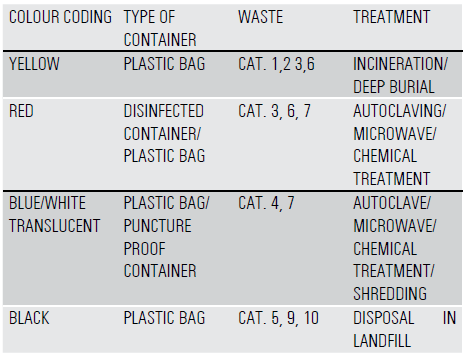
All the generators of biomedical waste should adopt universal precautions and appropriate safety measures while doing therapeutic and diagnostic activities.
Teeth without amalgam restorations and other tissues can be placed directly into a biohazard bag or a sharps container, which can then be sterilized. Teeth with amalgams could release mercury vapor during sterilization, thus they should be neutralized through disinfection ideally, immersion for 30 min in a fresh solution of a tuberculocidal disinfectant held within a sealed container. Items heavily soiled with blood/saliva can be placed into sharps containers. However, it may be easier to store them in small biohazard bags until treated.
Used anesthetic capsules should be placed into sharps containers. Impression compound, agar, dental waxes, green stick compound, impression pastes, shellac base plates should be kept in a “yellow plastic bag” then sent for either incineration or deep burial. Rubber base impression material, investment material, pumice, acrylic, metal dust, alginate, old models, and casts, old acrylic dentures and teeth kept in a “black plastic bag” and dispose of in municipal dump.
BEST MANAGEMENT PRACTICES FOR AMALGAM WASTE6
- Switch to precapsulated dental amalgam.
- Use a “mercury spill kit” if you have a spill of elemental mercury.
- React unused elemental mercury with silver alloy to form scrap amalgam.
- Elemental mercury should never be washed down the drain.
- Use a sponge type mercury disposal container to store the scrap amalgam.
- Use an amalgam separator on the suction lines to remove over 95% of the contact amalgam prior to entering the sewer system.
ESTABLISHMENT OF DENTAL OFFICES
- Use stratica or linoleum flooring - Natural linoleum is bio-based, highly durable, non-toxic, anti-microbial and easy to maintain. It is made from solidified linseed oil (linoxyn), pine rosin, ground corkdust, wood flour, and mineral fillers such as calcium carbonate. Stratica offers unrivalled environmental benefits including no chlorine, no plasticizers, no detectable VOC emissions, a low VOC adhesive and simple maintenance. It is made from 20% post-industrial waste.
- Use high efficacy air conditioners, geysers, etc.- Energy efficiency and renewable energy are said to be the twin pillars of sustainable energy policy.
- Use L.E.D. for illumination - Compact fluorescent lights use two-thirds less energy and may last 6 to 10 times longer than incandescent light bulbs or halogen bulbs. However, Flourescent bulbs contain mercury which is, released when they are broken, disposed off in a landfill, or combusted. An LED bulb lasts 2 to 4 times longer than a CFL, is more energy efficient due to minimal wasted energy, has a smaller size, greater durability and reliability.
- Save energy - Set a main switch for the whole dental office so that all electrical switches can be turned off after working hours with a single switch.
- Use tinted glasses for windows to avoid heating up of the office.
SWITCH TO REUSABLES OVER DISPOSABLES
- Use gowns made of cloth instead of disposable gowns.
- Use cloth patient bibs instead of plastic ones.
- Use stainless steel glasses instead of plastic glasses.
- Use glass syringes for irrigation instead of plastic ones.
- Use autoclaving cassettes and cloth pouches instead of sterilisation pouches made of paper on one side and polythene on the other.
- Use autoclavable stainless steel suction tips instead of disposable plastic ones.
- Use reusable stainless steel prophy cups instead of disposable ones.
- Use autoclavable stainless steel impression trays instead of plastic disposable ones.
- Use instrument sharpening stones instead of disposing dull instruments.
SWICTH TO LATEST TECHNOLOGIES TO SAVE TIME, MATERIAL AND INCREASE EFFICIENCY2
- PATIENT RECORDS: Switch to digital computographic record keeping for patients in dental offices. A folder for each patient can be made and radiographs and photographs kept with payment records. Records on paper can be misplaced and occupy unnecessary space in the office. Computographic records are more organised and eco-friendly.
- DENTAL X-RAYS: The lead foil in X-ray films and lead aprons contain toxin that can result into defilement of soil and groundwater in landfill areas after disposal. The X-ray fixer is considered hazardous because of its high silver content. Spent X-ray fixer used in dental clinics to develop X-rays is a hazardous material that should not be rinsed in the drain. Also, X-ray cleaners contain chromium.6 Thus, the use of digital radiographs not only reduces the radiation exposure, but also eliminates the use of biohazardous materials.
- DENTAL IMPRESSIONS: Sectional trays and dual arch impression trays to minimise wastage of impression material. Nowadays, trays made of biodegradable material are also available. Digital optical impressions eliminate need to make impressions with conventional method. Conventional dental impressions don’t provide adequate detail reproduction and might require remaking at times, leading to wastage of material. Digital impressions significantly increase accuracy and productivity and the impression can be sent through e-mail to the dental laboratories. Combined with CAD/CAM, digital impressions/models are helpful to minimise wastage of material and provide high accuracy.
RECYCLING OF DENTAL MATERIALS7
- DENTAL WAXES: waxes are widely used in dentistry in so many forms such as modelling wax, inlay wax, utility wax, casting wax, beading & boxing wax, baseplate wax, sticky wax and bite registration wax. Some of the waxes are naturally obtained (carnauba, candela and beeswax) and some are petroleum products(ceresin and paraffin wax). In most of the procedures, Maximum amount of wax is not consumed, but used and rejected. About 80 – 90 % of wax can be recycled without affecting their properties using a simple laboratory procedure of removing the impurities. As this is an in vitro procedure, no biocompatibility issues exist
- CASTING ALLOYS: in dentistry, alloys are used in fabrication of metal copings, crowns and bridges, cast partial denture frameworks, metal denture bases and implant supported frameworks and crowns. 50 – 60 % of the alloy remains as wastage in the form of buttons and sprues in this process. The remaining wasted materials can be effectively reused for fabricating new restorations or appliances by proper cleaning techniques (sand blasting, electro polishing). There is only 5 - 10% decrease in their mechanical properties even after 20th recast. However, the only concern is biocompatibility. Thus, these materials can be redirected to other engineering areas for the fabrication of cutting tools, oil well drilling bits, dredging cutters, hot trimming dies, internal combustion engine valves, Gas turbine vanes, buckets, etc. These alloys are termed as super alloys in engineering fields due to their high strength and high corrosion resistance.
- SILVER AMALGAM: From the amlagam scrap, it is possible to separate mercury and silver by laboratory procedures and thus, they can be redirected for use.
- GYPSUM8: It is a universally accepted fact now that gypsum when discarded in landfills, the reduction of its sulphate cause production of hydrogen sulphide, having a characteristic rotten egg smell. The respiratory tract and nervous system are the most sensitive targets of hydrogen sulfide toxicity. Few symptoms include irritation to the eyes, nose, or throat. It may also cause difficulty in breathing for some asthmatics. Headaches, poor memory, tiredness, and balance problems may also occur. Permanent or long-term effects include headaches, poor attention span, poor memory, and poor motor function. In U.K., gypsum to gypsum recycling projects have been started which include demolition waste and other gypsum products. It is claimed that the recycled gypsum powder is 99 per cent as good as virgin gypsum.
CONCLUSION
An eco-friendly dentist need not be an environmentalist, just a rethinker. It is a matter of choice for the dentist to choose eco friendly products and practices and save as much paper, water, material and energy as possible. Dentistry is such a noble profession that our efforts should always aim towards the betterment of the society and not harm it. In developing countries like India, it is important that we realise the importance of being environment friendly and understand that the efforts of each individual count. More research and funds are required to regulate and promote eco-friendly practices.
REFERENCES
- Avinash B, Avinash BS, Shivalinga BM, Jyothikiran S, Padmini MN. Going Green with Ecofriendly Dentistry. J Contemp Dent Pract 2013;14(4):766-9.
- Dixit K, Dixit KK, Kapoor N. Eco-Friendly Dentistry: A Reality. J Dent Sci & Oral Rehab 2013;1:5-6
- Thota MM, Bathala LR, Theruru K, Shaik S, Jupidi B, Rayapati S. “There’s plenty of room at the bottom”: The biomedical waste management in dentistry. J NTR Univ Health Sci 2014;3:149-55.
- Rastogi V, Sharma R, Yadav L, Satpute P, Sharma V. Green Dentistry, A Metamorphosis Towards an Eco-Friendly Dentistry: A Short Communication. J Clin Diag Res 2014;8(7):1-2.
- Passi S, Bhalla S. Go green dentistry. J Educ Ethics Dent 2012;2:10-2.
- Singh H, Bhaskar DJ, Dalai DR, Rehman R, Khan M. Dental Biomedical Waste Management. Int J Sci Stud 2014;2(4):66-68
- .
- Thopegowda NB, Shenoy K, Shankarnarayana RK, Kukkila J, Vaddya SB, Gingipalli K. Recycling of Materials used in Dentistry with Reference to its Economical and Environmental Aspects. Int J Health Rehabil Sci 2013;2(3):140-5.
- Fairweather RJ, Barlaz MA. Hydrogen sulfide production during decomposition of landfill inputs. J. Environ. Eng. 1998.124:353-361.
More references are availabe on request.
Disclaimer from Guident
The views and opinions expressed in articles published in Guident are solely those of the authors and do not necessarily reflect the views of the editors, the editorial board or the publisher, Ivory India. Guident does not endorse any product, technique or treatment described. Clinical content is intended for qualified dental and medical professionals and is not a substitute for individual clinical judgement. Guident, its editors and the publisher accept no liability for any consequence arising from the use of information published in the journal.
How to cite this article
Dr. Sudhanshu Shekhar Depaertment of Prosthodontics. Switch to Ecofriendly Dentistry. Guident. 2015 Nov;8(12). Available from: https://guident.in/articles/general/switch-to-ecofriendly-dentistry.html

