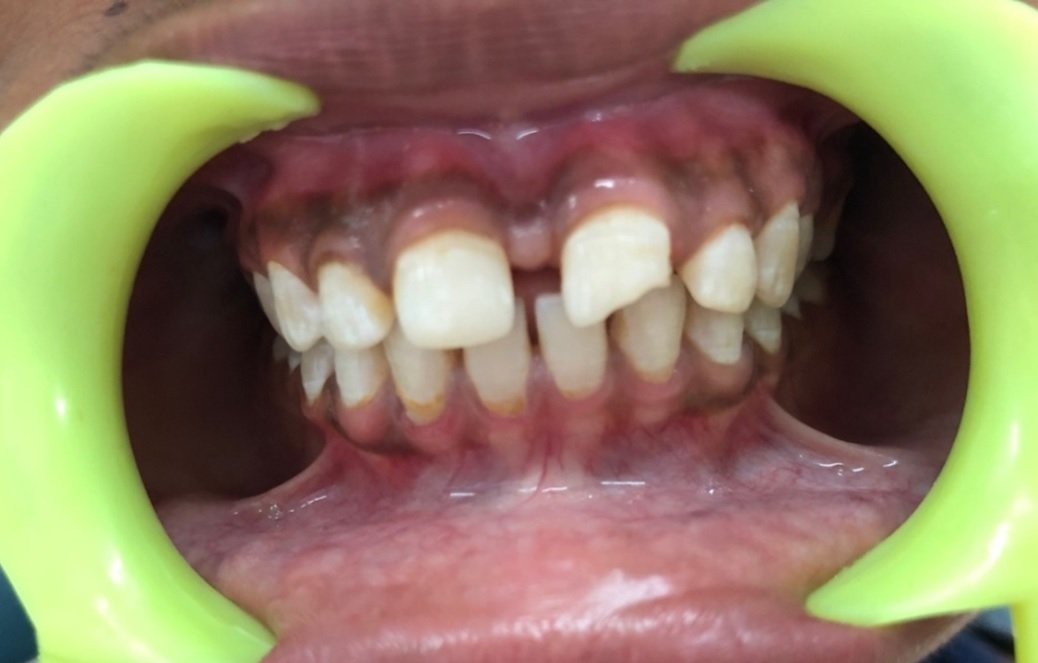
Endocrown - a Paradigm Shift in Rehabilitation: A Report of Two Cases
Department of Conservative Dentistry and Endodontics, Seema Dental College And Hospital, Rishikesh
ABSTRACT
Rehabilitation of endodontically treated molar still remains a challenge. After endodontic treatment, molars lost their mechanical characteristics. In fact, they became fragile and that is in relation with the removal of pulp and surrounding dentin tissues.2 Endocrown which is a single partial restoration could be considered as a good alternative for restoring molars having large coronal destruction and presenting endodontic treatment difficulties.1
INTRODUCTION
The term “Endocrown” was coined by Bindl and Mormann in 1999. In the field of restorative dentistry, continuous advancements are being made to enhance the durability and functionality of dental restorations. One such innovative technique gaining popularity is the endocrown. The endocrown is a type of dental restoration that combines both endodontic and prosthetic aspects. Unlike traditional crowns, endocrowns are designed to be directly placed on the pulp chamber of a tooth, utilizing the remaining tooth structure for support. This technique is particularly beneficial in cases where extensive damage or endodontic treatment has compromised the tooth's structural integrity.3
CASE REPORT-1
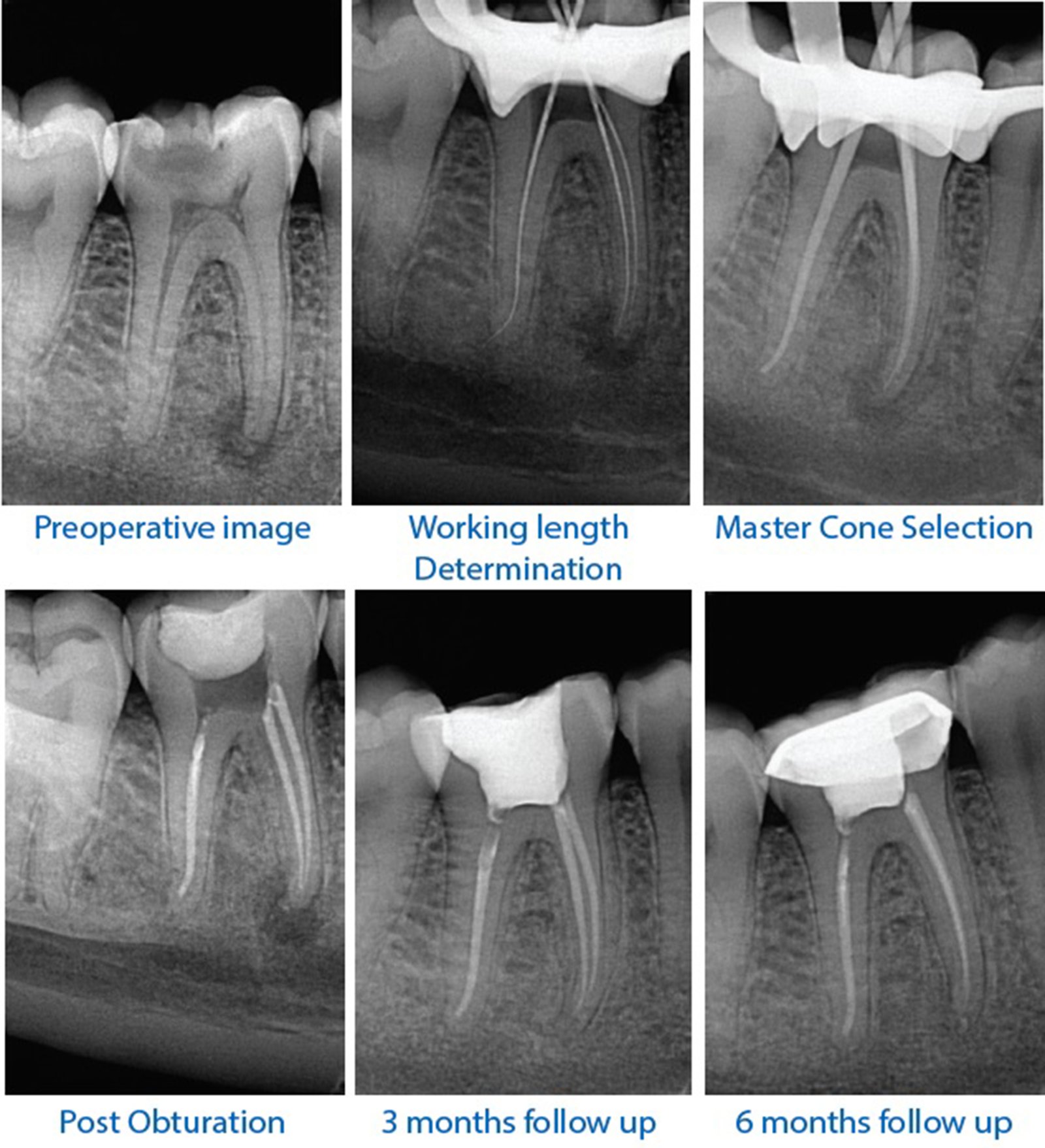
A 29 year old Female patient reported to Department Of Conservative dentistry And Endodontics with a chief complaint of decayed tooth in the lower right back tooth region of the jaw since 2 months. On the basis of clinical and radiographic examination root canal treatment was advised which was followed by endocrown placement.

Endocrown Preparation

Endocrown Cementation
CASE REPORT 2
A 17 year old male patient reported to Department Of Conservative dentistry And Endodontics with a chief complaint of decayed tooth in the lower right back region of the jaw since 4 months. On the basis of clinical and radiographic examination root canal treatment was adviced which was followed by endocrown placement

Endocrown Preparation

Endocrown Cementation
DISCUSSION
Due to its minimal and ease of preparation, endocrowns offer a more advantageous option as compared to conventional and post- and core-retained restorations. Several factors can be attributed to this positive outcome, as in terms of its preparation technique, occlusal thickness, and elastic moduli. The presence of a “ferrule” can be seen in a conventional crown preparation for its retentiveness, however, it also involves the removal of sound enamel and dentin for its preparation, which would be critical for proper bonding. This factor is negated in the ferrule-less preparation of endocrowns.6
In 2012, Biacchi and Basting compared the fracture strength of 2 types of full ceramic crowns: indirect conventional crowns retained by glass fibre posts and endocrowns. They came to the conclusion that endocrowns were more resistant to compressive forces than the first ones.
According to Schultheis et al., endocrown seems to be a more reliable alternative for posterior loadbearing teeth.5
CONCLUSION
The preparation for endocrowns is simple and can be achieved quickly. Root canals are not engaged in the process, and the procedure is less traumatic than others. The supragingival position of the cervical margin protects the marginal periodontium, facilitates impression taking, and preserves the solid substance of the remaining tooth. Forces are dispersed over the cervical butt joint (compression) and axial walls (shear force), thus moderating the load on the pulpal floor.
The endocrown represents a very hopeful treatment alternative for endodontically treated molars, it allows maintaining of tooth structure, it is compatible with goal minimally invasive dentistry, and it is adequate for the concept of biointegration. It is a conservative approach for mechanical and aesthetic restoration of nonvital posterior teeth.4
REFERENCES
- Endocrown: An Alternative Modality to Resort Extensively Damaged Molars: A Case Report Monika Tandan, Divyangana Madaan , Akshat Sachdeva,OHDM, VOL -20, 2021.
- Dogui H, Abdelmalek F, Amor A, Douki N. Endocrown: An Alternative Approach for Restoring Endodontically Treated Molars with Large Coronal Destruction. Case Rep Dent. 2018 Aug 30;2018:1581952.
- Ploumaki A., Bilkhair A., Tuna T., Stampf S., Strub J. R. Success rates of prosthetic restorations on endodontically treated teeth; a systematic review after 6 years. Journal of Oral Rehabilitation. 2013
- Fages M., Bennaser B. The endocrown: a different type of all-ceramic reconstruction of molars. Journal of the Canadian Dental Association. 2013
- Trushkowsky RD. Esthetic and functional consideration in restoring endodontically treated teeth. Dent Clin North Am. 2011 Apr;55(2):403-10, x. doi: 10.1016/j.cden.2011.01.009. PMID: 21474001
- Govare N, Contrepois M. Endocrowns: A systematic review. J Prosthet Dent. 2020 Mar;123(3):411-418.e9. doi: 10.1016/j.prosdent.2019.04.009. Gupta R, Thakur S, Pandey NK, Roopa B, Fares KT. Endocrown - A Report of Two Cases. Contemp Clin Dent. 2021 Apr-Jun;12
Disclaimer from Guident
The views and opinions expressed in articles published in Guident are solely those of the authors and do not necessarily reflect the views of the editors, the editorial board or the publisher, Ivory India. Guident does not endorse any product, technique or treatment described. Clinical content is intended for qualified dental and medical professionals and is not a substitute for individual clinical judgement. Guident, its editors and the publisher accept no liability for any consequence arising from the use of information published in the journal.
How to cite this article
Dr. Ayushi Rawat, Dr. Anil Dhingra. Endocrown - a Paradigm Shift in Rehabilitation: A Report of Two Cases. Guident. 2024 Feb;17(3). Available from: https://guident.in/articles/endodontics/endocrown-a-paradigm-shift-in-rehabilitation-a-report-of-two-cases.html