Enamel Hypoplasia
Burhani Hospital, Surat, India
ABSTRACT
Many times we come across people who have some white, brown or yellow spots on their teeth and may be opaque-looking tooth enamel, dear friends it is a case of HYPOCALCIFICATION.
These chalky spots or stains occurs due to hypocalcification that may lead to discoloration and if left untreated can trigger tooth decay.
KEYWORDS:Hypocalcification, Chalky spot, enamel hypoplasia.
INTRODUCTION
ENAMEL HYPOPLASIA-
An incomplete or defective formation of organic enamel matrix of teeth.
Local and systemic factors that interfere with normal matrix formation can cause enamel surface defects and irregularities.
TYPES OF ENAMEL HYPOPLASIA-
- Hereditary Types
- Environmental Types
Hereditary types-
- Both deciduous and permanent dentitions involved.
- Only enamel is affected.
Environmental types-
- Either dentition or single tooth is affected.
- Both enamel and dentin are affected.

CASE REPORT
A 14 year-old female patient reported to the dental department with a chief complaint of white spot in upper left central incisor of her mouth. She also complained for mild sensitivity towards extreme hot and cold food stuff.
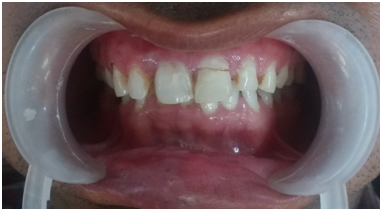
On intraoral examination, left central incisor tooth showed half of labial surface exhibits a marked opacity or appears chalky white. Teeth in lower jaw also showed thin white opaque lines running across the tooth surface. Radiographic examination showed localized small radiolucency in the incisal and middle third of central incisal.
TREATMENT PROGRESS
- Patient was draped and aseptic condition was established.
- The confined area of hypocalcification was removed with the help of aerotor and carbide burs.
- As soon as affected area was removed, patient was asymptomatic no more sensitivity was sensed by patient.
- Aesthetic composite restoration was done and similar appearance was achieved as adjacent tooth colour shade

Pre-op view-Showing chalky white spot on central incisor

Post-op view- Showing aesthetical composite restoration giving similar appearance of tooth without defect.
DISCUSSION
Types of Environmental Hypoplasia
a.Hypoplasia due to nutritional deficiency- deficiency of vitamin A, C, D; Calcium and phosphorus.
b.Hypoplasia due to exanthematous diseases- like chicken pox, measles and scarlet fever.
c.Syphilitic Hypoplasia-
- It involves maxillary and mandibular permanent incisors and 1st molars.
- Affected incisors are called as Hutchinson’s incisors, molars are called as Mulberry molars (Moon’s molar, Fournier’s Molar).
d.Hypoplasia due to hypocalcaemia- Tetany induced by decreased level of calcium in blood which is as low as 6-8mg/ml. As calcium is required for normal tooth formation, there is defective formation of enamel. Enamel hypoplasia, is usually of pitting variety.
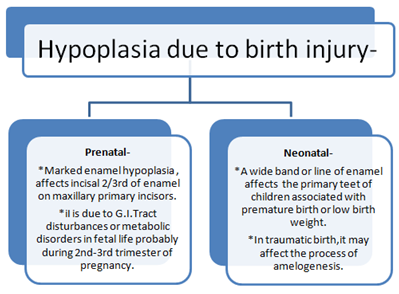
e. Hypoplasia due to birth injury-
f.Turner’s Hypoplasia- localized type of hypoplasia caused by local infection or trauma and that tooth is called as “Turner’s tooth”.
g.Dental Hypoplasia- Drinking water that contains in excess of 1ppm
(parts per million) fluoride can affect the ameloblasts during tooth formation stage and can cause the clinical entity called as “mottled enamel”.
h.Tetracycline Hypoplasia- It may be incorporated in calcifying enamel matrix by formation of tetracycline calcium orthophosphate complex.
CONCLUSION
So while providing treatment to your patient proper selection of case, depending upon the appearance of defect, choice of treatment can be a successful alternative that satisfies a patient’s request to avoid endodontic surgery or tooth extraction.
REFERENCES
- Textbook of Oral Medicine-Anil Govindrao Ghom 2nd edition.
- Shafer’s Textbook of Oral Pathology- 6th Edition.
Disclaimer from Guident
The views and opinions expressed in articles published in Guident are solely those of the authors and do not necessarily reflect the views of the editors, the editorial board or the publisher, Ivory India. Guident does not endorse any product, technique or treatment described. Clinical content is intended for qualified dental and medical professionals and is not a substitute for individual clinical judgement. Guident, its editors and the publisher accept no liability for any consequence arising from the use of information published in the journal.
How to cite this article
Dr. Kalpana Sinsinbar Department of Dentistry. Enamel Hypoplasia. Guident. 2018 Aug;11(9). Available from: https://guident.in/articles/endodontics/enamel-hypoplasia.html