Can We Replace Amalgam with Cention N?
INTRODUCTION
Over the past years esthetic dentistry has shown considerable progress leading to the development of a number of improved restorative materials (1)Numerous direct restorative materials are available to the modern dental practice - from amalgams through to modern bulk fill composites. Amalgam materials were first introduced to western dentistry in the 19th century,1, glass ionomer cements (GICs) were introduced around the 1970s, composites became standard during the 1980s, resin modified glass ionomers,2and compomers,3 were introduced in the 1990s and the current decade saw the launch of several bulk-fill composites. Amalgams and glass ionomer cements can be viewed as most popular restorative materials. Basic in the sense that they are long-established, economical and simple to use. They are usually applied in bulk without an adhesive, are self-curing and do not require complicated dental equipment. Although the greater strides forward in direct filling materials have been made with dental composites and their accompanying adhesives in recent decades; simple restoratives such as amalgam and glass ionomer cements remain popular. Amalgams offer unparalleled longevity and strength but are coupled with poor esthetics and controversial ingredients. Glass ionomer cements offer depot ion-release and undoubtedly improve on the esthetics of amalgams but they provide far less strength and longevity. Both products clearly have certain drawbacks and represent a clinical compromise in one respect or another. The chemistry of GIC has evolved over the time. Cermet is a glass ionomer cement that has been reinforced with filler particles prepared by fusing silver particles to glass. Composite resin has been used for esthetic resoration but its shrinkage during polymerization resulted in contraction stresses within the restoration leading to marginal failure and subsequent microleakage. This leads to poor marginal seal, secondary caries, marginal staining, post operative sensitivity and partial or total loss of restoration. Modern composite resins undergo volumetric contractions ranging between 2.6% to 4.8%. Also the coefficient of thermal expansion of composite resin is several times higher that of Department of Conservative Dentistry and Endodontics Seema Dental College and Hospital, Rishikesh, Uttrakhand, India A Case series enamel and dentin. This physical property is also reported to be responsible for microleakage in resin based restorations.1
Cention N is an “alkasiteâ€Â restorative. Alkasite refers to a new category of filling material, which like compomer or ormocer materials is essentially a subgroup of the composite material class. This new category utilizes an alkaline filler, capable of releasing acid-neutralizing ions. Cention N is a tooth- coloured, basic filling material for direct restorations. It is self-curing with optional additional light-curing. It is radiopaque, and releases fluoride, calcium and hydroxide ions. As a dual-cured material it can be used as a full volume (bulk) replacement material. Optional light curing is carried out with blue light in the wavelength range of approximately 400 - 500 nm - thus all standard polymerization lights can be used to cure the material. Cention N consists of a separately packaged powder and liquid that are mixed by hand directly before use. One scoop of powder is used per 1 drop of liquid, corresponding to a powder/liquid weight ratio of 4.6 to 1. The liquid comprises dimethacrylates and initiators, whilst the powder contains various glass fillers, initiators and pigments.
CASE REPORT
CAVITY PREPARATION FOR CENTION N
Isolation was done using of rubber dam. The temporizing material was removed. The access cavity was cleaned and dried. The two components of the material were used by mixing one scoop of powder with one drop of liquid, thus corresponding to Powder: liquid ratio of 4.6:1 on a paper pad as per manufacturer’s instructions. It was manipulated and with the help of condenser it was condensed in the access cavity. Then excess material was removed with tungsten carbide finishers or fine-grit diamonds. Check the occlusion and articulation and grind in necessary adjustments to prevent premature contacts or undesired articulation paths on the surface of restoration.
Cention N as Post Endodontic Restoration
The prepared cavity was etched with 37% Phosphoric Acid (Proetch) for 10-15 seconds. The cavity was rinsed thoroughly and dried using blotting paper strip. Bonding Agent (Tetric N-Bond Ivoclar Vivadent) was applied and light cured for 20 seconds. Then the cavity was restored with Cention N and light cured for 60 seconds. The final curing was done for 60 seconds. Then excess material was removed with tungsten carbide finishers or fine- grit diamonds. Check the occlusion and articulation and grind in necessary adjustments to prevent premature contacts or undesired articulation paths on the surface of restoration.
CASE 1
PRE OPERATIVE (Post Endodontic Class I Cavity Preparation done with respect to 27)
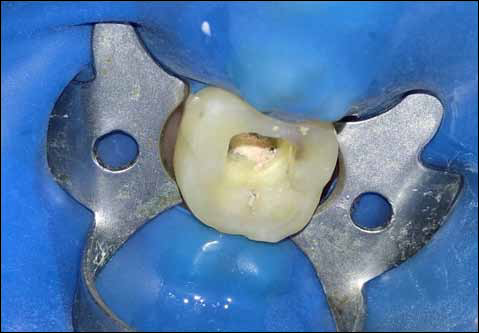
POST OPERATIVE (Post Endodontic Class I Restoration done with Cention N without Adhesive with respect to 27)

CASE 2
PRE OPERATIVE(Post Endodontic Class I Cavity preparation done with respect to 17)
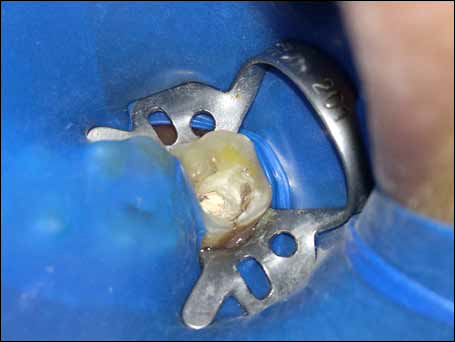
POST OPERATIVE (Post Endodontic Class I Restoration done with Cention N with adhesive with respect to 17)
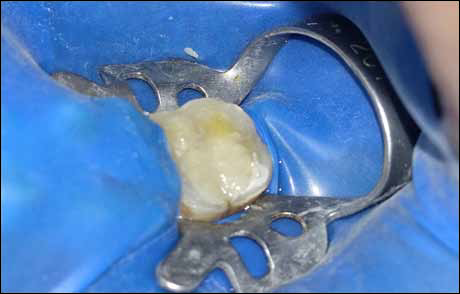
CASE 3
PRE OPERATIVE (Deep Carious Lesion Class II cavity preparation done with respect to 26)
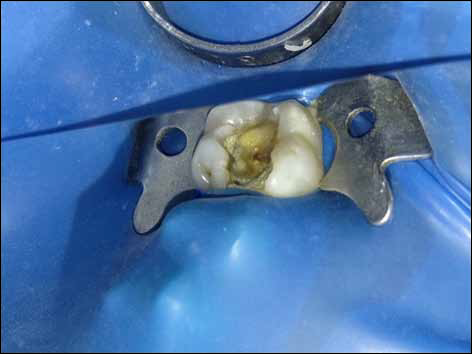
POST OPERATIVE (Post Endodontic Class II Restoration done with Cention N with adhesive with respect to 26)

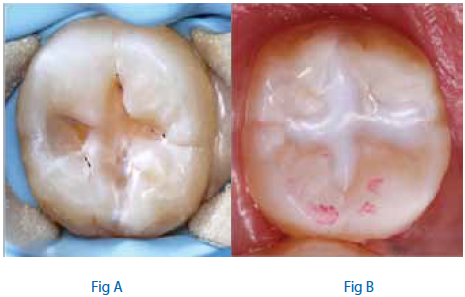
CASE 4
PRE OPERATIVE (Carious Lesion Class I cavity preparation done with respect to 26)-Fig A
POST OPERATIVE (Class I Restoration done with Cention N without adhesive with respect to 26)-Fig B
DISCUSSION
Cention N exhibits a high polymer network density and degree of polymerization over the complete depth of restoration. It also includes a special filler which acts as a shrinkage stress reliever minimizing the shrinkage force. The organic/inorganic ratio as well as the monomer composition of the material is also responsible for the low volumetric shrinkage leading to least microleakage1Glass Ionomer Cement bonds chemically to tooth stucture, achieved via an exchange of ions arising from both the tooth and restoration leading to formation of calcium-polyacrylate bond.10The coefficient of thermal expansion of conventional glass ionomer cement have been shown to be closer to tooth structure than resin composites hence there is less chance of formation of voids or openings at the tooth restoration interface when temperature changes occour. These cements are highly technique sensitive and the most critical aspect is isolation from moisture for the first 30 minutes after placement. On exposure to water the matrix forming ions are easily leached out during the initial set which could interfere at tooth restoration interface. Also excessive dehydration can result in a chalky, crazed or a cracked surface leading to considerable marginal leakage. Cention N is designed as a self curing material with optional light curing perspectives. It consists in its current form of two components- a fluid and a powder-that have to be mixed together. While the initiation rates can be very fast in the light curing mode, its significant limitation is that the penetration of light energy in depth is low. In support of this, a redox activation was added consisting of a copper salt, a peroxide and a tiocarbamide and was implemented in the powder component6. The kinetics of redox-initiated polymerization in terms of propagation and termination steps. When the material polymerizes, either in self-cure mode or via additional light curing, the monomer chains located on the fillers together with the silanes begin a cross linking process and forces between the individual fillers which play stress on the cavity walls. This stress is influenced by both volumetric shrinkage and modulus of elasticity of the material. Due to its low elastic modulus(10GPa) the shrinkage stress reliever within Cention N reduces polymerization shrinkage and polymerization1Cention N is described as releasing fluoride, hydroxide and clcium ions6 able to prevent tooth demineralization.
CONCLUSION
In the following case series, after ethical committee clearance 100 patients were included in the Department of Conservative Dentistry and Endodontics, at Seema Dental College and Hospital, Rishikesh. The teeth were restored with Cention N with or without adhesive in all clinical situations with respect to Class I, Class II or Post Endodontic restorations. Over a period of 6 months patients were recalled and it was observed that Cention N in all clinical situations with or without adhesive performed similarly but the restorations with adhesive were clinically superior. On the clinical recall observation patient’s were highly satisfied and there were no cases of debonding, fractured restoration, endodontic complications or incidence of secondary caries. Hence it can be concluded that the Cention N as a restorative material proves successful clinically and can be considered as an alternative to amalgam, composite and Glass Ionomer cements.
REFERENCES
1. Samantha S, Das UK, Mitra A Comparison of microleakage in class v cavity restored with flowable composite resin, glass ionomer cement and cention N IJIR 2017:3(8);180 - 183
2. Finan, L.; Palin, W.M.; Moskwa, N.; McGinley, E.L.; Fleming, G.J. The influence of irradiation potential on the degree of conversion and mechanical properties of two bulk-ï¬ÂÂÂll flowable rbc base materials. Dent. Mater. 2013, 29, 906 - 912.
3. Alrahlah, A.; Silikas, N.; Watts, D.C. Post-cure depth of cure of bulk ï¬ÂÂÂll dental resin-composites. Dent. Mater. 2014, 30, 149 - 154.
4. Ilie, N.; Simon, A. Effect of curing mode on the micro-mechanical properties of dual-cured self-adhesive resin cements. Clin. Oral Investig. 2012, 16, 505 - 512.
More References are available on request
Disclaimer from Guident
The views and opinions expressed in articles published in Guident are solely those of the authors and do not necessarily reflect the views of the editors, the editorial board or the publisher, Ivory India. Guident does not endorse any product, technique or treatment described. Clinical content is intended for qualified dental and medical professionals and is not a substitute for individual clinical judgement. Guident, its editors and the publisher accept no liability for any consequence arising from the use of information published in the journal.
How to cite this article
Dr. Annil Dhingra, Dr. Shalini Sharma, Dr. Praveen Singhal. Can We Replace Amalgam with Cention N?. Guident. 2018 Mar;11(4). Available from: https://guident.in/articles/endodontics/can-we-replace-amalgam-with-cention-n.html