Cu-Sil Denture-a Novel Method to Preserve the Remaining Teeth and Bone-a Case Report
Department Of Prosthodontics And Crown & Bridge, Seema Dental College and Hospital, Rishikesh
ABSTRACT
Cu-sil denture is a transitional removable partial denture which helps in preserving the remaining natural teeth and the alveolar process. Presence of few teeth in oral cavity help in preserving alveolar ridge integrity, maintain the proprioception, and gives psychological benefit to the patient.. This article reports a case where a Cu-sil denture is used to increase retention and preserve the few remaining natural teeth which will allow in providing proprioception.
Keywords: cu-sil, dentures, removable partial dentures, retention
INTRODUCTION
Cu sil dentures are transitional dentures for patients with very few remaining natural teeth not willing to undergo extraction and wanting to replace the remaining missing teeth. These dentures use a simplified approach of preserving teeth, which helps in creating a positive attitude among the patients by maintaining proprioception,1 preserving ridge integrity2 and providing psychological benefit to the patients. Therefore, retention of natural teeth preserves some of the sensory input from the periodontal receptors, which is more precise than that obtained from the oral mucosa.3 Patients with very few remaining natural teeth may be treated using overdentures, they may not be favourable in all clinical situations. Immediate or transitional dentures are the next option available for such patients who delay getting all their teeth extracted due to the detrimental effect it has on their psychology.
This is a case report of a patient with a single lone standing tooth in the maxillary arch wanting to replace the remaining missing teeth to restore the normal masticatory function.
CASE REPORT

Figure 1: Pre operative frontal view
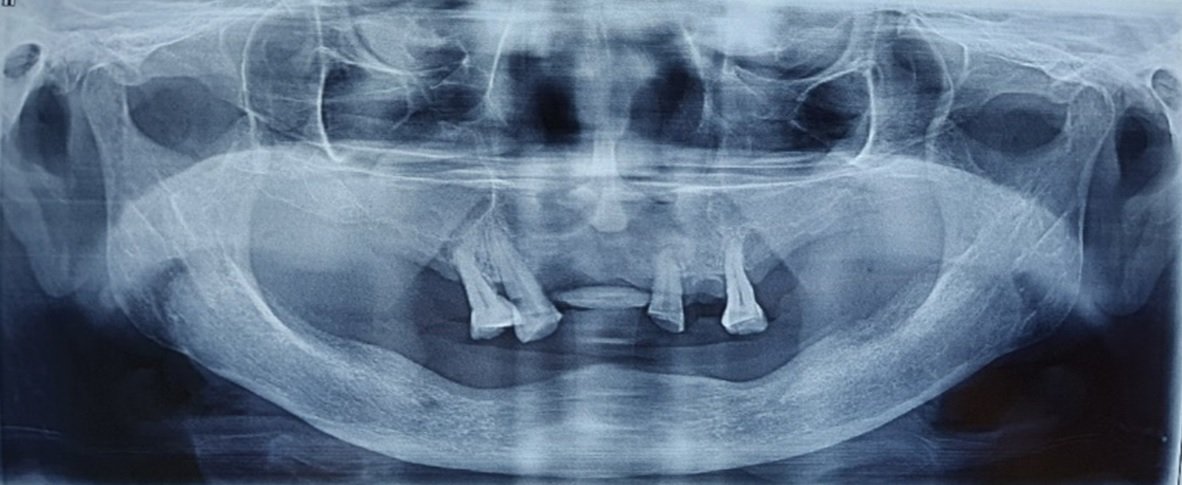
A 66 year old female patient reported to the Department of Prosthodontics and Crown & Bridge in Seema Dental College and Hospital, Rishikesh, with a chief complaint of difficulty in chewing due to missing teeth in upper and lower back tooth region she also complained of loosening of previously fabricated dentures and poor aesthetics. Intra oral examination revealed that only the maxillary left second molar was present which was firmly attached to the bone in the upper arch while in the lower arch mandibular right and left central incisor, lateral incisor and canine were present. Patient had no relevant medical history and past dental history revealed that patient had undergone multiple extraction in maxillary and mandibular region due to the presence of periodontal condition. Patient was suggested to undergo extraction of remaining tooth followed by fabrication of complete denture in the maxillary arch, however patient wanted to retain the tooth and wanted a retentive denture fabricated for the remaining missing teeth. Thus, a transitional removable partial denture for the mandibular arch and a Cu-sil denture for the maxillary arch was planned for the patient.
PROCEDURE
Preliminary impression of maxillary and mandibular arches were made with irreversible hydrocolloid impression material (Alginate, Dentsply) and poured in type III dental stone. After the casts were obtained, custom tray was fabricated using autopolymerizing resin with a wax spacer covering the edentulous ridge.

Figure 2: Pre operative maxillary arch- Intra oral view showing presence of maxillary left third molar

Figure 3: Preliminary impression using irreversible hydrocolloid
Border moulding was done using green stick compound, (DPI Pinnacle) and secondary impression was recorded using zinc oxide eugenol impression paste. A dual impression was taken using irreversible hydrocolloid. The impressions were poured with Type IV dental stone and temporary denture bases were fabricated using autopolymerizing acrylic resin.

Figure 4: Completed border moulding of maxillary and mandibular arch

Figure 5: Final impression recorded using Dual impression technique
The occlusal rims were prepared for bite registration, further which teeth arrangement, try in procedure, flasking and dewaxing was done in a routine manner. After wax elimination procedure, separating media was applied on both parts of mould and maxillary left third molar was trial packed near the cervical region with permanent silicone soft liner in 3-4 mm thickness.
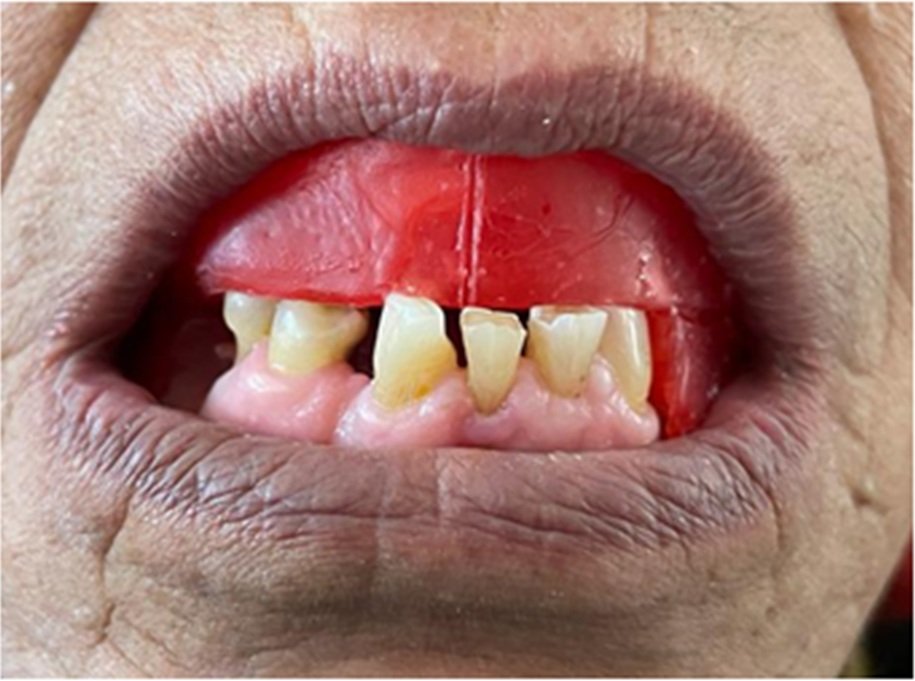
Figure 6: Bite registration

Figure 7: Try in procedure
Then, heat cure acrylic resin was packed in the remaining mould, flask was closed and curing was completed. The final denture was finished, polished and inserted in patient’s mouth.

Figure 8: Finished and polished dentures; Occlusal surface and Intaglio surface

Figure 9: Post operative intra oral view
The patients were given denture insertion instructions and recalled for post insertion adjustments. As soft liner was used patient was instructed to maintain optimum oral hygiene and get the denture relined once the remaining tooth was extracted. It was seen that the patient was satisfied with retention and stability of their prosthesis using this technique.

Figure 10: Post operative frontal view
DISCUSSION
Cu-sil denture is a denture with holes, which provides space for the remaining natural teeth to emerge into the oral cavity through the denture.4 This treatment alternative does not require any special tooth preparations or impression technique. It is a more affordable treatment option to rejuvenate the bone loss and preserve the remaining tooth structures. The Cu-sil like denture can serve as conventional complete denture after relining once the patient loses all the natural teeth.5 It is a viable treatment alternative to implant supported dentures, overdentures and full dentures. It is however contraindicated in cases with numerous, evenly distributed teeth across the dental arch which may lead to a weak appliance, in cases with abutments having severe undercuts and in patients who have a habit of bruxism.6
CONCLUSION
Cu-sil dentures are a good treatment options in patients with isolated teeth and limited prosthodontic options. These dentures are typically designed to preserve the remaining tooth and thus preventing residual ridge resorption. Sensory input from the periodontal receptors is one of the major determinants of masticatory function and the remaining teeth offer more discrete discriminatory input than the oral mucosa. The silicone snugly fits around the natural teeth, which helps in establishing peripheral seal. It also acts as a cushion, distributing the forces evenly and giving patients a psychological satisfaction of retaining their natural teeth and not having to undergo any extractions.
REFERENCES
- Zarb-Bolender: Prosthodontic treatment for edentulous patients, 12th ed. Mosby.6- 23,160-176,190-208
- Sheldon Winkler: Essentials of complete denture prosthodontics, 2nd ed.Ishiyaku EuroAmerica Inc.U.S.A. 22-34,384-402
- Rathee, Manu & Bhoria, Mohaneesh & Singla, Shefali & Malik, Poonam. (2014). Oral Proprioception for Prevention and Preservation.
- Khandelwal M, Punia V. Saving one is better than none: Technique for cu-sil like denture – A case report. 2011;03(01):41–5.
- Carlsson GE. Clinical morbidity and sequelae of treatment with complete dentures. J Prosthet Dent 1998;79:17-23.
- Jain JK, Prabhu CR, Zahrane MA, et al. Cu-sil dentures - a novel approach to conserve few remaining teeth: Case reports. J Int Oral Health. 2015;7(8):138–140.
Disclaimer from Guident
The views and opinions expressed in articles published in Guident are solely those of the authors and do not necessarily reflect the views of the editors, the editorial board or the publisher, Ivory India. Guident does not endorse any product, technique or treatment described. Clinical content is intended for qualified dental and medical professionals and is not a substitute for individual clinical judgement. Guident, its editors and the publisher accept no liability for any consequence arising from the use of information published in the journal.
How to cite this article
Dr. Himanshu Aeran, Dr. Jyotsna Seth, Dr. Aishwarya Kesavan. Cu-Sil Denture-a Novel Method to Preserve the Remaining Teeth and Bone-a Case Report. Guident. 2022 Apr;15(5-6). Available from: https://guident.in/articles/prosthodontics/cu-sil-denture-a-novel-method-to-preserve-the-remaining-teeth-and-bone-a-case-report.html