Bleaching - Individualised Treatment Plan
Abstract
Discoloured teeth, is a cause for concern for people, leading them to seek dental care for its correction. Due to the myriad causes of tooth discoloration there is no fixed treatment modality available at present for each and every case. The clinician must therefore be well informed of different options available to choose the best for a given case.
INTRODUCTION
Esthetics, by definition is the science of beauty, derived from the Greek word ‘perception’ which deals with beauty as an art.
In the modern civilized, cosmetically conscious world, well-contoured and well-aligned white teeth set the standard for beauty. Such teeth are not only considered attractive, but are also indicative of health, self-esteem and pride.
The causes of tooth discoloration are varied and complex. Tooth discolorations can be broadly classified as Extrinsic or intrinsic.1 Extrinsic staining usually occurs due to certain oral habits or poor oral hygiene. The intrinsic stains, on the other hand, may be caused due to a number of conditions like trauma, fluorosis, intake of drugs. Currently, there are several methods to treat discoloured teeth such as bleaching, laminates, veneers and jacket crowns and metal free crowns.
Bleaching as a treatment modality continues to hold its century’s’ old place as the simplest, most common, least invasive and least expensive means to lighten discoloured teeth. Bleaching agents can be applied externally to the teeth (vital bleaching), or internally within the pulp chamber (Non-vital bleaching). Few school of thoughts say newer in-office versions of light and LASER activated bleaching promise faster and better results.
The following case series attempts to present an array of cases to highlight some of the many techniques used at present.
CASE-I
A 23 year old male reported to the department of dentistry with the complaint of discolouration localized to one tooth that is tooth number 7 (Fig Ia). Patient gave history of pain in the same tooth around 9 months back and had visited the dentist for the same. On clinical examination the tooth was slightly discoloured and there was IRM restoration. Tooth was completely asymptomatic except the discolouration. Pulp vitality test was done with endo ice. X- ray was taken which showed complete root canal treatment. Shade of tooth was taken before starting the treatment with Vita shade guide. The tooth was isolated using a rubber dam. Access was improved and all the necrosed pulpal horns removed and access cavity was widened. Coronal chamber thoroughly irrigated with 3% sodium hypochlorite and followed by 3% hydrogen peroxide and saline. Cavit was placed of 2mm thickness below the CEJ or below the labial gingival margin. Sodium perborate was mixed with saline and placed in the entire coronal chamber except the margins and sealed by IRM over it.
Patient was recalled after a week. There was significant change in esthetics ( Fig I b). Once the desired shade was obtained, coronal pulp chamber was copiously irrigated with saline and coronal pulp chamber was obturated with calcium hydroxide- saline thick paste and temporary seal for a week. Again after a week the entire coronal chamber thoroughly irrigated with saline and distilled water and hybrid composite restoration was done.
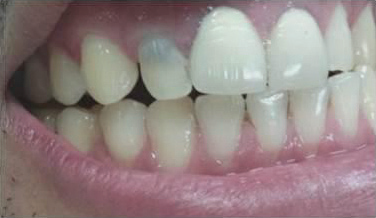
Figure I (a )-PRE-OPERATIVE
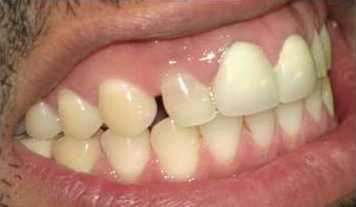
Figure I (b )-POST-OPERATIVE
CASE I -discoloured Lateral incisor corrected using walking bleach
CASE- II
A female patient aged 38 came to the department of Dentistry with the chief complaint of discoloured tooth ( Fig II a). On clinical examination there was a discolouration in the tooth number 23 and pulp vitality testing was negative. Root canal treatment was completed and sodium perborate was used in the same manner as in the case no 1. After a week follow up discolouration had improved (Fig II b).

Figure II (a ) - PRE-OPERATIVE
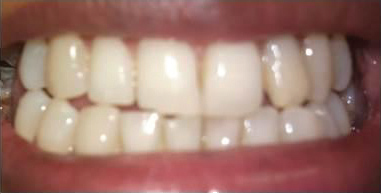
Figure II (b) - POST-OPERATIVE
CASE II - discoloured Lateral incisor corrected using walking bleach
CASE- III
A 25 year old male patient presented to the dental department with chief complaint of white and brown spots present on his teeth since childhood ( Fig III a). He reported no history of trauma or of any prolonged illness. The patient’s sister had similar stains. A diagnosis of dental fluorosis (Dean’s index moderate) was established after examination. Rubber dam was applied from 14 to 24 and light activated bleaching was done (Zoom, Philips oral healthcare) (Fig III b) . The patient was prescribed relief ACP for any post-operative sensitivity.
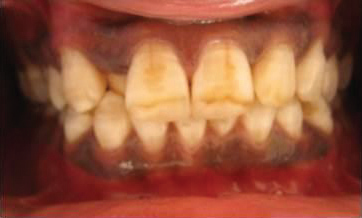
Figure III (a ) - PRE-OPERATIVE

Figure III (b) - POST-OPERATIVE
CASE III - Power bleaching done for fluorosis stains from 13 to 23.
CASE- IV
A female patient aged 31 had come to dental department with complain of yellowish teeth and wants whitening of same. On oral examination teeth of upper and lower jaw was little darker in shade ( Fig IV a). Shade was taken with vita shade guide tabs, was B2 and A3 at canine region. Patient was informed tha dazzling white smile may no be possible but bleaching may treat your teeth one or two shade lighter. Rubber dam was applied 15 to 25 and light activated bleaching was done (Zoom, philips oral healthcare). Procedure was repeated for lower jaw from 35 to 45. Patient was satisfied with the result (Fig IV b) .

Figure IV (a ) - PRE-OPERATIVE
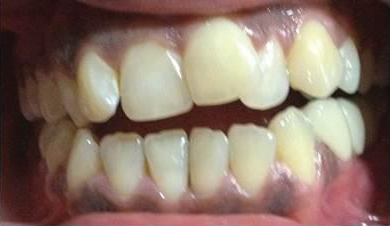
Figure IV (b) - POST-OPERATIVE
CASE-IV Vital tooth bleaching performed for discoloured 14 to 24 and 34 to 44
DISCUSSION
Discolouration or darkening of non vital tooth is usually caused by necrosed pulpal tissue or narrow access opening or insufficent irrigation regime.2,3 Antibiotic dressing containing tetracycline and obturating material in the coronal pulpal area also can also be etiology of root canal treated tooth discolouration.3,4,5 Access cavity of anteriors should be involving distal and mesial pulp horn and copious irrigation with sodium hypochlorite alone can change the shade of involved tooth.2 Dentin conditioning with 37% phosphoric acid or 10% polyacrylic acid has role in removing smear layer and opening the dentin tubules for better penetration of bleaching agent.10,11 In this presentation walking bleach was selected in first two cases walking bleach was initiated after a week of obturation for complete setting of sealer. This subject is controversial, however some authors report that bleaching procedure can be stated immediately after endodontics. Whereas some others say 30 days time should elapse between endodontia and bleaching treatment.10
Instead of hydrogen peroxide, Sodium perborate with saline was used as it breaks down into less concentrated hydrogen peroxide and releases active oxgen and initiates the bleaching. It is less aggressive and safe.6,7,8 .calcium hydroxide was placed in coronal chamber for a week after bleaching to alkaline the ph and to repair any possible damage to the cervical resorption.10,11 One week time is also important for to clear the residual oxygen which can interfere the polymerisation reaction of composite restoration., ,9,10,11
Long standing non vital tooth discolouration have shown poor prognosis but in fewer cases surprisingly significant results. Good cervical seal has important role in success since it is important to prevent leakage of bleachimg agent into oral cavity.10
In case III , power bleaching was attempted to mask the brown and white stains present. The ACP relief gel was prescribed to counter post-operative sensitivity commonly reported. This cannot be done in patients with latex allergy, those who have dentinal sensitivity prior to bleaching. The main safety issue concerning the activating lights used in power bleaching is heat generation and its effect on the pulp. Recent research showed the increase in the intra-pulpal temperature with most bleaching lamps was below the critical threshold of a 5.5 degree Celsius increase thought to produce irreversible damage.
During the past decade, tooth bleaching has undergone great development with increased number of options available to the patient and the dentist. However, treatment selection is based on the correct identification of the cause of discoloration. Case selection should br depends on patient expectations and probability of improvement and should be presented in realistic form without false promises.
REFERENCES
- Kenneth M. Hargreaves, Stephen Cohen, Louis H. Berman.Cohen's Pathways of the Pulp. Elsevier. 10th ed. 2010
- Faunce F. Management of discoloured teeth Dent din North Am 1983 ; 27:657-70
- Brown G. Factors influencing suucessful bleaching of the discoloured root filled tooth. Oral Surg Oral Med Oral Patol 1965; 20:238-44.
- Vander Burgt TP, Plaesschart AJM. Tooth discoluration induced by dental material. Oral Surg Oral Med Oral Pathol 1985; 60: 666-9.
- Vander Burgt TP, Plaesschart AJM. Bleaching of tooth discolouration caused endodontic sealers. J Endo 1986; 12: 231-34.
- Rotstein I, Mor C, Friedman S. In vitro efficacy of sodium perborate prepration used for intracoronal bleaching of discoloured non vital teeth. Endo Dent Traumatol 1991; 7:177-80.
- Kaneko J, Inoue S, KawaKami S, Sano H. Bleaching effect of sodium perborate on discoloured pulpless teeth in vitro. J Endod 2000; 26: 25-8.
- Hosoya N, cox CF, Arai T, Nakamura J. The walking bleach procedure: an in vitro study to measure microleakage of five temporary sealing agents.
- Dishman MV, Covey DA, Baughan LW. The ejects of peroxide bleaching on composite to enamel bond strength.
- Gianluca Plotino, Laura Buono. Nonvital Tooth Bleaching: A review of the literature and clinical procedures. JOE 2008; 34: 394-407.
- M. Sulieman . An overview of Bleaching Techniques: Night guard vital Bleaching and Non – Vital Bleaching.
- Luiz Narciso Baratieri, Andre Vicente, Ritter. Nonvital tooth bleaching: Guidelines for the clinician . Quintessence Int 1995; 26: 597-608.
Disclaimer from Guident
The views and opinions expressed in articles published in Guident are solely those of the authors and do not necessarily reflect the views of the editors, the editorial board or the publisher, Ivory India. Guident does not endorse any product, technique or treatment described. Clinical content is intended for qualified dental and medical professionals and is not a substitute for individual clinical judgement. Guident, its editors and the publisher accept no liability for any consequence arising from the use of information published in the journal.
How to cite this article
Dr. Sharda Yadav, Dr. Senior Resident, Dr. Jasheena Singh. Bleaching - Individualised Treatment Plan. Guident. 2014 Jul;7(8). Available from: https://guident.in/articles/prosthodontics/bleaching-individualised-treatment-plan.html