Management of Class II Malocclusion
Department of Orthodontics and Dentofacial Orthopedics Regional Dental College, Guwahati, India
INTRODUCTION
Class II malocclusions are of interest to the practicing orthodontists since they constitute a significant percentage of the cases they treat,it is among the most common developmental anomalies with a prevalence ranging from 15 to 30% in most populations6.In individuals with Class II malocclusions, there is an anteroposterior discrepancy between the maxillary and mandibular dentitions, which may or may not be accompanied with a skeletal discrepancy.
The resulting anomaly may demonstrate various severities of class II malocclusion in different ages, which dictates the preferred approach to clinical management. Treatment timing of class II malocclusion has long been a topic of controversy for decades . The literature is replete with research aimed at answering most clinical challenges of this type of malocclusion1.
ETIOLOGY AND PATHOGENESIS OF CLASS II MALOCCLUSION
The etiology of class II malocclusion has been linked to hereditary and environmental factors4
Class II Division 1 malocclusions
:-
- Proclined maxillary incisors, an increased overjet with or without a relatively narrow maxillary arch.
- The lips of the patients are usually incompetent and they try to compensate it via circumoral muscular activity
- Rolling the lower lip behind the upper incisors, or moving the tongue
- forward between the incisors causing hyperactive mentalis.
- Fingerâ€sucking or other oral habits may also lead to the development of this malocclusion, mostly
following imbalances of the
buccinator muscles and tongue force, and narrowing the maxillary arch.
- Low tongue position favours the appearance of maxillary contraction (unilateral or bilateral cross bite).
- Hypertonic lower lip.
- Short and hypotonic upper lip.
Dental features such as tooth size arch length discrepancies might be the reason for the labial movement of the upper incisors resulting in exacerbation of the overjet .
CLASS II DIVISION 2
- Vertical dimension of class II division 2 patients is usually decreased in comparison to other types, which may result in the absence of an occlusal stop on lower incisors and consequently an increase in the overbite .
- Dental crowding also, in contrast to the division 1 category, is exacerbated by retroinclination of the upper incisors .
- Active muscular lips are responsible for upper and lower retroinclination in this type.
SKELETAL CLASS II TYPES –
- Due to maxillary prognatism (increased maxillary depth angle between Frankfort plane and Nâ€A).
- Due to mandibular retrognatism (decreased facial depth angle between Frankfort plane and Facial plane.
- Combination of the previous two.
- The cranial base length (increased length of the anterior cranial base: midface protrusion, lengthening of the posterior cranial base
- more retruded position of the temporomandibular articulation),
- vertical discrepancy (anterior upper face height often greater than normal),
- steep occlusal plane
3. DIAGNOSIS AND CLINICAL FEATURES OF CLASS II MALOCCLUSION
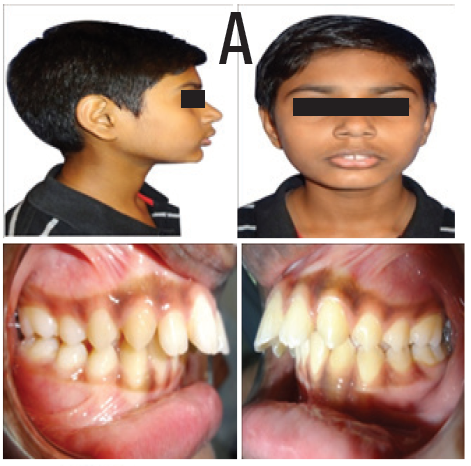
Class II malocclusion could be identified based on precise clinical evaluation (extra†and intraâ€oral features), diagnostic aids (history, photographic analysis, radiographic analysis, and cast analysis), and functional analysis (examination of postural rest position and maximum intercuspation, examination of the temporomandibular joint and orofacial dysfunction) of the patients .
- The angle defined class II malocclusion as characterized by a distal relation of the lower to the upper permanent first molars to the extent of more than oneâ€half the width of one cusp and the maxillary incisors being protrusive
The presence of distal step molar relation, tooth size discrepancy, and/or excessive overjet may lead the clinicians to a false interpretation of skeletal class II malocclusion1.
TREATMENT OF CLASS II MALOCCLUSION
Treatment strategies of class II malocclusion are categorized based on the growing and non†growing status of patients.
The existing evidence suggests that providing early orthodontic treatment for children with class II malocclusion and prominent upper front teeth is more effective in reducing the incidence of incisal trauma than providing one course of orthodontic treatment when the child is in early adolescence3 .
EARLY MANAGEMENT IN THE MIXED DENTITION
The best treatment modalities for class II malocclusion in growing patients include using
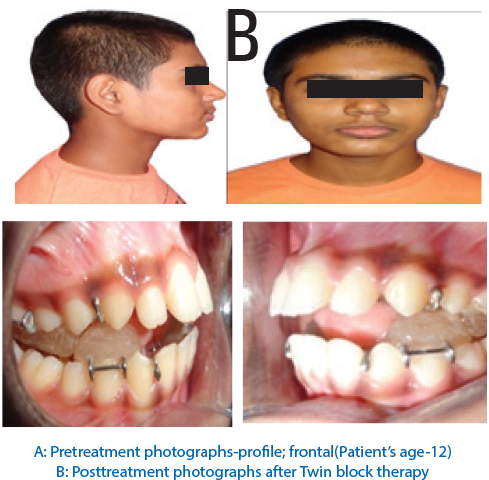
- Functional appliances either removable (Activator, Bionator, Frankel, and Twinâ€block) or fixed appliances (MARA, Jasper Jumper, or Herbst appliance) that mostly enhance further mandibular growth via mandibular advancement.
- Headgear (Cervical, Highpull, and combination type), which provides extra oral force to restrict further maxillary growth.
- Mandibular retrusion(Horizontal growth pattern)-Functional appliance gives best results
- Mandibular retrusion or Maxillary prognathism(Vertical growth pattern):-Combined therapy with High pull headgear
Both removable functional appliances and headgear therapy depend on the cooperation of the patients.
Removable functional appliances were effective in improving class II malocclusion in short term, although their effects are mainly dentoalveolar, rather than skeletal .
On the other hand, more long†term skeletal effects following removable functional appliances were seen in patients during their pubertal growth phase, compared to prepubertal phase.
The key differences between removable and fixed appliances are
- different working hours (intermittent vs. continuous),
- also optimal treatment timing (before puberty growth vs. at or after puberty spurt)
and direction of further growth5
Various types of fixed functional appliances (rigid, semirigid, and flexible) have been developed and used in clinical settings .
Dental changes including mesial movement of lower molars and proclination of lower incisors were proven more significant than skeletal changes following their implication, compared to removable appliances , which can negatively affect the longâ€term stability of the results.
LATE MANAGEMENT OF CLASS II MALOCCLUSION
Currently, the number of adult patients seeking orthodontic treatment has gradually increased which focus mostly on camouflaging the malocclusion.
Depending on the severity of malocclusion, class II elastics, compensatory extraction (maxillary premolars and/or mandibular premolars) or even orthognathic surgical modalities may be used to alleviate the functional and esthetic problems associated with this type of malocclusion.
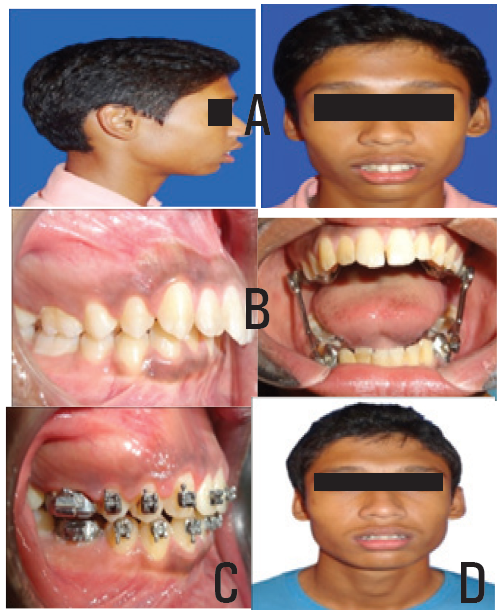
A: Pretreatment Photographs
B: Herbst appliance in place
C: Fixed mechanotherapy started
D: Posttreatment photographs
Class II elastics with nonâ€extraction treatment plan is a typical interarch approach for managing mild class II malocclusion . The effects of class II elastics include mesial movements of the mandibular molars, tipping of the mandibular incisors, distal movements and tipping of the maxillary incisors, extrusion of the mandibular molars and maxillary incisors, and consequently clockwise rotation of the mandibular plane .
DISADVANTAGE
Depends heavily on patient compliance for their effectiveness, poor cooperation can lead to poor treatment outcomes and increased treatment time.
In many nonâ€extraction cases, the distilizing appliance like pendulum appliance,distal jet are the most effective device for distalizing maxillary molars2.
ADVANTAGES
minimal dependence on patient compliance, allows for correction of minor transverse and vertical molar positions by incorporation of uâ€loop in adjustment springs (which further enhance additional space achievement), and laboratoryâ€friendly fabrication.
The expected distal movement of the first molars appears to be more significant if it could be used before the eruption of the upper second molars.
Extractions of only upper premolars:-According to a current softâ€tissue paradigm, clinicians must pay attention to several factors such as softâ€tissue thickness, amount of pretreatment crowding or cephalometric discrepancy, when deciding their extraction regimens for adult patients .
- When class II division 1 malocclusion is treated with maxillary and mandibular premolar extractions, the nasolabial angle increases and the lips are retracted.
- There is less retraction of the lower lip in the only upper premolar extraction protocol.
- A delicate adjustment and tradeâ€off between the amount of anterior retraction and the mesial movement of the posterior segment following extraction regimens in each adult class II patient have to be considered to maintain the profile and the position of the upper lip at its most appropriate state.
In order to reduce anchorage loss and space management obtained in extraction and nonâ€extraction cases (distalization appliances), temporary anchorage devices have been introduced in clinical orthodontic situations.
These devices serve considerable advantages including the ease of insertion and the removal in addition to the possibility of immediate loading .
In rare and very severe cases, distraction osteogenesis (DO) with or without further orthognathic surgery can be done to promote the situation . This technique was first developed by Ilizarov for the long bones in the 1950s and was ultimately applied for the facial skeleton.This procedure can be applied for very severe class II malocclusions following mandibular deficiencies with wide age range such as infants with Pierre Robbins syndrome, growing children with severe class II malocclusion or even adult patients with the history of bilateral condylar ankylosis.
In severe class II malocclusion cases, orthognathic surgery (mandibular advancement with or without maxillary impaction) can be done to enhance softâ€tissue esthetic . The proper presurgical orthodontic tooth movements and alignment of arches are essential to maximize the amount of discrepancy correction during surgery .
Many class II patients present with proper mandible size, which is located downward and backward secondary to vertical maxillary excess. Superior impaction of the maxilla with proper center of rotation allows the mandible to rotate upwards and forwards, which enhance the facial height and increase chin prominence.
CONCLUSION
Treatment of Class II malocclusion is not definite for any particular situation. Orthodontist must take factors like age,growth,underlying skeletal bases into consideration before instituting any treatment.Through evaluation and diagnosis is mandatory for successful results.
REFERENCES
- 1Contemporary Orthodontics; William R Profitt,Henry W.Fields,David M.Sarver
- Current Principles and Techniques, St.Louis :Mosby 1994Grabers TM,Vanarsdall RL ,eds Orthodontics :
- The timing of Class II treatment Timothy T. Wheeler, Susan P. McGorray.Am J Orthod 2006;129:S66-70
- Classification and treatment of Class II subdivision malocclusions.Sara E. Cassidy, Stona R. Jackson. (Am J Orthod Dentofacial Orthop 2014;145:443-51)
- Cephalometric study of Class II Division 1 patients treated with an extended duration, reinforced, banded Herbst appliance followed by fixed appliances.Travis Tomblyn,Michael Rogers.
- Vasquez MJ, Baccetti T, Franchi L, McNamara JA, Jr. Dentofacial features of class II malocclusion associated with maxillary skeletal protrusion: a longitudinal 2009;135(5):568.e1–7
Disclaimer from Guident
The views and opinions expressed in articles published in Guident are solely those of the authors and do not necessarily reflect the views of the editors, the editorial board or the publisher, Ivory India. Guident does not endorse any product, technique or treatment described. Clinical content is intended for qualified dental and medical professionals and is not a substitute for individual clinical judgement. Guident, its editors and the publisher accept no liability for any consequence arising from the use of information published in the journal.
How to cite this article
Dr. B.K.Roy, Dr. Trailokya Bharali, Dr. Mahasweta Dasgupta. Management of Class II Malocclusion. Guident. 2017 Jul;10(8). Available from: https://guident.in/articles/orthodontics/management-of-class-ii-malocclusion.html