What Next: The New Norm Post COVID-19 in Dentistry!!
Department of Conservative Dentistry and Endodontics, Seema Dental College And Hospital, Rishikesh (UK)
INTRODUCTION
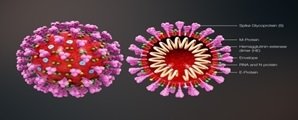
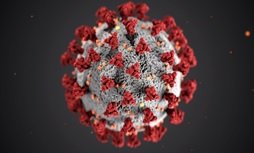
Corona viruses are a large family of viruses, including some that the common cold to some that cause major diseases such as the Severe Acute Respiratory Syndrome (SARS)and the Middle East Respiratory Syndrome.1The coronavirus (Covid-19)outbreak came to light on December 31, 2019, China informed the World Health Organization(WHO) of a cluster of cases of pneumonia of an unknown cause in Wuhan city in Hubei provinces. On January 9, 2020, the WHO issued a statement saying Chinese researchers have made “preliminary determination of the virus as a Novel Corona Virus.
Since then ,more than 3,000 deaths have been reported due to Covid-19 across the world. Cases have been reported from more than 80 countries, including India. The virus has acquired the ability to spread among humans, with cases of human to human transmissions being reported first in Vietnam and Germany.
With the overall cases world wide rising, the WHO has declared the outbreak a Global Health Emergency.2
OVERVIEW OF COVID-19
Modes of transmissionBased on findings of genetic and epidemiologic research, it appears that the COVID-19 outbreak started with a single animal-to-human transmission, followed by sustained human-to-human spread (Chan et al. 2020; Del Rio and Malani 2020). It is now believed that its interpersonal transmission occurs mainly via respiratory droplets and contact transmission (The Chinese Preventive Medicine Association 2020). In addition, there may be risk of fecal-oral transmission, as researchers have identified SARS-CoV-2 in the stool of patients from China and the United States (Holshue et al. 2020). However, whether SARS-CoV-2 can be spread through aerosols or vertical transmission (from mothers to their newborns) is yet to be confirmed (Chen, Guo, et al. 2020; WHO 2020c; Zhu et al. 2020).
Source of Transmission
Although patients with symptomatic COVID-19 have been the main source of transmission, recent observations suggest that asymptomatic patients and patients in their incubation period are also carriers of SARS-CoV-2 (Chan et al. 2020; Rothe et al. 2020). This epidemiologic feature of COVID-19 has made its control extremely challenging, as it is difficult to identify and quarantine these patients in time, which can result in an accumulation of SARS-CoV-2 in communities (The Chinese Preventive Medicine Association 2020). In addition, it remains to be proved whether patients in the recovering phase are a potential source of transmission (Rothe et al. 2020).
Incubation Period
The incubation period of COVID-19 has been estimated at 5 to 6 d on average, but there is evidence that it could be as long as 14 d, which is now the commonly adopted duration for medical observation and quarantine of (potentially) exposed persons (Backer et al. 2020; Li et al. 2020).
Fatality Rate
According to current data, the fatality rate (cumulative deaths divided by cumulative cases) of COVID-19 is 0.39% to 4.05%, depending on different regions of China, which is lower than that of SARS (severe acute respiratory syndrome; ≈10%) and MERS (Middle East respiratory syndrome; ≈34% (Malik et al. 2020) and higher than that of seasonal influenza (0.01% to 0.17%) according to data for 2010 to 2017 from the US Centers for Disease Control and Prevention (2020).
People at High Risk of Infection
Current observations suggest that people of all ages are generally susceptible to this new infectious disease. However, those who are in close contact with patients with symptomatic and asymptomatic COVID-19, including health care workers and other patients in the hospital, are at higher risk of SARS-CoV-2 infection. In the early stage of the epidemic, in an analysis of 138 hospitalized patients with COVID-19 in Wuhan, 57 (41%) were presumed to have been infected in hospital, including 40 (29%) health care workers and 17 (12%) patients hospitalized for other reasons (Wang et al. 2020). As of February 14, 2020, a total of 1,716 health care workers in China were infected with SARS-CoV-2, consisting of 3.8% affected patients nationally, 6 of that group who have died.3
“The Workers Who Face the Greatest Coronavirus Risk”, where an impressive schematic figure described that dentists are the workers most exposed to the risk of being affected by COVID-19, much more than nurses and general physicians.4

CLINICAL MANIFESTATIONS
Symptoms of COVID-19 are non-specific and the disease presentation can range from no symptoms (asymptomatic) to severe pneumonia and death. As of 20 February 2020 and 12 based on 55924 laboratory confirmed cases, typical signs and symptoms include: fever (87.9%), dry cough (67.7%), fatigue (38.1%), sputum production (33.4%), shortness of breath (18.6%), sore throat (13.9%), headache (13.6%), myalgia or arthralgia (14.8%), chills (11.4%), nausea or vomiting (5.0%), nasal congestion (4.8%), diarrhea (3.7%), and hemoptysis (0.9%), and conjunctival congestion (0.8%). People with COVID-19 generally develop signs and symptoms, including mild respiratory symptoms and fever, on an average of 5-6 days after infection (mean incubation period 5-6 days, range 1-14 days). Most people infected with COVID-19 virus have mild disease and recover.Approximately 80% of laboratory confirmed patients have had mild to moderate disease, which includes non-pneumonia and pneumonia cases, 13.8% have severe disease (dyspnea, respiratory frequency ≥30/minute, blood oxygen saturation ≤93%, PaO2/FiO2 ratio 50% of the lung field within 24-48 hours) and 6.1% are critical (respiratory failure, septic shock, and/or multiple organ dysfunction/failure). Asymptomatic infection has been reported, but the majority of the relatively rare cases who are asymptomatic on the date of identification/report went on to develop disease. The proportion of truly asymptomatic infections is unclear but appears to be relatively rare and does not appear to be a major driver of transmission.5
THE GLOBAL IMPACT OF PANDEMIC ON DENTISTRY
The spread of coronavirus (COVID-19) has posed significant challenges for dentistry and medicine, and dental and medical schools, in all affected countries.6Dental patients and professionals can be exposed to pathogenic microorganisms, including viruses and bacteria that infect the oral cavity and respiratory tract. Dental care settings invariably carry the risk of 2019-nCoV infection due to the specificity of its procedures, which involves face-to-face communication with patients, and frequent exposure to saliva, blood, and other body fluids, and the handling of sharp instruments. The pathogenic microorganisms can be transmitted in dental settings through inhalation of airborne microorganisms that can remain suspended in the air for long periods7, direct contact with blood, oral fluids, or other patient materials8 contact of conjunctival, nasal, or oral mucosa with droplets and aerosols containing microorganisms generated from an infected individual and propelled a short distance by coughing and talking without a mask9,10 and indirect contact with contaminated instruments and/or environmental surfaces.
SPREADS IN THE DENTAL CLINIC
Airborne spreadThe airborne spread of SARS-Cov (severe acute respiratory syndrome coronavirus) is well-reported in many literatures. Droplet and aerosol transmission of 2019-nCoV are the most important concerns in dental clinics and hospitals, because it is hard to avoid the generation of large amounts of aerosol and droplet mixed with patient’s saliva and even blood during dental practice9. In addition to the infected patient’s cough and breathing, dental devices such as high-speed dental handpiece uses high-speed gas to drive the turbine to rotate at high speed and work with running water. When dental devices work in the patient’s oral cavity, a large amount of aerosol and droplets mixed with the patient’s saliva or even blood will be generated. Particles of droplets and aerosols are small enough to stay airborne for an extended period before they settle on environmental surfaces or enter the respiratory tract. Thus, the 2019-nCoV has the potential to spread through droplets and aerosols from infected individuals in dental clinics and hospitals.
Contact spread
A dental professional’s frequent direct or indirect contact with human fluids, patient materials, and contaminated dental instruments or environmental surfaces makes a possible route to the spread of viruses9. In addition, dental professionals and other patients have likely contact of conjunctival, nasal, or oral mucosa with droplets and aerosols containing microorganisms generated from an infected individual and propelled a short distance by coughing and talking without a mask. Effective infection control strategies are needed to prevent the spread of 2019-nCoV through these contact routines.
Contaminated surfaces spread
Human coronaviruses such as SARS-CoV, Middle East Respiratory Syndrome coronavirus (MERS-CoV), or endemic human coronaviruses (HCoV) can persist on surfaces like metal, glass, or plastic for up to a couple of days.8,11 Therefore, contaminated surfaces that are frequently contacted in healthcare settings are a potential source of coronavirus transmission. Dental practices derived droplets and aerosols from infected patients, which likely contaminate the whole surface in dental offices. In addition, it was shown at room temperature that HCoV remains infectious from 2 h up to 9 days, and persists better at 50% compared with 30% relative humidity. Thus, keeping a clean and dry environment in the dental office would help decrease the persistence of 2019-nCoV.
GUIDELINES FOR DENTAL PROFESSIONALS IN COVID-19 PANDEMIC SITUATION 17
(Issued on 19/05/2020 by Ministry of Health and Family Welfare)Several guidelines have been issued earlier by DCI, IDA, Indian Endodontic Society and other organizations and hence there is a need to issue unified guidelines.
In the current COVID 19 pandemic, Dentists, auxiliaries as well as patients undergoing dental procedures are at high risk of cross-infection.
These guidelines address dental services in the country, and cover:
- Health care workers who are required to attend dental ailments in remote locations in the government sector.
- Dental Surgeons working in PHC/ small towns and different locations.
- Dental Surgeons working in government and private hospitals set up.
- Dental surgeons working in cities with solo or multi-speciality practices.
CLASSIFICATION OF DENTAL EMERGENCY 18
(Acc to Dental Council of India 07/05/2020)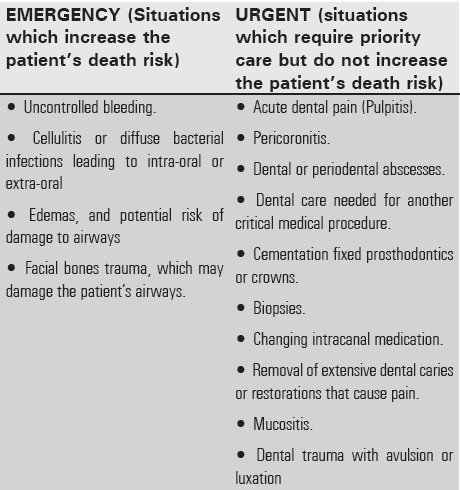
Classify patients into emergency and non-emergency dental care and plan well before initiating any dental procedures.
Modifications required for a dental Clinic setup have been proposed in 3 phases
- Preparatory Phase,
- Implementation Phase
- Follow up
PHASE I: PREPARATORY PHASE FOR A DENTAL CLINIC
A. Testing of clinician for the Covid-19 before resuming work in the clinicsB. Hydroxychloroquine Prophylaxis - As per the advisory given by the MOHFW dated 22.03.2020, all asymptomatic healthcare workers involved in the care of suspected or confirmed cases of COVID-19 are advised to take HCQ prophylaxis after medical consultation.
C. Dental Clinic -Ventilation and air quality management in stand-alone dental clinics
- Maintain air circulation with natural air through a frequent opening of windows and using an independent exhaust blower.
- Avoid the use of a ceiling fan while performing procedure.
- Place a table fan behind the operator and let the airflow towards the patient.
- A strong exhaust fan to be so located to create a unidirectional flow of air away from the patient.
- The window air condition system/ split AC should be frequently serviced, and filters cleaned.
- Use of indoor portable air cleaning system equipped with HEPA filter and UV light may be used.
D. Clinic entrance, reception and waiting –
- Display visual alerts about respiratory hygiene, cough etiquette, social distancing and disposal of contaminated items in trash cans.
- Install glass or plastic barrier at the reception desk.
- Distant waiting chairs
- No magazines, toys, TV remotes
- Cashless/contactless payment.
E. Hand Hygiene: As per the WHO guidelines:
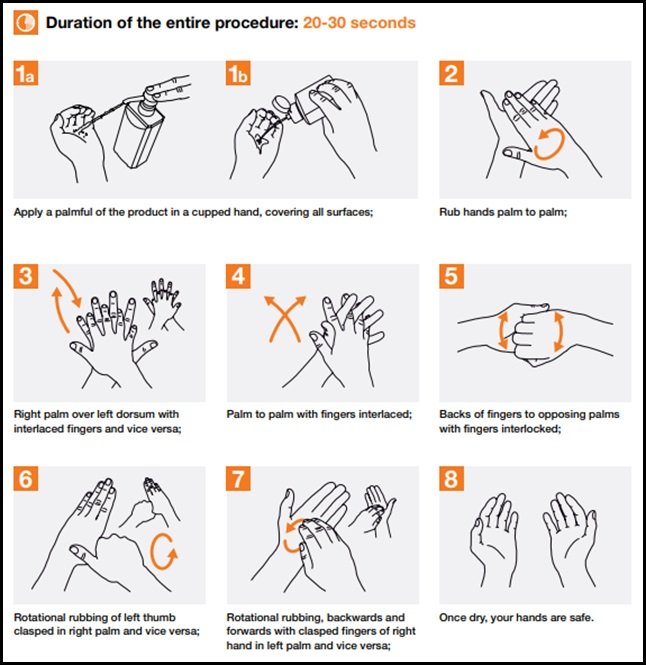

PHASE II: IMPLEMENTATION PHASE
A. Tele-consult Tele-screening- Encourage all to download the Arogya Setu App.
- Fix appointments through phone only & Discourage Walk-in Patients
- Hot Spot Matching & Medical Symptoms Assessment (Table 1)
- Dental needs assessment (Table 2)
- Disclosure/ Consent Form to be sent to patient electronically (If possible)
- Ask patient to wear mask and preferably come alone without any attender
B. Dental history and remote TRIAGE
- Obtain Oral Health (Mobile Phone-based Oral Health) screening about dental history.
- Clinics can evolve a web-based form which can also include a consent form.
- Comprehend dental treatment according to the urgency of the required treatment and the risk and benefit associated with each treatment.
- Only pre-appointed patients should be entertained in the clinic.
C. Personal protection for doctor and staff:
- Goggles / face shield (Both to be used , fitting goggles with a soft tissue seal)
- Triple layer surgical mask
- N95 respirator during routine dental procedures
- FFP3 – Standard mask should be used during treatment of COVID19 positive patients.
- Surgical gloves
- Disposable coverall / gown with hood /waterproof lining (to be changed daily).
- Coverall / gown outer; maybe improvised but will need to be changed after each patient
- Shoe covers
D. Protocols of patient handling in the clinic area
- For appointments that do not result in aerosols, and need examination only wear a triple layer surgical mask and protective eyewear/face shield and gloves. Wear N95 face masks, protective eyewear/face shields and gloves along with coverall for High Risk and very high-risk procedures. To increase the shelf life of N95 masks, you may cover them with a surgical mask and discard only the surgical mask after use.
- When examining patients with moderate risks the treating doctor will require all PPE as high risk except that the coveralls can be substituted with surgical gowns.
- Practice non-aerosol generating procedures.
- Use of rubber dam is encouraged.
E. Patient turn around and disinfection protocol
- All 3 in 1 syringe, water outlets, hand piece water pipelines, etc. should be flushed with the disinfectant solution for 30-40 seconds.
- Remove water containers and wash them thoroughly and disinfect with 1% sodium hypochlorite using clean cotton/ gauge piece and then fill with fresh 0.01% sodium hypochlorite solution and attach back to the dental chair.
- Then, disinfect the Dental Chair along with all the auxiliary parts within 3 feet of distance using 1% sodium hypochlorite and clean and sterilised cotton/gauge piece using inner to outer surface approach and leave for drying. New cotton/ gauge piece should be used for every surface.
F. Protocol for clinic closure:
Fogging: It is used as ‘No-touch surface disinfection’ and not for disinfection of air after a large area has been contaminated. The commercially available hydrogen peroxide is 11% (w/v) solution which is stabilized by 0.01% of silver nitrate. A 20% working solution should be prepared.
After the procedure has been completed in the operatory, exit the room and close the operatory for half hour for the aerosols/droplets to settle down.
Perform the 2 Step surface cleaning followed by fogging.
The fogging time is usually 45min followed by contact time/dwell time of one hour.
After that the room can be opened and fans can be switched on for aeration.
PHASE III: PATIENT FOLLOW-UP AND REVIEW
The patient should be contacted telephonically 24 hrs and in a week’ time to know if he has developed any symptoms that should warn the dental Staff to undertake appropriate actions.
He should be advised to inform back to the dental clinic should there be any adverse symptoms.
THE NEW NORMAL IN DENTISTRY POST COVID-19
In the light of WHO declaring the COVID-19 virus to be a pandemic, many preventative measures for dental professionals to minimize transmission through contact and dental procedures have been recommended.20 Dental care settings consistently carry the risk of 2019-nCoV infection due to its procedures, which involves face-to-face communication with patients, and frequent exposure to saliva, blood, and other body fluids, and the handling of sharp instruments.The ‘new’ normal will probably not look like the ‘old’ normal for a long time, if ever again. Things will change, but not inevitably for the worse in the longer term.19
The key to getting dental activity back on track lies in:
- Reducing infection risks, to allow the;
- Resumption of dental provision, which will require the adoption of;
- New approaches, products, technologies and treatments, and inevitably;
- Changes to the structure and delivery of NHS/private dentistry
However, following recommendations will reduce exposure and add a layer of protection in an already high exposure career. We should try our best to stay informed and calm, to provide patients with the best dental care we have always provided.
Better a thousand times careful than once Sorry!
CONCLUSION
Dental health care personnel need to understand the implications of potential transmission of the (SARS)-CoV-2 virus in a clinical setup. Hence, they need to keep themselves updated with any new information regarding this disease. New approaches such as Teledentistry will help dentists assist patients without adding the risk of cross infection. The recent state of affairs obligates the need to strike a balance between the safety of the healthcare professionals yet providing optimum dental care to the patients requiring emergency intervention.REFERENCES
- Ksiazek TG, Erdman D, Goldsmith CS. A novel coronavirus associated with severe acute respiratory syndrome. N Engl J Med. 2003;348:1953–1966. [PubMed] [Google Scholar].
- WHO Novel coronavirus – China. Jan 12, 2020. http://www.who.int/csr/don/12-january-2020-novel-coronavirus-china/en/
- Meng L, Hua F, Bian Z. Coronavirus Disease 2019 (COVID-19): Emerging and Future Challenges for Dental and Oral Medicine. J Dent Res 2020; DOI: 10.1177/0022034.
- Gamio, L. The Workers Who Face the Greatest Coronavirus Risk. Available online:March 2020
- World Health Organization. Report of the WHO - China Joint Mission on Coronavirus Disease 2019 (COVID-19). 2020.
- Impact of COVIDâ€Â19 in Dentistry (Sabinoâ€ÂSilva et al . 2020).
- Kampf, G., Todt, D., Pfaender, S. & Steinmann, E. Persistence of coronaviruses on inanimate surfaces and its inactivation with biocidal agents. J. Hosp. Infect. https://doi.org/10.1016/j.jhin.2020.01.022 (2020).
- Chen, J. Pathogenicity and transmissibility of 2019-nCoV—a quick overview and comparison with other emerging viruses. Microb. Infect. https://doi.org/10.1016/j.micinf.2020.01.004 (2020).
- Cleveland, J. L. et al. Transmission of blood-borne pathogens in US dental health care settings: 2016 update. J. Am. Dent. Assoc. (1939) 147, 729–738 (2016).
- Harrel, S. K. & Molinari, J. Aerosols and splatter in dentistry: a brief review of the literature and infection control implications. J. Am. Dent. Assoc. (1939) 135, 429–437 (2004).
- Otter, J. A. et al. Transmission of SARS and MERS coronaviruses and influenza virus in healthcare settings: the possible role of dry surface contamination. J. Hosp. Infect. 92, 235–250 (2016).
- Guidelines for Dental Professionals in Covid-19 pandemic situation Issued on 19/05/2020 Ministry of Health and Family Welfare (Govt of India) .
- Dental Council of India - Advisory No.DE-22-BDS(Academic)- 2020/16042020 dated 16.04.2020 .
- Proffitt, E. (2020). What will be the new normal for the dental industry? British Dental Journal, 228(9), 678–680. doi:10.1038/s41415-020-1583-x .
- Standard Operating protocol (sop) for dental patients During covid pandemic Indian Endodontic Society .
- Parin Bhanushali, Farhin Katge .COVID-19: Changing Trends and Its Impact on Future of Dentistry. Volume 2020 https://doi.org/10.1155/2020/8817424
- Guidelines for Dental Professionals in Covid-19 pandemic situation Issued on 19/05/2020 Ministry of Health and Family Welfare (Govt of India)
- Dental Council of India - Advisory No.DE-22-BDS(Academic)- 2020/16042020 dated 16.04.2020
- Proffitt, E. (2020). What will be the new normal for the dental industry? British Dental Journal, 228(9), 678–680. doi:10.1038/s41415-020-1583-x
- Standard Operating protocol (sop) for dental patients During covid pandemic Indian Endodontic Society
Disclaimer from Guident
The views and opinions expressed in articles published in Guident are solely those of the authors and do not necessarily reflect the views of the editors, the editorial board or the publisher, Ivory India. Guident does not endorse any product, technique or treatment described. Clinical content is intended for qualified dental and medical professionals and is not a substitute for individual clinical judgement. Guident, its editors and the publisher accept no liability for any consequence arising from the use of information published in the journal.
How to cite this article
Dr. Deepika Rawat, Dr. Unnati Nautiyal, Dr. Annil Dhingra. What Next: The New Norm Post COVID-19 in Dentistry!!. Guident. 2020 Jul;13(8). Available from: https://guident.in/articles/general/what-next-the-new-norm-post-covid-19-in-dentistry.html