Recreating Smiles: A Case Series
Department of Conservative Dentistry and Endodontics, Seema Dental College And Hospital, Rishikesh
ABSTRACT
This case report highlights the successful treatment of an Ellis Class II fracture in a young patient's maxillary central incisor using composite resin build-up. The trauma resulted in enamel and dentin loss without pulp exposure, presenting both aesthetic and functional challenges. A minimally invasive approach utilizing composite resin was employed to restore the tooth's structure, function, and aesthetics. The case underscores the effectiveness of composite resin as an immediate and aesthetically pleasing solution for dental trauma.
INTRODUCTION
In the realm of modern dentistry, the quest for achieving perfect smiles has led to remarkable advancements in materials and techniques. One such technique that has gained immense popularity is anterior esthetic build-up using composite resin. This procedure is a testament to the fusion of artistry and dentistry, allowing dental professionals to restore and enhance the aesthetics of a patient's anterior teeth.1 This article explores the art and science of anterior esthetic build-up with composite resin.
CASE REPORT-1
A 18 year old patient reported to the department of Conservative dentistry and Endodontics with the chief complaint of broken tooth in the upper front tooth region since 8-9 years. The patient gave a history of fall during childhood. It was her first dental visit.
Upon clinical examination, Ellis Class II fracture was noted irt 21. Cold test and EPT gave a normal response. Treatment plan suggested was Composite Build Up irt 21.
Preoperative records were taken followed by shade selection using VITA Classical Shade Guide. Upon isolation, enamel margins were bevelled. Etching was done using 37% phosphoric acid for 15 seconds followed by application of bonding agent using an applicator tip and light cured for 20 seconds.
Composite resin build up was done irt 21 followed by finishing and polishing.
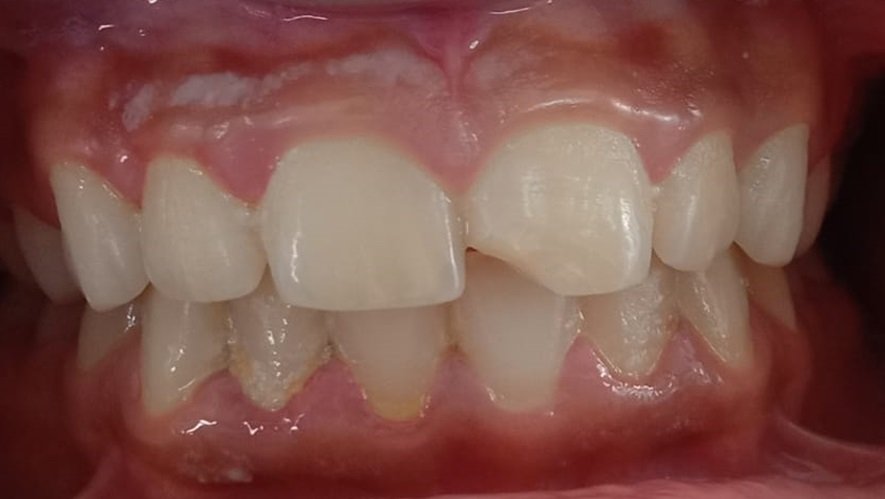
PREOPERATIVE IMAGE
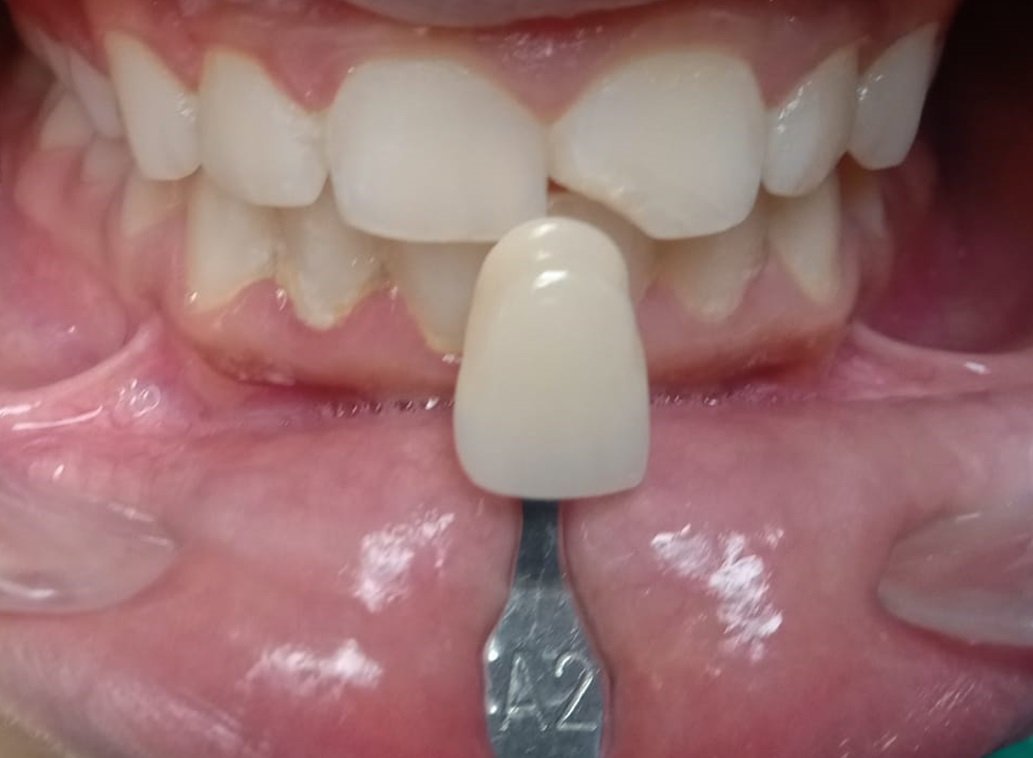
SHADE SELECTION

BEVELLED MARGINS

ACID ETCHING

COMPOSITE BUILD UP IRT 21

PRE AND POST OPERATIVE IMAGE
CASE REPORT-2:
A 21 year old patient reported to the department of Conservative dentistry and Endodontics with the chief complaint of broken tooth in the upper front tooth region since 6-7 years. The patient gave a history of fall while playing. It was his first dental visit.
Upon clinical examination, Ellis Class II fracture was noted irt 21 and Ellis Class I fracture irt 22. Cold test and EPT gave a normal response. Treatment plan suggested was Composite Build Up irt 21, 22.
Preoperative records were taken followed by shade selection using VITA Classical Shade Guide. Upon isolation, enamel margins were bevelled. Etching was done using 37% phosphoric acid for 15 seconds followed by application of bonding agent using a applicator tip and light cured for 20 seconds.
Composite resin build up was done irt 21,22 followed by finishing and polishing.

PREOPERATIVE IMAGE

SHADE SELECTION

BEVELLED MARGINS
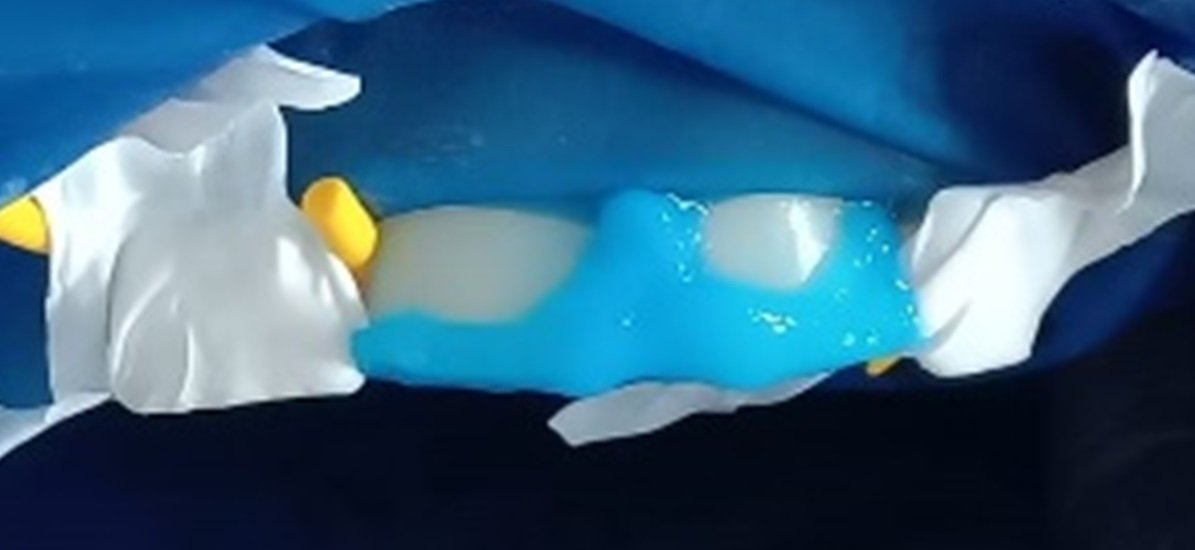
ACID ETCHING

BONDING AGENT APPLICATION

COMPOSITE BUILD UP IRT 21,22

PRE AND POST OPERATIVE IMAGE
DISCUSSION
The restoration of anterior teeth is a crucial aspect of modern dentistry, as it significantly impacts both oral function and aesthetic appearance. One common challenge encountered in anterior tooth restoration is the correction of tooth angles, which can affect a patient's smile and overall facial harmony. Composite resin, a versatile and aesthetic dental material, has emerged as an effective solution for angle build-up in anterior teeth.2
Composite resin offers several advantages in the rehabilitation of anterior teeth. Its ability to mimic the natural tooth structure allows for seamless integration with the remaining dentition. Furthermore, composite resin is highly customizable in terms of shade, translucency, and texture, enabling the creation of restorations that closely resemble natural teeth.3 This aesthetic flexibility makes composite resin an ideal choice for anterior tooth rehabilitation. While anterior esthetic build-up with composite resin offers numerous benefits, it is essential to be aware of potential challenges and considerations: staining, longevity and need of expertise.4
Terry and Geller (2010) advocate for a detailed understanding of tooth morphology, color, and translucency to recreate lifelike restorations. They delve into the concept of "chameleon effect," where composite shades are chosen to match the patient's existing dentition, leading to restorations that blend harmoniously.5
Amaro et al. showcase how careful layering of composite materials and precise contouring can achieve lifelike tooth morphology. They emphasize the importance of a comprehensive treatment approach that considers tooth shape, color, and overall facial harmony.6
CONCLUSION
The rehabilitation of anterior teeth using composite resin provides a conservative and aesthetically pleasing solution for patients seeking smile enhancement. By preserving natural tooth structure, achieving optimal shade matching, and meticulous attention to detail during the layering and finishing process, clinicians can deliver functional and natural-looking restorations that greatly improve the patient's smile and self-confidence. With proper case selection, treatment planning, and clinical skills, composite resin restorations can yield excellent long-term outcomes and patient satisfaction.
REFERENCES
- Aschheim, K. W., & Dale, B. G. (2017). Esthetic Dentistry: A Clinical Approach to Techniques and Materials
- Rastelli, A. N., & Putignano, A. (2020). Minimally invasive adhesive restorations: Current concepts for the treatment of the anterior dentition. Quintessence Publishing
- Spear FM, Kokich VG. Mathews DP. Interdisciplinary management of anterior dental esthetics. J Am Dent Assoc. 2006;137(2):160-169.
- Burke FJT, Crisp RJ, Brunton PA. Composite resin build-ups in anterior teeth: a technique for achieving improved aesthetics. Dent Update. 2011;38(1):18-24.
- Terry DA, Geller W. Building the Composite Restoration. Inside Dentistry. 2010;6(6):48-55.
- Amaro, I.; Saraiva, J.; Gomes, A.C.; Araújo, A.; Marto, C.M.; Coelho, A.; Ferreira, M.M.; Paula, A.; Carrilho, E. Direct Restorations for Anterior Esthetic Rehabilitation and Smile Symmetry Recovery: Two Case Reports. Symmetry 2021, 13, 1848.
Disclaimer from Guident
The views and opinions expressed in articles published in Guident are solely those of the authors and do not necessarily reflect the views of the editors, the editorial board or the publisher, Ivory India. Guident does not endorse any product, technique or treatment described. Clinical content is intended for qualified dental and medical professionals and is not a substitute for individual clinical judgement. Guident, its editors and the publisher accept no liability for any consequence arising from the use of information published in the journal.
How to cite this article
Dr. Siddhi Goyal, Dr. Anil Dhingra, Dr. Seema Dixit. Recreating Smiles: A Case Series. Guident. 2023 Nov;16(12). Available from: https://guident.in/articles/endodontics/recreating-smiles-a-case-series.html